Freedom251 › Code Playground Software
Babel REPL
What Babel REPL is
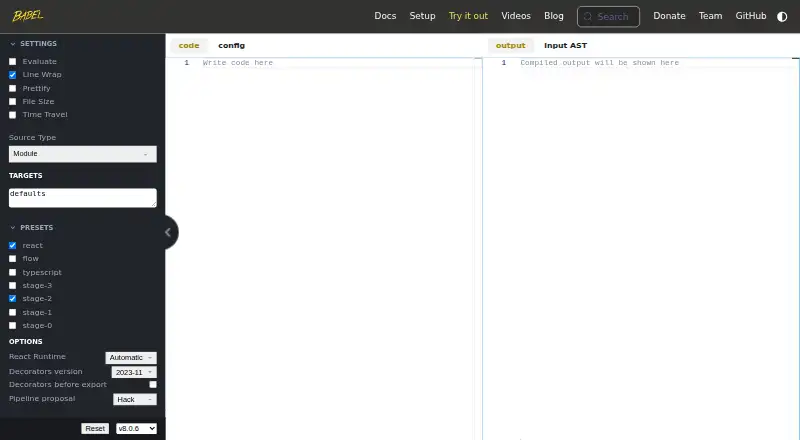
Babel REPL is a free, browser-based tool for exploring Babel transformations on code. Babel converts ECMAScript 2015 and newer into backward-compatible JavaScript for current and older browsers or environments. The page pairs input code with compiled output and offers an input AST pane. Controls include evaluation, line wrapping, prettifying, file size, time travel, and source type; settings cover targets, the Env preset, assumptions, and plugins. The displayed target default is “defaults.” Available presets include Env, React, Flow, TypeScript, and stage proposals. Babel can transform modern JavaScript and JSX, and strip Flow or TypeScript annotations, but it does not type-check either language. Transformations can combine presets and plugins, including custom ones. The REPL is intended for learning and prototyping. Babel recommends using a Node.js build system such as Webpack, Rollup, or Parcel to transpile production code ahead of time. In standalone use, configuration files do not work because filesystem access is unavailable, so presets and plugins must be supplied through transform options. The REPL also does not support assumptions configuration or plugin options.
Who it suits
The REPL suits people learning how Babel transforms code or prototyping transformations in a browser. It is not the recommended route for production transpilation, for which Babel recommends a Node.js build system.
What it does well
- Free and open source.
- Shows input code, compiled output, and an AST pane.
- Includes React, Flow, TypeScript, and Env presets.
- Supports modern JavaScript and JSX transformations.
- Allows custom plugins and presets.
What to know first
- Does not type-check Flow or TypeScript.
- Configuration files do not work in standalone use.
- REPL does not support assumptions configuration or plugin options.
- Babel recommends a build system for production transpilation.
Limits
The REPL does not support assumptions configuration or plugin options according to Babel's roadmap. Standalone configuration files cannot be used, and Babel recommends ahead-of-time Node.js transpilation rather than production use of the standalone REPL.
Getting started
- Open the Babel REPL website
- Enter JavaScript or JSX in the code pane
- Choose targets, presets, plugins, or source type
- Evaluate the transformation
- Inspect the compiled output and input AST
Verdict
Babel REPL offers a browser-based way to inspect and prototype transformations, with output and AST views. Its configuration limits and Babel’s production guidance make it more suited to learning and experimentation than production builds.
Questions
How much does Babel REPL cost?
Babel REPL is free and open source.
What can Babel REPL transform?
It transforms modern JavaScript and JSX, and can strip Flow or TypeScript type annotations without type-checking them.
Which presets are available?
The interface lists React, Flow, TypeScript, stage proposal, and Env presets.
Can I use custom transformations?
Yes. Babel supports combining plugins and presets, including plugins users write themselves.
Can Babel REPL be used in production?
Babel recommends a Node.js build system such as Webpack, Rollup, or Parcel for production transpilation instead of standalone use.
Where can I get support?
Babel links to Stack Overflow and a Slack channel as community resources.
Facts from Babel REPL's own pages
- Additional controls
- The REPL page lists Evaluate, Line Wrap, Prettify, File Size, Time Travel, and Source Type controls. · babeljs.io, 8 Oct 2026
- AST view
- The REPL page offers an input AST pane alongside compiled output. · babeljs.io, 8 Oct 2026
- Browser availability
- Babel documents the site REPL as an example of a site that compiles user-provided JavaScript in real time. · babeljs.io, 8 Oct 2026
- Compiler
- Babel converts ECMAScript 2015+ code into backward-compatible JavaScript for current and older browsers or environments. · babeljs.io, 8 Oct 2026
- Configuration limitation
- Babel configuration files do not work in @babel/standalone because it has no filesystem access; presets and plugins must be passed through transform options. · babeljs.io, 8 Oct 2026
- Customization
- Babel documents registering custom plugins and presets for @babel/standalone. · babeljs.io, 8 Oct 2026
- Custom transformations
- Babel supports composing transformations from plugins and presets, including plugins users write themselves. · babeljs.io, 8 Oct 2026
- Input and output
- The REPL page provides code and compiled output panes. · babeljs.io, 8 Oct 2026
- Integrations
- Babel documentation names Webpack, Rollup, and Parcel as build systems that can transpile JavaScript ahead of time. · babeljs.io, 8 Oct 2026
- JavaScript and JSX
- Babel supports transforming modern JavaScript syntax and JSX syntax. · babeljs.io, 8 Oct 2026
- Presets
- The REPL interface lists React, Flow, TypeScript, and stage proposal presets, along with an Env Preset section. · babeljs.io, 8 Oct 2026
- Production guidance
- Babel recommends using a Node.js build system such as Webpack, Rollup, or Parcel to transpile production JavaScript ahead of time instead of using @babel/standalone. · babeljs.io, 8 Oct 2026
- Production limitation
- The documentation says @babel/standalone normally should not be used for production and recommends a Node.js build system to transpile code ahead of time. · babeljs.io, 8 Oct 2026
- Project status
- Babel describes itself as maintained by a small group of volunteers and funded by the community. · babeljs.io, 8 Oct 2026
- Purpose
- The REPL is a browser-based tool for trying Babel transformations on code. · babeljs.io, 8 Oct 2026
- REPL controls
- The REPL page shows code and output panes, Evaluate, Line Wrap, Prettify, File Size, Time Travel, Source Type, Targets, Presets, Options, and Plugins controls. · babeljs.io, 8 Oct 2026
- REPL limitations
- Babel's roadmap says the REPL does not support assumptions configuration or plugin options. · babeljs.io, 8 Oct 2026
- Security and configuration limit
- Babel states that standalone config files do not work because it has no filesystem access; presets and plugins must be specified in transform options. · babeljs.io, 8 Oct 2026
- Standalone usage
- Babel says @babel/standalone supports browser and other non-Node.js environments and can be installed through npm, Yarn, pnpm, or Bun. · babeljs.io, 8 Oct 2026
- Standalone use
- The @babel/standalone documentation identifies the Babel site REPL, JSFiddle, JS Bin, and JSitor as examples of sites compiling user-provided JavaScript in real time. · babeljs.io, 8 Oct 2026
- Support channels
- Babel’s site links to Stack Overflow and a Slack channel as community resources. · babeljs.io, 8 Oct 2026
- Supported syntax options
- Babel lists env, react, typescript, and flow among the popular built-in standalone presets. · babeljs.io, 8 Oct 2026
- Transform settings
- The REPL page includes settings for targets, the env preset, assumptions, and plugins. · babeljs.io, 8 Oct 2026
- Transform targets
- The REPL interface provides a Targets control whose displayed default is “defaults.” · babeljs.io, 8 Oct 2026
Where Babel REPL stands on Freedom251
- Code Playground Software#21 of 58
- JavaScript Build Tools#12 of 27