Freedom251 › LLM Security Tools
GLACIS
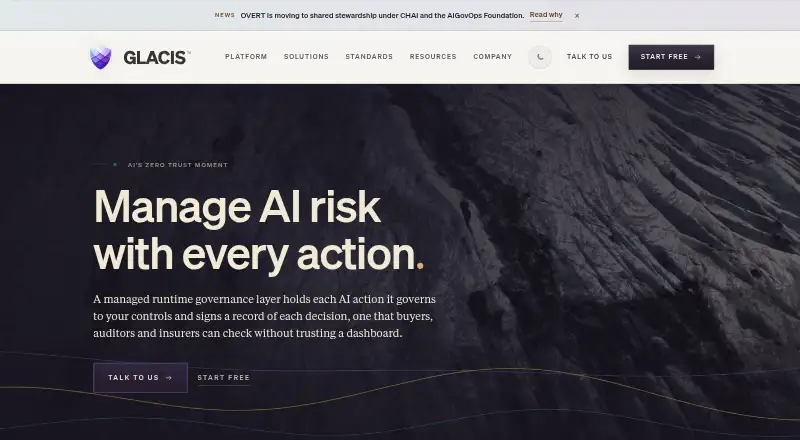
What GLACIS is
GLACIS places runtime controls in the path of AI actions and creates signed records of covered decisions for outside verification. It can let actions pass unchanged or, when they cross configured limits, constrain them, pause them for a person, or deny them. Glacis says it operates nine production components as a managed service alongside a customer’s existing identity provider, cloud, and security systems. Covered decisions generate signed records in OVERT, a published open format that implementers and reviewers can inspect and use. A verifier can check a record in a browser without a GLACIS account. The site says payloads stay in the customer’s environment while records carry hashes; omitting protected fields depends on deployment setup. A record check does not establish whether an action was correct, whether every event was captured, or whether a system is safe or compliant. GLACIS offers a free account at no cost, with no card required, and describes a six-week evaluation for a workflow under review. It is available through API, self-hosted, and web options.
Who it suits
GLACIS is presented for AI-agent builders and operators, AI sellers serving healthcare or other regulated buyers, and healthcare AI overseers. It may also suit people evaluating the product for a workflow.
What it does well
- Can hold, constrain, or deny actions.
- Creates signed records in an open format.
- Record checks do not require an account.
- Free account requires no card.
- Available through API, self-hosted, and web options.
What to know first
- Evidence packs must be assembled by hand.
- Record checks do not verify action correctness.
- A record check cannot establish that every event was captured.
Limits
The free account is listed as free. Evidence packs must be assembled by hand for a particular review; GLACIS does not currently offer automated export.
Plans
| Plan | Billed and limits | Price |
|---|---|---|
| Free account | No card required · setup about a minute | Free |
As glacis.io lists them, read 4 Oct 2026. The maker's own page has the final word.
Getting started
- Visit the GLACIS website.
- Create a free account at no cost; no card is required.
- Choose an API, web, or self-hosted deployment option.
- Evaluate the workflow under review over the six-week evaluation.
GLACIS is a runtime control layer for AI actions, built for teams whose agents operate in sensitive or regulated workflows. It is most suitable for AI vendors serving regulated customers, healthcare overseers, and operators who need intervention before an action proceeds. The strongest case is the combination of runtime decisions and independently checkable records; the main compromise is that review evidence still requires manual assembly.
Overview
GLACIS evaluates actions against configured bounds and can allow them unchanged, constrain them, pause them for a person, or deny them. That puts a control point in front of consequential activity instead of relying solely on an after-the-fact log. Prompt-injection defense, PII redaction, and output guardrails address common failure and exposure modes, although the product does not claim that a guarded action is necessarily correct or safe.
Its managed service runs nine production components and works alongside the identity provider, cloud, and security systems a customer already uses. The hybrid model is therefore a practical fit for organizations that want managed operation without replacing established infrastructure.
Key features
Runtime intervention
The four outcomes—pass, constrain, human hold, or deny—give teams more options than a simple blocklist. A healthcare AI operator can reserve ambiguous cases for review, while an agent builder can limit actions that exceed a policy boundary. The value depends on configuring those bounds well; GLACIS does not turn policy design into an automatic process.
Signed, open records
Covered decisions are signed in OVERT, a published record format that implementers and reviewers can inspect without depending on a proprietary schema. Anyone can check a record in a browser without a GLACIS account, which makes an external review easier to share. Payloads remain in the customer’s environment and records carry hashes; protected fields can be omitted depending on deployment, a useful privacy choice when reviewers do not need the underlying content.
Verification has clear limits. A successful check confirms the record’s integrity, not that the action was right, that every event was captured, or that the overall system is safe or compliant. GLACIS also has no automated evidence-pack export: a pack for a particular review must be assembled by hand.
Pricing
GLACIS uses a freemium model. The Free account costs free, requires no card, and takes about a minute to set up. A 14-day trial is also offered. No paid-plan price or seat, usage, or renewal terms are published, so organizations needing a managed deployment should expect custom pricing discussions rather than a predictable self-serve bill.
The free account is a low-friction way for an evaluator or a small team to inspect the workflow and record model. It is not a basis for budgeting a larger rollout, because the published offer does not state paid quotas or expansion limits.
Platforms
GLACIS supports API, web, and self-hosted use. Its hybrid deployment and customer-environment data handling suit teams that need to retain control of payloads while connecting to existing cloud, identity, and security services.
Who it's for
The signup audience includes AI sellers serving healthcare and other regulated buyers, healthcare AI overseers, AI-agent builders and operators, and people evaluating the product. A contact-page workflow describes a six-week evaluation on the customer’s specific workflow, which is a sensible route for organizations that need to assess policy boundaries before committing. GLACIS says it usually replies to contact requests within one business day and accepts only a small number of managed deployments each quarter, so it is better suited to deliberate evaluations than an instant, high-volume rollout.
Pros and cons
Pros
- Intervention before execution: actions can be constrained, held for a person, or denied instead of merely recorded afterward.
- Independent checking: signed OVERT records can be verified in a browser without a GLACIS account.
- Open format: reviewers and implementers can inspect and use OVERT without a proprietary schema.
- Privacy-aware deployment: payloads stay in the customer environment, with hashes and optional omission of protected fields.
- Broad operating choices: API, web, self-hosted, and hybrid deployment accommodate different infrastructure policies.
Cons
- Evidence work remains manual: there is no automated export of review-specific evidence packs.
- Records are not proof of outcomes: verification does not establish correctness, complete event capture, safety, or compliance.
- Limited pricing visibility: the free account and trial are clear, but paid costs and quotas are not.
- Managed capacity is selective: the service takes on only a small number of managed deployments each quarter.
- No bug bounty: the vulnerability policy sets response targets but offers no bounty.
Alternatives
For a broader starting point, see LLM Security Tools.
Prompt Inspector is a better fit when you want a freemium API and SDK with a stated 1,000-detections-per-month free allowance and broad desktop, server, and web platform support.
PromptGuard suits teams seeking a published free quota of 20,000 scans a month, one API key, one project, and 24-hour log retention, with a $19.00-per-month Team plan.
NVIDIA NeMo Guardrails is the straightforward choice when an open-source Python library is preferable and external models and services can be set up separately.
Amazon Bedrock Guardrails fits buyers who prefer a paid AWS service with metered text and topic filters.
Openlayer Guardrails is an alternative for teams wanting a freemium workspace with projects, inference-log quotas, tests, and data retention in its Basic plan.
CyberSecEval is a free, open-source benchmark suite rather than a runtime control layer.
LLM Guard is a free open-source option, but its repository is archived and no longer actively maintained.
Sanctum Runtime is worth considering when an open-core, MIT-licensed approach is the priority.
Verdict
Choose GLACIS if your team needs runtime intervention for AI actions and signed, openly formatted records that outside reviewers can check, especially in regulated workflows. Look elsewhere if automated evidence packs, published paid quotas, or records that establish correctness and complete capture are non-negotiable.
Verdict
GLACIS offers controls for AI actions and signed records that can be checked independently. Its records have stated verification limits, and evidence packs are not automated.
Questions
Is GLACIS free?
A Free account is listed as free, with no card required.
What platforms and deployment options does it support?
The listed platforms are API, self-hosted, and web. The deployment model is hybrid.
What is OVERT?
OVERT is a published open record format that implementers and reviewers can inspect and use without a proprietary schema.
Can someone verify a record without a GLACIS account?
Yes. A verifier can check a record in a browser without a GLACIS account.
What does record verification establish?
It does not establish whether an action was correct, every event was captured, or a system is safe or compliant.
How long is the evaluation?
The deployment evaluation is described as six weeks on the workflow a customer is reviewing.
Facts from GLACIS's own pages
- Control decisions
- For actions that cross configured bounds, Glacis can constrain, hold for a person, or deny the action; it can also allow actions through unchanged. · glacis.io, 4 Oct 2026
- Data handling
- The site says payloads stay in the customer’s environment and records carry hashes; protected fields can be left out, depending on deployment setup. · glacis.io, 4 Oct 2026
- Deployment evaluation
- The contact page describes a six-week evaluation on the workflow a customer is reviewing. · glacis.io, 4 Oct 2026
- Evidence pack limitation
- Glacis does not offer automated evidence-pack export today; packs are assembled by hand for a particular review. · glacis.io, 4 Oct 2026
- Managed service
- Glacis says it runs nine production components as a managed service, while working with the identity provider, cloud, and security systems the customer already uses. · glacis.io, 4 Oct 2026
- Open standard
- OVERT is a published open record format that implementers and reviewers can inspect and use without a proprietary schema. · glacis.io, 4 Oct 2026
- Records
- Records are signed and use OVERT, an open record format; a verifier can check a record in a browser without a Glacis account. · glacis.io, 4 Oct 2026
- Security reporting
- The vulnerability disclosure policy says Glacis aims to acknowledge reports within three business days and provide an initial assessment within ten business days; it offers no bug bounty. · glacis.io, 4 Oct 2026
- Support
- Glacis says it typically replies to contact requests within one business day and takes on a small number of managed deployments each quarter. · glacis.io, 4 Oct 2026
- Verification limits
- A record check does not establish whether an action was correct, every event was captured, or a system is safe or compliant. · glacis.io, 4 Oct 2026
- What it does
- Glacis places runtime controls in the path of AI actions and creates signed records of covered decisions for external verification. · glacis.io, 4 Oct 2026
- Who it serves
- The signup form lists AI sellers serving healthcare or other regulated buyers, healthcare AI overseers, AI-agent builders or operators, and people evaluating the product. · glacis.io, 4 Oct 2026
Where GLACIS stands on Freedom251
- LLM Security Tools#4 of 31