Freedom251 › AI governance tools
Openlayer Guardrails
What Openlayer Guardrails is
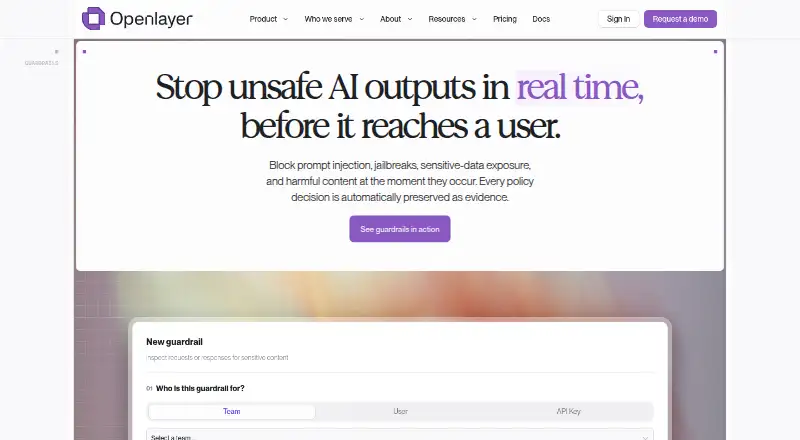
Openlayer Guardrails inspects live AI inputs and outputs and can block, redact, escalate, or route policy violations for review. It targets prompt injection, jailbreak attempts, exposure of personal or health information, and harmful or toxic content; Openlayer says it detects and blocks more than 50 PII and PHI entity types inline. Teams can configure which sensitive-data categories to block and topics an assistant should avoid. Guardrails are commonly enforced through the Gateway or applied directly through the SDK. Each decision can be logged with a timestamp, system version, owner, supporting trace, and reason for blocking. The product connects through SDKs, framework integrations, a network-level gateway, a CLI, and a REST API. Deployment options include a customer VPC and air-gapped environments; on-premise deployment is available on Enterprise. The free Basic plan is limited to one member, five projects, one inference pipeline per project, 20,000 inference logs per month, 20 tests per project, one workspace, and three months of data retention. Enterprise has custom pricing and includes unlimited members and projects, custom pipelines and logs, unlimited tests, and on-premise deployment.
Who it suits
It suits engineering, AI, security, compliance, and finance teams managing AI policies, including teams in healthcare and financial services. Basic may fit small evaluations within its listed limits.
What it does well
- Can block, redact, escalate, or route policy violations.
- Detects and blocks more than 50 PII and PHI types.
- Decisions can include traces and reasons for blocking.
- Supports customer VPC and air-gapped deployment.
- Basic plan is free.
What to know first
- Basic is limited to one member and five projects.
- Basic allows 20,000 inference logs per month.
- Basic data retention is three months.
- On-premise deployment is Enterprise-only.
Limits
Basic is limited to one member, five projects, one inference pipeline per project, 20,000 inference logs per month, 20 tests per project, one workspace, and three months of data retention. On-premise deployment and unlimited members, projects, tests, and custom log capacity are Enterprise features.
Plans
| Plan | Billed and limits | Price |
|---|---|---|
| Basic | 1 member · 5 projects · 1 inference pipeline per project · 20,000 inference logs/month · 20 tests/project · 3-month retention · CLI, SDK and API · community support | Free |
| Enterprise | Unlimited members/projects/tests · custom inference volume · team access controls · on-premise deployment · explainability · SAML SSO · 99.99% SLA · white-glove onboarding · advanced support | On request |
As openlayer.dev lists them, read 21 Oct 2026. The maker's own page has the final word.
Getting started
- Open the Openlayer Guardrails product page.
- Choose the free Basic plan or review Enterprise pricing.
- Connect through an SDK, framework integration, network-level Gateway, CLI, or REST API.
- Configure the sensitive-data categories and topics your policies should address.
- Apply guardrails through the Gateway or directly through the SDK.
Openlayer Guardrails is a live policy-enforcement layer for AI applications, best suited to engineering, security and compliance teams managing LLM traffic. Its combination of configurable controls and decision records is compelling, but Basic’s tight usage caps make it a small-scale starting point rather than a broad rollout.
Overview
As inputs and outputs move through an application, Guardrails can block or redact a policy violation, escalate it, or route it for review. Teams can choose which sensitive-data categories to block and which topics an assistant should avoid, so policies can reflect their own requirements rather than a single fixed filter set.
The controls target prompt injection, jailbreak attempts, PII and PHI exposure, and harmful or toxic content. Openlayer says it detects and blocks more than 50 PII and PHI entity types inline. Each decision can be recorded with a timestamp, system version, owner, supporting trace and reason for the block. That record gives teams useful context for investigating a decision and supporting governance work.
Key features
Teams can enforce policies through the Gateway or apply them directly through the SDK. SDKs, framework integrations, a network-level gateway, CLI and REST API provide several ways to connect; the Gateway is designed to work across LLM providers. This flexibility should help teams fit enforcement into different application architectures, though it also leaves the choice of integration path to them.
Openlayer says guardrail activity feeds into compliance evidence and names the EU AI Act, ISO/IEC 42001, NIST AI RMF and OSFI E-23. Those records can support compliance processes, but the stated role is evidence support, not a promise of compliance by itself.
Deployment can be in a customer’s VPC or an air-gapped environment, with on-premise deployment reserved for Enterprise. Openlayer states that it has SOC 2 Type II certification and GDPR compliance, supports HIPAA-aligned use cases, and encrypts data at rest with AES-256 and in transit with TLS 1.2 or higher. These are relevant assurances for sensitive workloads; teams should match the deployment and controls to their own security needs.
Pricing
Openlayer uses a freemium model. Basic costs nothing and includes one member, five projects, one inference pipeline per project, 20,000 inference logs per month, 20 tests per project, one workspace, three months of data retention and Discord community support. This is enough room to assess a limited setup, but the single-seat allowance, monthly log ceiling and short retention period constrain team use and longer-running analysis.
Enterprise has custom pricing and includes unlimited members and projects, custom inference pipelines and logs, unlimited tests, custom data retention, SAML SSO, on-premise deployment, white-glove onboarding and direct Slack access to Openlayer’s team. It is the more suitable tier for larger or regulated deployments that need those controls and support, but the custom price means buyers will need to assess cost against their specific scale and requirements.
Platforms
Guardrails is offered through API, web and self-hosted options. Its hybrid deployment model, including customer-VPC and air-gapped deployments, gives organizations alternatives to a standard hosted setup; on-premise deployment is an Enterprise option.
Who it's for
Openlayer says engineering, AI, security, compliance and finance teams use its platform, including in healthcare and financial services. Guardrails is a strong fit for organizations that need policy checks on live AI traffic alongside records of why a request or response was stopped. Basic can suit a small evaluation, while teams needing multiple members, higher or custom log volumes, longer retention or on-premise deployment will need Enterprise. It is less suited to buyers seeking a generous free allowance for a larger team.
Pros and cons
- Pros: Policies can be tailored to sensitive-data categories and avoided topics, and enforcement can block, redact, escalate or route violations for review.
- Pros: Decision records include ownership, version, trace and reason, supporting investigation as well as compliance evidence.
- Pros: Gateway, SDK, framework, CLI and API integration paths, plus VPC and air-gapped deployment, offer practical flexibility for different architectures.
- Cons: Basic is limited to one member, five projects, one workspace and 20,000 inference logs per month, making it restrictive beyond a small evaluation.
- Cons: Basic retains data for only three months, while custom retention and on-premise deployment require Enterprise.
- Cons: Enterprise pricing is custom, so organizations cannot compare its cost from a published plan price.
Alternatives
ComplyLayer is worth considering when AI-system inventory and risk classification are the priority: its free plan offers unlimited AI systems and use cases, along with inventory, risk classification, documents and acknowledgements.
Prufer is another freemium option with a free trial, but its Free Plan retains audit data for seven days and has limited features and quotas, making its retention trade-off important to weigh.
Trusys AI may suit teams looking for a free evaluation tier with published allowances: Starter is free forever and includes one application, unlimited functional and security evaluations, 5,000 metrics per month and 30,000 production spans.
Verisum is another freemium alternative with a free Explorer plan priced in GBP.
SAS/STAT is a paid alternative with Linux, macOS, Windows, web and self-hosted platforms; its pricing is available by contacting SAS.
AI Verify is a free, open-source toolkit under the permissive Apache 2.0 license, for readers who prefer that model.
Riskonnect is a paid integrated risk-management alternative whose pricing depends on project size, complexity and customization.
AIGovernr offers a Professional plan at $79 a month, including unlimited website scans, full findings, gap analysis and action-plan PDFs, an AI governance brief PDF and priority support.
For broader comparisons, see AI Governance Software and LLM Security Tools.
Verdict
Openlayer Guardrails is a sound choice for teams that need configurable controls on live AI traffic and traceable decisions to support security and governance. Its integration and deployment options strengthen the case for established or regulated environments. Choose Basic for a constrained evaluation; look elsewhere if a larger free team allowance matters, or compare Enterprise carefully if custom pricing is a barrier.
Verdict
Openlayer Guardrails combines live policy enforcement with decision records and several deployment choices. Basic has substantial project, log, and retention limits; Enterprise pricing is custom.
Questions
Is Openlayer Guardrails free?
Yes. The Basic plan is free. Enterprise pricing is custom.
What are the Basic plan limits?
Basic includes one member, five projects, one inference pipeline per project, 20,000 monthly inference logs, 20 tests per project, one workspace, and three months of data retention.
How can Guardrails connect to an AI system?
Openlayer lists SDKs, framework integrations, a network-level Gateway, a CLI, and a REST API. Guardrails are commonly enforced through the Gateway or applied directly through the SDK.
Can Guardrails run on-premise?
On-premise deployment is available on Enterprise. Openlayer also supports customer VPC and air-gapped deployments.
What security and compliance details does Openlayer state?
Openlayer states it has SOC 2 Type II certification and GDPR compliance, supports HIPAA-aligned use cases, and encrypts data at rest with AES-256 and in transit with TLS 1.2 or higher.
What support comes with each plan?
Basic includes community support through Discord. Enterprise includes white-glove onboarding and direct Slack access to Openlayer's team.
Facts from Openlayer Guardrails's own pages
- Audit evidence
- Each policy evaluation and enforcement result is recorded with decision evidence for later audit use. · openlayer.com, 21 Oct 2026
- Changelog update
- The 2026 changelog describes a remote OAuth-protected MCP connector usable from Claude Code and claude.ai. · openlayer.dev, 21 Oct 2026
- Company founding
- LinkedIn lists Openlayer as founded in 2021. · linkedin.com, 21 Oct 2026
- Company headquarters and size
- LinkedIn lists San Francisco, California headquarters and a company size of 11–50 employees. · linkedin.com, 21 Oct 2026
- Compliance evidence
- Openlayer says guardrail activity feeds into compliance evidence, and its page names the EU AI Act, ISO/IEC 42001, NIST AI RMF, and OSFI E-23. · openlayer.dev, 4 Oct 2026
- Data retention
- Basic retention is three months, while Enterprise retention can be customized. · openlayer.dev, 21 Oct 2026
- Deployment options
- Openlayer supports customer VPC, on-premise and air-gapped deployment options for enterprise use. · openlayer.dev, 21 Oct 2026
- Encryption and availability
- The security page states 99.9% platform availability, AES-256 encryption at rest and TLS 1.2 or higher in transit. · openlayer.dev, 21 Oct 2026
- Evaluation platform
- Openlayer combines pre-release testing, production monitoring and runtime policy enforcement in one platform. · openlayer.com, 21 Oct 2026
- Evidence logging
- Each guardrail decision can be recorded with a timestamp, system version, owner, supporting trace, and the reason a request or response was blocked. · openlayer.dev, 4 Oct 2026
- Founded
- 2021 · openlayer.dev, 28 Sept 2026
- Framework coverage
- Traffic routed through Openlayer can be protected regardless of the underlying AI framework or model provider. · openlayer.com, 21 Oct 2026
- Funding and accelerator
- Y Combinator lists Openlayer as a Summer 2021 company based in San Francisco and identifies it as active. · ycombinator.com, 21 Oct 2026
- Gateway and SDK enforcement
- Guardrails can be enforced through Openlayer Gateway or applied directly through the SDK. · openlayer.com, 21 Oct 2026
- Harmful-output filtering
- Configurable policies can block toxic, harmful and malicious generated content inline. · openlayer.com, 21 Oct 2026
- Identity controls
- Security features include RBAC, Google SSO, SAML, OIDC and directory synchronization. · openlayer.dev, 21 Oct 2026
- Integrations
- Openlayer advertises SDKs, a network gateway, CLI, REST API, Git, OpenTelemetry and Snowflake connectivity. · openlayer.com, 21 Oct 2026
- Intended users
- Openlayer says engineering, AI, security, compliance, and finance teams use the platform, including in regulated industries such as healthcare and financial services. · openlayer.dev, 4 Oct 2026
- Java SDK
- The official Java library is generated for the Openlayer REST API, supports Java 8 or later and is installable through Maven or Gradle. · github.com, 21 Oct 2026
- Legal entity
- The privacy policy identifies Unbox Inc. as the legal entity doing business as Openlayer. · openlayer.com, 21 Oct 2026
- Limit: Basic collaboration
- The Basic plan is limited to one member, which constrains free-team collaboration. · aitechsuites.com, 21 Oct 2026
- Limit: Basic retention
- The Basic plan retains data for only three months. · aitechsuites.com, 21 Oct 2026
- Limit: Enterprise gating
- On-premise deployment, explainability and SAML SSO are reserved for Enterprise customers. · aitechsuites.com, 21 Oct 2026
- Notable limits
- The Basic plan is limited to one member, five projects, one inference pipeline per project, 20,000 inference logs per month, and one workspace. · openlayer.dev, 4 Oct 2026
Where Openlayer Guardrails stands on Freedom251
- AI governance tools#4 of 56
- AI Governance Software#5 of 56
- LLM Security Tools#8 of 31