Freedom251 › LLM Security Tools
LLM Guard
What LLM Guard is
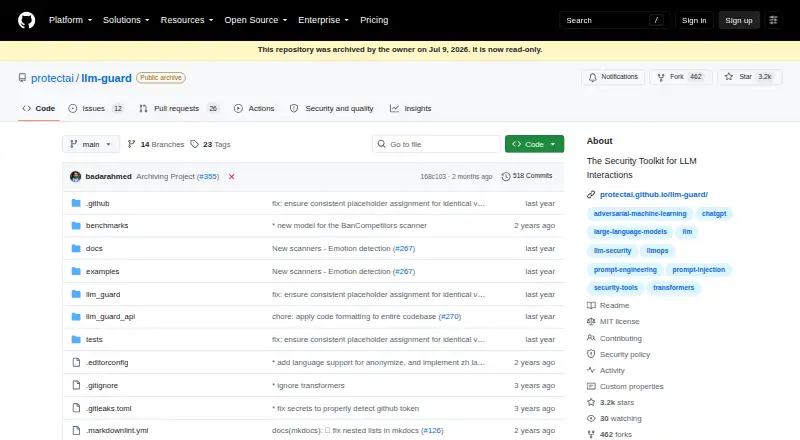
LLM Guard is a free, open-source security toolkit for checking prompts and model responses. Its scanners cover anonymization, prompt injection, secrets, toxicity, bias, malicious URLs, and factual consistency. The project describes its purpose as sanitizing interactions, detecting harmful language, helping prevent data leakage, and resisting prompt injection. Documentation includes examples for the OpenAI SDK, LangChain, LiteLLM, and LlamaIndex. In the OpenAI SDK example, prompts are scanned before requests and responses are checked; a streaming example checks prompts and response chunks. LLM Guard can also run as an API, and custom scanners can be added. It is self-hosted and listed for API and Linux use. Installation uses `pip install llm-guard` and requires Python 3.9 or higher. The project is under the MIT License and costs nothing. Its repository was archived on July 9, 2026, is read-only, and is no longer actively maintained. The README points production deployment questions to GitHub issues, Slack, and email support.
Who it suits
It suits developers building LLM applications who want to scan inputs and outputs, including guarded RAG and agent workflows. Self-hosting and the archived status are important considerations.
What it does well
- Scanners cover prompts and model outputs.
- Examples include four LLM frameworks.
- Can run as an API.
- Custom scanners can be added.
- Free under the MIT License.
What to know first
- Requires Python 3.9 or higher.
- Repository is archived and read-only.
- No longer actively maintained.
Plans
| Plan | Billed and limits | Price |
|---|---|---|
| LLM Guard | Open source solution · repository archived and no longer actively developed or maintained | Free |
As github.com lists them, read 9 Oct 2026. The maker's own page has the final word.
Getting started
- Open the project website on GitHub.
- Install the package with `pip install llm-guard` in an environment running Python 3.9 or higher.
- Use the documented integration for the OpenAI SDK, LangChain, LiteLLM, or LlamaIndex.
- Alternatively, follow the deployment documentation to run LLM Guard as an API.
- Review the documentation for adding custom scanners if needed.
Verdict
LLM Guard brings a broad set of prompt and output scanners to a self-hosted toolkit with framework examples and API deployment. Its archived, unmaintained repository is a significant consideration for production use.
Questions
How much does LLM Guard cost?
The LLM Guard plan is free. The project is open source.
Which platforms does it support?
LLM Guard is listed for API, Linux, and self-hosted deployment.
Which integrations are documented?
The documentation includes integrations and examples for the OpenAI SDK, LangChain, LiteLLM, and LlamaIndex.
Is LLM Guard open source?
Yes. The repository lists the project under the MIT License.
Is the project maintained?
The repository was archived on July 9, 2026, is read-only, and is no longer under active development or maintenance.
Can it scan streaming responses?
The OpenAI SDK streaming example scans prompts alongside the API request and checks response chunks.
Facts from LLM Guard's own pages
- API deployment
- The documentation provides a deployment option to run LLM Guard as an API. · protectai.github.io, 9 Oct 2026
- Customization
- The documentation describes adding custom scanners to LLM Guard. · protectai.github.io, 9 Oct 2026
- Input and output scanners
- It provides scanners for prompts and outputs, including anonymization, prompt injection, secrets, toxicity, bias, malicious URLs, and factual consistency. · github.com, 9 Oct 2026
- Installation
- The project documents installation with `pip install llm-guard` and requires Python 3.9 or higher. · protectai.github.io, 9 Oct 2026
- Integrations
- The documentation includes integrations and examples for the OpenAI SDK, LangChain, LiteLLM, and LlamaIndex. · protectai.github.io, 9 Oct 2026
- Intended users
- The project describes production deployment and offers tutorials for developers building LLM applications, including guarded RAG and agent workflows. · github.com, 9 Oct 2026
- License
- The GitHub repository lists the project under the MIT License. · github.com, 9 Oct 2026
- Maintenance status
- GitHub says the repository was archived on July 9, 2026, is read-only, and is no longer under active development or maintenance. · github.com, 9 Oct 2026
- OpenAI request handling
- The OpenAI SDK example scans prompts before sending requests and scans responses; its streaming example scans prompts alongside the API request and checks response chunks. · protectai.github.io, 9 Oct 2026
- Purpose
- LLM Guard is a security toolkit for LLM interactions that sanitizes inputs, detects harmful language, helps prevent data leakage, and resists prompt injection attacks. · github.com, 9 Oct 2026
- Security coverage
- The project says it can sanitize interactions, detect harmful language, prevent data leakage, and resist prompt injection attacks. · protectai.github.io, 9 Oct 2026
- Support
- The README directs users to GitHub issues, Slack, and [email protected] for production deployment assistance. · github.com, 9 Oct 2026
Where LLM Guard stands on Freedom251
- LLM Security Tools#5 of 31
- AI Guardrail Software#5 of 23