Freedom251 › Product Lifecycle Management Software
GitPLM
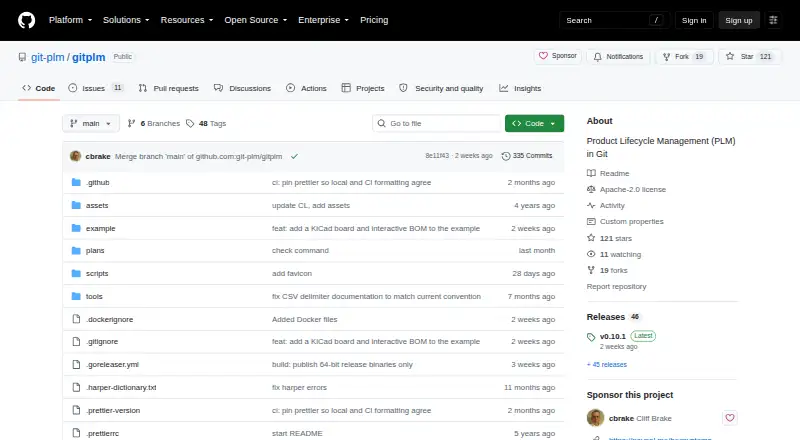
What GitPLM is
GitPLM is an open-source tool for managing product manufacturing information alongside product designs in Git. It brings together bills of materials (BOMs), part numbers, and manufacturing release data, with functions for revision control, change management, and BOM management. It can combine source BOMs with partmaster data, assemble BOMs spanning subassemblies, and collect release information for custom components.
Partmaster and BOM records are stored in CSV files, while release settings use YAML. Its terminal interface supports searches across columns, parameter-based searches within individual columns, editing, and links to datasheets. For KiCad users, GitPLM can provide a parts database through KiCad’s HTTP Libraries feature and reload it when CSV files change. Optional release hooks can run tools such as KiCad’s InteractiveHtmlBom generator; those hooks are supported on Linux and macOS. The KiCad HTTP server can use an authentication token. GitPLM is offered as a self-contained Go binary without dependencies, for Linux, macOS, and Windows. It is free, licensed under Apache 2.0, and deployed on-premise. The maker describes it as designed for small product-building teams and invites users to open an issue or discussion for help fitting it to their process.
Who it suits
GitPLM suits small teams that build products and want to keep manufacturing records and designs together in Git. It is especially relevant to teams managing BOMs, component data, and KiCad workflows through CSV-based records and a terminal interface.
What it does well
- Combines BOMs and partmaster data across subassemblies.
- Terminal interface supports column and parametric searches.
- Connects a parts database to KiCad’s HTTP Libraries feature.
- Free and released under the Apache 2.0 license.
- Runs on Linux, macOS, and Windows as a self-contained binary.
What to know first
- Release hooks are supported only on Linux and macOS.
- Partmaster and BOM data use CSV files; release settings use YAML.
Plans
| Plan | Billed and limits | Price |
|---|---|---|
| GitPLM | No paid plans or usage limits are stated on the opened maker pages. | Free |
As github.com lists them, read 8 Oct 2026. The maker's own page has the final word.
Getting started
- Open the GitPLM project website on GitHub.
- Use GitPLM on Linux, macOS, or Windows.
- Keep partmaster and BOM data in CSV files and release configuration in YAML.
- Connect its parts database to KiCad through HTTP Libraries if needed.
- Configure optional release hooks on Linux or macOS if needed.
GitPLM brings product manufacturing information and design work into Git, with BOM and part management at its core. It suits small teams building products who want an on-premise workflow built around files and revision control. Its focused toolkit is a strong fit for teams already comfortable working with Git, though release hooks are limited to Linux and macOS.
Overview
GitPLM connects product designs with the manufacturing data that accompanies them. It combines source BOMs with partmaster data, rolls subassembly BOMs into a combined BOM, and gathers custom-component release data for manufacturing. Revision control, change management, BOM management, and API access are supported.
The maker describes GitPLM as a single, self-contained Go binary with no dependencies. Partmaster and BOM data are stored in CSV, while release configuration uses YAML. That file-based approach keeps the core workflow legible to teams familiar with Git, but it makes Git and structured data files central to how the product is managed.
Key features
Parts and BOMs
The terminal interface supports quick searches across columns, parametric searches within a column, editing, and datasheet links. This gives teams a direct way to find and maintain parts alongside their designs. Combining source BOMs across subassemblies is useful when manufacturing needs a complete product view rather than separate lists for each assembly.
KiCad and release data
GitPLM can serve a parts database to KiCad through its HTTP Libraries feature and reload that data when CSV files change. An optional authentication token protects the KiCad HTTP server. Release configuration can also run optional hooks, including tools such as KiCad’s InteractiveHtmlBom generator, to collect manufacturing release data.
The main platform caveat is specific: release hooks are documented for Linux and macOS, not Windows. Windows users can still use GitPLM, but teams whose release process depends on those hooks should choose another workflow or product.
Pricing
GitPLM is open source under the Apache 2.0 license. Its GitPLM plan costs nothing. There are no paid plans or usage limits stated, and no free trial is offered. The free plan has no published seat cap or quota, making it suitable for small teams that want to adopt the tool without a subscription commitment.
Platforms
GitPLM supports Linux, macOS, and Windows and is deployed on-premise. Its self-contained Go binary has no dependencies, which suits teams that want to run the tool within their own environment. Release hooks are documented only for Linux and macOS, so Windows support does not extend to that part of the workflow.
Who it's for
GitPLM is aimed at small product teams that want designs, part numbers, BOMs, and manufacturing release data managed in Git. It is a particularly good fit for teams using KiCad and comfortable maintaining CSV and YAML files. Teams that need release hooks on Windows should look elsewhere for that workflow.
Pros and cons
- Pro: It combines partmaster records, source BOMs, subassembly rollups, and manufacturing release data in one Git-centered workflow.
- Pro: KiCad can use the parts database over HTTP and reload it when CSV files change, keeping library data connected to the maintained parts records.
- Pro: The open-source Apache 2.0 license and free plan avoid a paid-plan or stated usage-limit barrier.
- Con: Release hooks are documented for Linux and macOS only, limiting Windows teams that rely on hook-based release steps.
- Con: Its terminal interface and CSV/YAML data model favor teams comfortable with Git and structured files; teams seeking a different style of workflow may prefer another PLM.
Alternatives
For a wider range of product lifecycle management options, browse Product Lifecycle Management Software.
- Cascadia PLM is worth considering if you want a freemium, self-hosted PLM with unlimited editors and viewers on its free Self-Hosted Core plan.
- Dokuly is another free, open-source, self-hosted PLM, delivered as a Docker stack.
- PDXpert PLM is a paid option with a three-week, fully functional evaluation for teams that want to assess a Windows or self-hosted PLM before subscribing.
- Oracle Fusion Cloud PLM is a paid cloud option; its Reviewer Cloud Service is priced at $100 a month, with a standard three-year term and a minimum of 50 hosted named users.
- Centric PLM is a paid alternative for readers comparing other PLM products.
- Infor Public Sector is a paid alternative for readers evaluating other software in this category.
- NETVIBES is a paid alternative with a free plan and free trial.
- Aptean Apparel PLM is a paid alternative with pricing provided on request.
Verdict
Choose GitPLM if a small product team wants free, on-premise management of designs, parts, BOMs, and manufacturing release data in Git, especially alongside KiCad. Its focused, file-based approach and open license are compelling for that team; Windows-dependent release hooks are the clearest reason to look elsewhere.
Verdict
Choose GitPLM if a small product team wants an on-premise, Git-based way to manage designs, parts, BOMs, and manufacturing release data. Teams relying on release hooks on Windows should look elsewhere for that part of the workflow, since hooks are documented for Linux and macOS.
Questions
How much does GitPLM cost?
GitPLM is free, with a listed price of $0 plan.
Is GitPLM open source?
Yes. GitPLM is released under the Apache 2.0 license.
Which platforms does it support?
GitPLM is available for Linux, macOS, and Windows. Its optional release hooks are documented for Linux and macOS only.
Does GitPLM work with KiCad?
It can serve a parts database to KiCad through the HTTP Libraries feature and reload data when CSV files change. Optional release hooks can run tools such as KiCad’s InteractiveHtmlBom generator.
How is GitPLM deployed?
GitPLM is deployed on-premise and is described as a self-contained Go binary with no dependencies.
What data formats does it use?
Partmaster and BOM data use CSV files, and release configuration uses YAML files.
Facts from GitPLM's own pages
- Architecture
- The maker describes GitPLM as a single, self-contained Go binary with no dependencies. · github.com, 8 Oct 2026
- BOMs and releases
- It combines source BOMs with partmaster data, creates combined BOMs across subassemblies, and gathers custom-component release data for manufacturing. · github.com, 8 Oct 2026
- Data format
- Partmaster and BOM data use CSV files, and release configuration uses YAML files. · github.com, 8 Oct 2026
- KiCad integration
- GitPLM can serve a parts database to KiCad through KiCad’s HTTP Libraries feature and reload the data when CSV files change. · github.com, 8 Oct 2026
- Licensing
- The GitPLM tool is released under the Apache 2.0 license. · github.com, 8 Oct 2026
- Limits
- Release hooks are documented as supported on Linux and macOS only. · github.com, 8 Oct 2026
- Other integrations
- The maker documents optional release hooks that can run tools such as KiCad’s InteractiveHtmlBom generator. · github.com, 8 Oct 2026
- Part management
- Its terminal UI supports quick search across columns, per-column parametric search, editing, and datasheet links. · github.com, 8 Oct 2026
- Purpose
- GitPLM manages product manufacturing information, including BOMs and part numbers, alongside product designs in Git. · github.com, 8 Oct 2026
- Security
- The KiCad HTTP server supports an optional authentication token. · github.com, 8 Oct 2026
- Support
- The maker invites users to open an issue or discussion for help fitting GitPLM to their process. · github.com, 8 Oct 2026
- Target teams
- The maker says GitPLM is designed for small teams building products. · github.com, 8 Oct 2026