Freedom251 › Network Monitoring
Ganglia
What Ganglia is
Ganglia is a free, self-hosted monitoring system for high-performance computing clusters and Grids. Its hierarchical design collects host information within clusters and combines it across groups of clusters. The gmond daemon runs on each node to monitor host state, while gmetad polls data sources, aggregates cluster information, stores numeric metrics in round-robin databases, and makes aggregated XML available to clients. A PHP web frontend presents live monitoring data and historical graphs for CPU, memory, disk, and network use. Administrators can announce additional host metrics with the gmetric command-line tool, and extend gmond using metric modules written in C or Python. Ganglia uses XML for data representation, XDR for transport, and RRDtool for storage and visualization. It is listed for Linux, macOS, Windows, and self-hosted use. The project profile reports use across thousands of clusters and scaling to clusters with 2,000 nodes. The web frontend depends on gmetad, which is not built by default and requires RRDtool when enabled.
Who it suits
Ganglia suits system administrators and other users who need to view monitoring data across clusters. It is aimed at high-performance computing environments that need node-level metrics and cluster aggregation.
What it does well
- Free, BSD-licensed open-source project
- Shows live data and historical metric graphs
- Custom host metrics can be announced with gmetric
- Supports pluggable C or Python metric modules
What to know first
- The web frontend depends on gmetad
- Gmetad requires RRDtool and is not built by default
- Large data displays may call for a powerful dedicated machine
- Public installations may need upgrading or password protection
Limits
The web frontend depends on gmetad. Gmetad is not built by default; enabling it requires RRDtool and its headers. For a large amount of displayed data, the documentation recommends a fairly powerful dedicated machine.
Plans
| Plan | Billed and limits | Price |
|---|---|---|
| Ganglia | BSD-licensed open-source project · self-hosted monitoring software | Free |
As ganglia.github.io lists them, read 11 Oct 2026. The maker's own page has the final word.
Getting started
- Visit the Ganglia project website.
- Set up the gmond monitoring daemon on cluster nodes.
- If using the web frontend, enable and build gmetad with the RRDtool library and headers.
- Set up the PHP web frontend, which depends on gmetad.
- For large data displays, use a fairly powerful dedicated machine.
Verdict
Ganglia combines node monitoring, cluster aggregation, and a web view of live and historical metrics. Account for the gmetad and RRDtool setup, and heed the project's security warning for publicly accessible installations.
Questions
How much does Ganglia cost?
The listed plan is free. The monitor-core repository lists the BSD-3-Clause license.
Where does Ganglia run?
The documentation lists Linux, FreeBSD, NetBSD, OpenBSD, DragonflyBSD, MacOS X, Solaris, AIX, IRIX, Tru64, HPUX, and Windows NT, XP, 2000, 2003, and 2008.
What does Ganglia monitor?
Gmond monitors host state, and the web frontend displays metrics such as CPU, memory, disk, and network use.
What is required for the web frontend?
The web frontend depends on gmetad. Gmetad is not built by default and requires the RRDtool library and headers when enabled.
Can Ganglia track custom metrics?
The gmetric command-line tool can announce arbitrary host metrics. Gmond also supports pluggable metric modules written in C or Python.
Where can users find community help?
The project profile points users to its wiki, IRC channel, and public mailing lists.
Facts from Ganglia's own pages
- Additional dependency
- Gmetad relies on RRDtool and is not compiled unless explicitly requested with the --with-gmetad flag. · github.com, 10 Oct 2026
- Aggregation
- Gmetad polls cluster data sources, aggregates their state, stores numeric volatile metrics in round-robin databases, and exports aggregated XML. · github.com, 11 Oct 2026
- Architecture
- Its hierarchical design is intended for federations of clusters. · github.com, 11 Oct 2026
- Audience
- The web frontend documentation describes it as serving system administrators and computer users viewing cluster data. · github.com, 11 Oct 2026
- Cluster aggregation
- The gmetad daemon polls data sources, stores numeric volatile metrics in round-robin databases, and exports aggregated XML to clients. · github.com, 10 Oct 2026
- Components
- The system includes the gmond monitoring daemon, gmetad aggregation daemon, and a PHP-based web frontend. · github.com, 11 Oct 2026
- Custom metrics
- The gmetric utility lets users monitor arbitrary host metrics beyond the core metrics collected by gmond. · github.com, 11 Oct 2026
- Deployment requirements
- The web frontend depends on gmetad, and its documentation recommends a fairly powerful dedicated machine when displaying a large amount of data. · github.com, 10 Oct 2026
- Founded
- 2000 · ganglia.github.io, 28 Sept 2026
- Integrations
- The documentation describes integration with RRDtool for metric storage and graphs, Apache and PHP for the web frontend, and GD for pie charts. · github.com, 11 Oct 2026
- License
- The monitor-core repository lists the BSD-3-Clause license. · github.com, 10 Oct 2026
- Metric extensions
- Gmond supports pluggable metric modules written in C or Python. · github.com, 10 Oct 2026
- Metrics
- Gmond monitors host state and can be extended with pluggable C or Python metric modules. · github.com, 11 Oct 2026
- Node monitoring
- The multithreaded gmond daemon runs on each cluster node and monitors host state. · github.com, 10 Oct 2026
- Notable setup requirement
- Gmetad is not built by default and requires the RRDtool library and headers when enabled. · github.com, 11 Oct 2026
- Purpose
- Ganglia is a scalable distributed monitoring system for high-performance computing systems such as clusters and Grids. · github.com, 11 Oct 2026
- Scale
- The project profile says Ganglia has been used across thousands of clusters and can scale to clusters with 2,000 nodes. · github.com, 11 Oct 2026
- Security
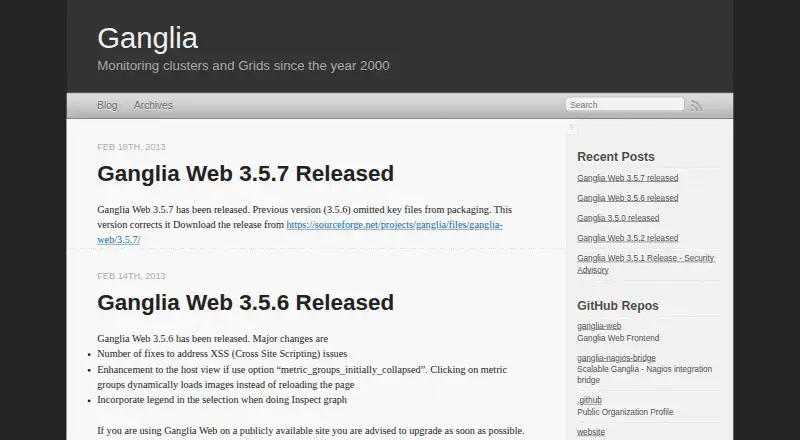
- A 2013 Ganglia Web release notice says version 3.5.6 included fixes for cross-site scripting issues and advised public-site users to upgrade promptly. · ganglia.github.io, 11 Oct 2026
- Support
- The project profile points users to its wiki, IRC channel, and public mailing lists for community help. · github.com, 11 Oct 2026
- Supported platforms
- The documentation lists Linux, FreeBSD, NetBSD, OpenBSD, DragonflyBSD, MacOS X, Solaris, AIX, IRIX, Tru64, HPUX, and Windows NT/XP/2000/2003/2008. · github.com, 10 Oct 2026
- Transport and storage
- Ganglia uses XML for data representation, XDR for data transport, and RRDtool for data storage and visualization. · github.com, 11 Oct 2026
- Visualization
- The web frontend displays dynamic pages and historical graphs for metrics such as CPU, memory, disk, and network use. · github.com, 11 Oct 2026
- Web frontend
- The PHP web frontend displays live monitoring data and historical graphs for metrics such as CPU, memory, disk, and network usage. · github.com, 10 Oct 2026
Where Ganglia stands on Freedom251
- Network Monitoring#8 of 55