Freedom251 › Virtual Routers Software
FRRouting
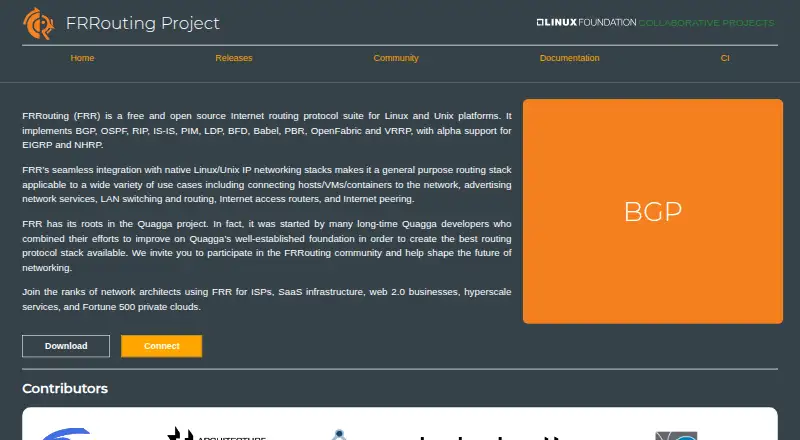
What FRRouting is
FRRouting is a free, open-source routing protocol suite for Linux and Unix platforms. It implements BGP, OSPF, RIP, IS-IS, PIM, LDP, BFD, Babel, PBR, OpenFabric, and VRRP, with EIGRP and NHRP support in alpha. Listed uses include connecting hosts, virtual machines, and containers to networks; advertising network services; LAN switching and routing; Internet access routing; and Internet peering.
FRR works with native Linux and Unix IP networking stacks. Optional build features include Sysrepo and gRPC northbound plugins and a ZeroMQ handler. The project identifies network architects at ISPs, SaaS infrastructure providers, web businesses, hyperscale services, and Fortune 500 private clouds among its users. Downloads include signed DEB and RPM packages, Snap images, best-effort Docker images, and source tarballs; installation documentation also covers source builds and packages from some Linux distributions. FRR can drop elevated privileges after startup, and on Linux with libcap it can retain only required capabilities and raise them briefly when needed. The project uses security-reporting procedures including embargoes where appropriate and CVE identifiers when needed. Alpha EIGRP and NHRP do not receive security advisories or CVE identifiers.
Who it suits
FRRouting suits network architects and teams operating Linux or Unix networks, including ISPs, SaaS infrastructure providers, web businesses, hyperscale services, and private clouds.
What it does well
- Implements a broad set of routing protocols
- Integrates with native Linux and Unix networking stacks
- Offers DEB, RPM, Snap, Docker, and source downloads
- Can limit elevated privileges after startup
What to know first
- EIGRP and NHRP support is in alpha
- Alpha EIGRP and NHRP receive no security advisories or CVE identifiers
- Docker images are provided on a best-effort basis
Plans
| Plan | Billed and limits | Price |
|---|---|---|
| FRRouting | Free and open source routing software | Free |
As frrouting.org lists them, read 4 Oct 2026. The maker's own page has the final word.
Getting started
- Choose an installation route: Debian or Red Hat package, Snap image, source build, or a package from a Linux distribution.
- Download a signed DEB or RPM package, Snap image, source tarball, or best-effort Docker image as appropriate.
- Install FRRouting on a Linux or Unix platform.
- Use the native Linux or Unix IP networking stack; optional builds can include Sysrepo or gRPC northbound plugins and a ZeroMQ handler.
- Join the community Slack or mailing lists for discussion and announcements.
FRRouting is a free, open-source routing suite for Linux and Unix systems. It suits network engineers running routers, peering infrastructure, and virtualized networks who want protocol-level control rather than a vendor-managed graphical controller. Its breadth and native-system integration are compelling, but operating it still demands infrastructure expertise.
Overview
FRRouting connects hosts, virtual machines, and containers to networks; advertises network services; handles LAN switching and routing; and supports Internet access routers and Internet peering. The project is used by network architects at ISPs, SaaS infrastructure providers, web businesses, hyperscale services, and Fortune 500 private clouds, making it a fit for serious production and private-cloud networking rather than a basic office dashboard.
FRR integrates with native Linux and Unix IP networking stacks. That lets teams incorporate routing into an operating-system-based design instead of adopting a separate appliance platform. It is free and open source, with no trial requirement.
Key features
Broad protocol coverage
FRR implements BGP, OSPF, RIP, IS-IS, PIM, LDP, BFD, Babel, policy-based routing, OpenFabric, and VRRP. This spans interior routing, Internet edge and peering, multicast, label distribution, rapid failure detection, fabric networking, and gateway redundancy. The coverage is useful when one Linux-based stack must serve several network roles. EIGRP and NHRP are supported only in alpha state, so they are a poor basis for deployments that require mature support or the project's normal security-reporting process.
Deployment and integration choices
Signed DEB and RPM packages, universal Snap images, source tarballs, and best-effort Docker images accommodate both distribution-managed hosts and custom builds. Documentation covers Debian and Red Hat packages, Snap installation, source compilation, and packages supplied by some Linux distributions. Optional Sysrepo and gRPC northbound plugins, plus a ZeroMQ handler, provide integration points for systems that need programmatic control beyond the core routing process.
Security and operations
FRR can drop elevated privileges after startup. On Linux with libcap, it keeps only the capabilities it needs and raises them briefly, reducing the exposure of a long-running routing service. Vulnerability reports can use embargoes where appropriate and CVE identifiers when needed, with a dedicated security email. The exception matters: the alpha eigrpd and nhrpd components do not receive security advisories or CVE identifiers. Community discussion and announcements run through Slack and mailing lists, and releases typically arrive about every four months when significant features or important fixes are ready.
Pricing
| Plan | Price | What it includes |
|---|---|---|
| FRRouting | free | Free and open source routing software |
There is one free plan, no paid tier, and no free trial period. Because the software is self-hosted, the published offer does not impose seat or device quotas; teams should instead account for their own Linux infrastructure and operational effort.
Platforms
FRR runs on Linux and Unix environments and is designed to work with their native IP networking stacks. Installation options include Debian and Red Hat packages, Snap images, source builds, distribution packages, signed DEB and RPM files, and best-effort Docker images. That flexibility favors teams comfortable choosing and maintaining their own host and packaging approach.
Who it's for
Choose FRR when you need standards-based routing across ISP, SaaS, web, hyperscale, or private-cloud infrastructure; when Linux or Unix is already part of the network design; or when one open-source suite must cover edge, interior, fabric, and virtualized-network roles. It is less suitable for buyers seeking a turnkey controller, a vendor-managed appliance, or mature EIGRP or NHRP security handling.
Pros and cons
Pros
- Extensive protocol set: BGP through VRRP supports varied routing, peering, multicast, fabric, and redundancy requirements.
- Strong Linux/Unix fit: Native-stack integration and multiple package formats suit self-hosted infrastructure.
- Useful hardening controls: Privilege dropping and minimal Linux capabilities reduce runtime exposure.
- No license cost: The sole plan is free and open source.
Cons
- Alpha EIGRP and NHRP: These components do not receive security advisories or CVE identifiers.
- Operational responsibility: Self-hosting, source builds, and infrastructure integration favor experienced network teams over turnkey buyers.
- Best-effort Docker images: Container users should not treat that distribution route as the project's strongest packaging guarantee.
Alternatives
For centralized, cross-platform network configuration with a freemium model and a two-device free edition, choose ManageEngine Network Configuration Manager; its Professional Edition is $238 a year. UniFi Network is a license-free alternative with self-hosted or UniFi-hardware deployment and apps for major desktop and mobile platforms.
TP-Link Omada SDN suits centralized management of up to 1,500 devices at no additional software expense. MikroTik RouterOS is the better fit for a commercial router platform with a 24-hour demo and paid licensing, including the 45.00 USD-per-month Level 4 WISP plan.
Arista NG Firewall focuses on web-delivered firewall and connectivity features. Cambium cnMaestro offers a no-subscription Essentials tier for up to 10,000 devices and 10 management users. Gluware provides a renewable Community Edition for up to 20 devices. Domotz uses per-device pricing at $1.50 a month, billed in bundles of 10.
For broader network-management choices, browse Network Management Software.
Verdict
FRRouting is the right choice for experienced network teams that want a broad, Linux-native routing stack without license fees. Pick it for protocol coverage, self-hosted flexibility, and integration with Unix networking; look elsewhere if you need a turnkey graphical controller, vendor-managed operations, or dependable security advisories for EIGRP and NHRP.
Verdict
FRRouting provides a wide range of routing protocols and distribution options for Linux and Unix environments. Its EIGRP and NHRP implementations are alpha and have a stated security-reporting limitation.
Questions
How much does FRRouting cost?
FRRouting is free and open source. Its listed plan costs nothing.
Which platforms does FRRouting support?
It is a routing protocol suite for Linux and Unix platforms. Installation documentation covers Debian and Red Hat packages, Snap images, source builds and packages from some Linux distributions.
Which protocols does it implement?
FRR implements BGP, OSPF, RIP, IS-IS, PIM, LDP, BFD, Babel, PBR, OpenFabric and VRRP. EIGRP and NHRP support is in alpha.
Is FRRouting open source?
Yes. FRRouting is described as free and open source.
What integrations are available?
FRR integrates with native Linux and Unix IP networking stacks. Optional build features include Sysrepo and gRPC northbound plugins and a ZeroMQ handler.
Where can I get support or community updates?
The project community uses Slack and mailing lists for discussion and announcements. Vulnerability reports can be sent to the security email.
Facts from FRRouting's own pages
- Audience
- The project says FRR is used by network architects at ISPs, SaaS infrastructure providers, web businesses, hyperscale services, and Fortune 500 private clouds. · frrouting.org, 4 Oct 2026
- Build integrations
- Optional build features include Sysrepo and gRPC northbound plugins and a ZeroMQ handler. · docs.frrouting.org, 4 Oct 2026
- Downloads
- FRR distributes signed DEB and RPM packages, Snap images, best-effort Docker images, and source tarballs. · frrouting.org, 4 Oct 2026
- Integrations
- FRR integrates with native Linux and Unix IP networking stacks. · frrouting.org, 4 Oct 2026
- Package platforms
- The installation documentation identifies Debian and Red Hat packages, universal Snap images, source builds, and packages from some Linux distributions. · docs.frrouting.org, 4 Oct 2026
- Privilege controls
- FRR can be configured to drop elevated privileges after startup, and on Linux with libcap it retains only the minimal required capabilities and raises them briefly as needed. · docs.frrouting.org, 4 Oct 2026
- Protocols
- It implements BGP, OSPF, RIP, IS-IS, PIM, LDP, BFD, Babel, PBR, OpenFabric and VRRP, with alpha support for EIGRP and NHRP. · frrouting.org, 4 Oct 2026
- Release cadence
- The project says releases typically arrive roughly every four months when significant features or important bug fixes are added. · frrouting.org, 4 Oct 2026
- Security limitation
- The project says alpha-state eigrpd and nhrpd will not receive security advisories or CVE identifiers. · frrouting.org, 4 Oct 2026
- Security process
- The project says vulnerability reports use embargoes where appropriate and CVE identifiers when needed, and provides a security email for reports. · frrouting.org, 4 Oct 2026
- Support channels
- The project community uses Slack and mailing lists for discussion and announcements. · frrouting.org, 4 Oct 2026
- Use cases
- The project lists connecting hosts, VMs and containers to networks, advertising network services, LAN switching and routing, Internet access routers, and Internet peering as use cases. · frrouting.org, 4 Oct 2026
- What it does
- FRRouting is a free and open source Internet routing protocol suite for Linux and Unix platforms. · frrouting.org, 4 Oct 2026
Where FRRouting stands on Freedom251
- Virtual Routers Software#4 of 25
- Network Management Software#6 of 34