Freedom251 › Email Template Software
Foundation for Emails
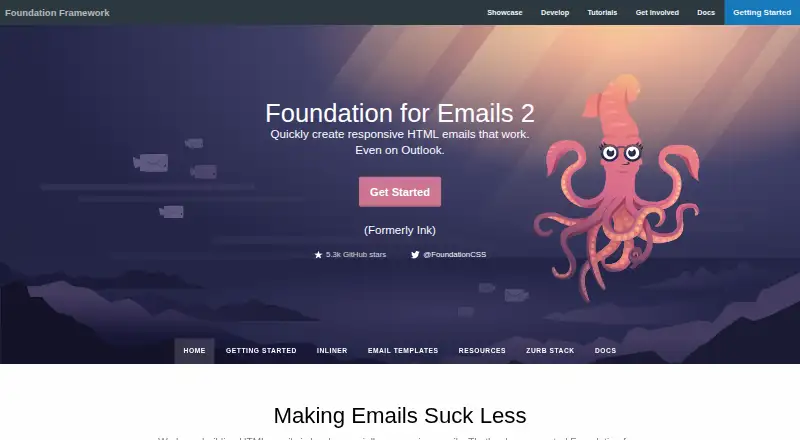
What Foundation for Emails is
Foundation for Emails is a free, open-source framework for creating responsive HTML email intended to work across email clients, including Outlook. The maker describes it for marketing, promotional, drip campaign, and transactional messages. Its template collection includes 11 customizable layouts, such as newsletters, order notices, password resets, and welcome emails. A responsive grid can stack content on small screens and adjust padding and row width for mobile. Developers can write Inky tags such as <row> and <columns>, which are converted into email table markup. The ZURB Email Stack brings together Gulp, Sass, Inky, CSS inlining, BrowserSync live reloading, and automatic image compression. Panini layouts and Handlebars partials support reusable content such as headers and footers. The web inliner embeds CSS in HTML style attributes, moves media query styles into the body, and compresses the output. The CSS version comes as a ZIP download; the Sass version includes a build process and requires Node.js. HTML is the listed export format.
Who it suits
It suits designers, developers, and marketers who create responsive marketing or transactional email. Developers can use its Inky syntax and build workflow to work with reusable layouts and email markup.
What it does well
- Free and open source
- Includes 11 customizable email templates
- Responsive grid adapts layouts for small screens
- Inky converts concise tags to table markup
- HTML is the listed export format
What to know first
- Sass version requires Node.js
- CSS version is provided as a ZIP download
Plans
| Plan | Billed and limits | Price |
|---|---|---|
| Foundation for Emails | Responsive email framework · CSS and Sass versions · 11 customizable HTML templates | Free |
| Open-source Foundation for Emails | Free; no paid tier stated · MIT-licensed framework · self-hosted tooling · no hosted sending service | Free |
As get.foundation lists them, read 4 Oct 2026. The maker's own page has the final word.
Getting started
- Visit https://get.foundation/emails.html.
- Choose the CSS ZIP download or the Sass version with its build process.
- Install Node.js if you choose the Sass version.
- Customize one of the 11 HTML templates or create an email with the framework.
- Use the inliner to prepare CSS within the email HTML.
- Export the result as HTML.
Foundation for Emails is a code-focused framework for producing responsive HTML email. It suits designers, developers, and marketers who can work with HTML and want reusable layouts; its free, open-source model makes it a practical option when visual editing is not the priority.
Overview
The framework is intended for marketing, promotional, drip-campaign, and transactional email, with layouts designed for major email clients including Outlook. Its strongest appeal is a workflow built around editable markup and reusable components. The tradeoff is that the full Sass workflow requires Node.js, so teams seeking a browser-based visual editor should look elsewhere.
Key features
Responsive layouts and templates
The grid stacks content on smaller screens and adjusts padding and row width for mobile. Eleven customizable HTML templates cover common formats such as newsletters, order messages, password resets, and welcome emails. They shorten the path to a working starting point, although teams with a distinctive design system will need to adapt them.
Compact authoring and build tools
Inky lets developers write tags such as <row> and <columns>, then converts them into the table markup used in email HTML. The ZURB Email Stack brings together Gulp, Sass, Inky, CSS inlining, BrowserSync live reloading, and automatic image compression. Panini layouts and Handlebars partials help teams reuse elements such as headers and footers instead of maintaining them separately in every message.
CSS inlining and compatibility
The inliner embeds CSS in HTML style attributes, moves media-query styles into the body, and compresses the output. The maker describes the framework and templates as designed for major email clients and says they are tested on Outlook, Gmail, and Apple Mail. That focus is useful for teams targeting those clients, but it does not remove the need to review a campaign in the environments that matter to its audience.
Pricing
Foundation for Emails is free and open source. The Foundation for Emails plan costs nothing and includes a responsive email framework, CSS and Sass versions, and 11 customizable HTML templates. There are no paid tiers or seat-based plan distinctions to weigh; teams choose between the lighter ZIP-based CSS version and the Sass build workflow.
The CSS version comes as a ZIP download, while the Sass version requires Node.js. The ZIP offers a simpler starting point, but users who want the included build process need to be comfortable setting up that dependency. Custom HTML editing is supported, and HTML is the export option.
Platforms
Foundation for Emails is a web-based offering. Its assets can be downloaded as a CSS ZIP, and the Sass workflow runs through a build process that requires Node.js.
Who it's for
This is a strong fit for people who author or maintain email HTML and want responsive layouts, reusable content, and a repeatable build workflow. Marketers can use the templates as a starting point, while developers can shape the markup and build process. It is less suitable for teams whose main need is a visual editor that hides HTML and tooling.
Pros and cons
- Pros: Free, open-source access includes both CSS and Sass versions, so teams can choose between a ZIP download and a build-based workflow.
- Pros: Eleven templates and reusable Panini layouts and Handlebars partials help cover common messages and shared components.
- Pros: Inky and the inliner address email-specific markup and CSS preparation within the workflow.
- Cons: The Sass route requires Node.js, adding setup work for teams that want the full build process.
- Cons: The code-oriented workflow is a poor match for teams that need to create and export messages without editing HTML.
Alternatives
For a broader set of options, browse Email Template Software.
- Canary is a free email app with a unified inbox, read receipts, snooze and pin, templates, and Inbox Zero; choose it when managing an inbox matters more than building email HTML.
- MJML is another free, open-source email framework, with a free-to-use REST API; consider it if an API-based workflow is the priority.
- Blocks Edit offers free and paid plans, including a Collaborate plan at $240 a year with 250 GB storage and a 5 users plan at $99 a year; consider it if its plan structure suits your team.
- Dragble has a free plan with 3 projects, 10 GB storage, 10 core content blocks, and Dragble branding; consider it if those project and storage allowances fit your needs.
- MailEditor has a Starter plan at $9 a month, billed yearly, with limits including 2 members, 100 HTML exports, and 50 ESP exports; consider it if those export allowances fit your workflow.
- Mela has a free plan capped at 1 site, 2 locales, 1 organization member, and 1 client seat; choose it if those site and collaboration limits align with your work.
- Mosaico is a free, open-source email template builder under the GPL license; consider it if that builder and licensing model better suit your project.
- PostBrix offers a free plan with 3 projects, 1 workspace, 50 MB storage, and capped daily downloads and test emails; consider it if those free-plan limits fit your needs.
Verdict
Choose Foundation for Emails if you want a free framework for responsive email and value control over markup, reusable components, and a build workflow. Its main reason to choose it is the combination of templates and email-focused development tools without a plan fee. Look elsewhere if you need visual-first editing or want to avoid the Node.js requirement of the Sass route.
Verdict
Foundation for Emails offers templates, responsive layout tools, and a build workflow for creating HTML email. Choose between the ZIP-based CSS version and the Sass option, which requires Node.js.
Questions
Is Foundation for Emails free?
Yes. The listed plan costs nothing, and the framework is open source.
What does the free plan include?
It includes a responsive email framework, CSS and Sass versions, and 11 customizable HTML templates.
Which platforms are supported?
Web is the listed platform.
What email clients is it designed for?
The framework and templates are designed for major email clients. The maker describes testing on Outlook, Gmail, and Apple Mail.
Does it support HTML export?
Yes. HTML is the listed export format.
Does the Sass version have a requirement?
Yes. It includes a build process and requires Node.js.
Facts from Foundation for Emails's own pages
- Audience
- The maker describes Foundation for Emails as useful to designers, developers, and marketers, from startups to Fortune 500 companies. · get.foundation, 4 Oct 2026
- Build commands
- The starter uses npm start for development and npm run build to inline CSS and complete the build. · github.com, 15 Oct 2026
- Build workflow
- The ZURB Email Stack includes Gulp, Sass, Inky, an inliner, BrowserSync live reloading, and automatic image compression. · get.foundation, 4 Oct 2026
- Buttons
- The framework includes button components with multiple sizes and colors. · get.foundation, 15 Oct 2026
- Callouts
- Callout components provide colored panels for sections or calls to action. · get.foundation, 15 Oct 2026
- CLI installation
- The documented setup installs foundation-cli with npm and creates a project using foundation new --framework emails. · get.foundation, 15 Oct 2026
- Company history
- ZURB says it began in 1998, moved to Campbell, California in 2005, released Ink in 2013 and renamed it Foundation for Emails 2 in 2016. · zurb.com, 15 Oct 2026
- Compatibility
- The maker says the framework and templates are designed for major email clients and describes testing on Outlook, Gmail, and Apple Mail. · get.foundation, 4 Oct 2026
- Compatibility coverage
- The compatibility table lists Apple Mail, Outlook 2000–2016, Android 4.4, Gmail, Google Apps, Office 365, Outlook.com and Yahoo Mail. · get.foundation, 15 Oct 2026
- Compatibility limitation
- The maker notes that Gmail for Android does not recognize media queries and therefore renders the large breakpoint. · get.foundation, 15 Oct 2026
- CSS inlining
- The web inliner embeds CSS into HTML style attributes, relocates media query styles into the body, and compresses the output. · get.foundation, 4 Oct 2026
- Email templates
- The templates page offers 11 responsive HTML email templates, including newsletter, order, password reset, and welcome layouts. · get.foundation, 4 Oct 2026
- Email testing
- The template includes an npm run litmus command that requires AWS S3 configuration. · github.com, 15 Oct 2026
- Email use cases
- The maker describes it for marketing, promotional, drip campaign, and transactional emails. · get.foundation, 4 Oct 2026
- Former name
- The project was originally called Ink. · get.foundation, 15 Oct 2026
- Getting started
- The CSS version is a ZIP download; the Sass version includes a build process and requires Node.js. · get.foundation, 4 Oct 2026
- Headquarters
- Campbell, California, United States · get.foundation, 28 Sept 2026
- Independent usage
- Your Movement documents using Foundation for Emails v2 to render its emails, with automatic CSS inlining and a 12-column grid. · developers.yourmovement.org, 15 Oct 2026
- Inky extensibility
- The Inky repository describes Rust-based distribution as a CLI, WASM module, native shared library and Rust crate, with bindings for Node.js, PHP, Python, Ruby and Go. · github.com, 15 Oct 2026
- Inky repository popularity
- The Inky GitHub repository showed about 706 stars, 104 forks and 525 commits when opened. · github.com, 15 Oct 2026
- Inky tags
- Documented Inky tags include container, row, columns, button, callout, menu and item. · get.foundation, 15 Oct 2026
- Inky templating
- Inky converts concise custom tags such as container, row and columns into table-based email HTML. · get.foundation, 15 Oct 2026
- License
- The GitHub repository identifies the project as MIT licensed. · github.com, 15 Oct 2026
- Limit: dated compatibility table
- FAUN.dev notes that the published compatibility matrix stops at client versions largely from the mid-2010s. · faun.dev, 15 Oct 2026
Where Foundation for Emails stands on Freedom251
- Email Template Software#2 of 26