Freedom251 › Next Generation Firewall Software

Forcepoint Next Generation Firewall
Visit Forcepoint Next Generation Firewall Alternatives Pricing
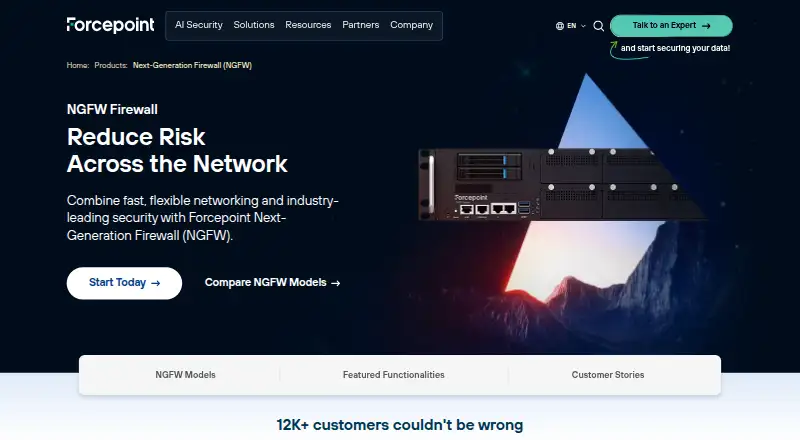
What Forcepoint Next Generation Firewall is
Forcepoint Next Generation Firewall is a paid firewall product with a hybrid deployment model. Its listed network security capabilities include intrusion prevention and SSL inspection, alongside site-to-site VPN for connections between sites. For managing network policy, it includes change control and policy automation, and it provides API access. These features give the product a stated scope across firewall protection, inspection, policy management and site connectivity. The maker is Forcepoint Next Generation Firewall, headquartered in Austin, Texas, United States; the product is also listed with Austin as its headquarters. Pricing is available on request, and there is no free plan. Organizations considering it can review whether its listed deployment model and controls match their needs, then contact Forcepoint to request pricing. The product’s listed features are specific: change control, policy automation and API access for administration; intrusion prevention and SSL inspection for network protection; and site-to-site VPN for connectivity. Its hybrid deployment model is the stated option for organizations evaluating how to deploy it.
Who it suits
It may suit organizations looking for a firewall with a hybrid deployment model and listed controls for policy management, inspection and site-to-site VPN. It is relevant to buyers who need intrusion prevention, SSL inspection, change control, policy automation or API access.
What it does well
- Hybrid deployment model.
- Includes intrusion prevention and SSL inspection.
- Supports site-to-site VPN.
- Provides change control, policy automation and API access.
What to know first
- There is no free plan.
- Pricing is available on request.
Plans
| Plan | Billed and limits | Price |
|---|---|---|
| Forcepoint Next Generation Firewall | Pricing by request · physical, virtual, and cloud deployments | On request |
As forcepoint.com lists them, read 12 Oct 2026. The maker's own page has the final word.
Getting started
- Visit the Forcepoint Next Generation Firewall website.
- Contact Forcepoint to request pricing.
- Evaluate the hybrid deployment model and listed capabilities for your needs.
Forcepoint Next Generation Firewall is an enterprise firewall and SD-WAN platform for networks spread across appliances, virtual infrastructure and cloud services. It fits organizations with distributed sites, centralized security administration and demanding availability requirements. Buyers who need broad deployment and policy controls will find a capable option, while those seeking a fixed, low-cost firewall should look elsewhere.
Overview
Forcepoint NGFW is aimed at large enterprises, campus networks, data centers, offices, branches, remote locations and stores. Its hybrid deployment model covers physical, virtual and cloud systems, with API access, policy automation and change control for teams that must keep rules consistent across many environments. That scope is useful for complex estates, but it is more infrastructure than a small office typically needs.
The Secure Management Center centralizes policy administration, log analysis, monitoring and reporting. A security team can work from one management layer rather than treating every firewall as a separate installation, which is particularly valuable for geographically distributed networks.
Key features
Threat protection
Deep packet inspection, anti-evasion defenses, intrusion prevention, vulnerability exploit detection and DoS/DDoS protection create several layers of network defense. SSL inspection, site-to-site VPN and standard IPsec-client support extend protection and connectivity beyond the appliance itself. URL filtering requires a separate subscription, so the full web-control feature set adds an extra purchasing decision.
Availability and updates
Firewall clustering supports active-active or active-standby operation with up to 16 nodes. Updates can be pushed without interrupting service, a practical advantage for organizations that cannot schedule frequent outages. Smaller 110/115 appliances do not provide local anti-malware scanning, which matters when selecting hardware for branch or compact deployments.
Cloud, virtual and remote deployment
Cloud support covers Amazon Web Services, Microsoft Azure, Google, Oracle and IBM infrastructure. Virtual appliances run on x86 64-bit systems, VMware ESXi and NSX, Microsoft Hyper-V, KVM and Nutanix AHV. Forcepoint also supports SASE/SSE integration, including forwarding web traffic to Forcepoint ONE, alongside CASB and Web Security integration. The Forcepoint VPN client is available for Windows, Android and Mac OS, with standard IPsec clients supported as well.
Assurance
Forcepoint states that NGFW has Common Criteria certification for Network Security Platform 7.3 and FIPS 140-3 Level 2 certification for its NGFW appliance. These certifications can be relevant to organizations with formal security or procurement requirements.
Pricing
| Plan | Price | What you get |
|---|---|---|
| Forcepoint Next Generation Firewall | Pricing by request | Physical, virtual and cloud deployments |
There is no free plan or published trial term. Prospective customers are directed to request pricing and speak with a Forcepoint network security expert, so budget comparison requires a sales conversation. The single plan is the natural fit for organizations needing the full hybrid deployment model; it offers no cheaper self-serve tier for smaller networks, and URL filtering is an additional subscription.
Platforms
Forcepoint lists Android, API, Linux, macOS, self-hosted and Windows support. Those entries cover management and client access as well as the firewall's physical, virtual and cloud deployment options.
Who it's for
Choose Forcepoint NGFW when one security program must span data centers, campuses, branches, remote sites and public or private cloud infrastructure. It is especially suited to teams that need centralized policy, automated changes, detailed logging, high-availability clustering and integration with SASE, CASB or web-security services.
It is a weaker fit for buyers who require transparent pricing, a free edition or a minimal firewall for a single small network. The separate URL-filtering subscription and the absence of local anti-malware scanning on 110/115 appliances should be considered during product and hardware selection.
Pros and cons
- Pro: Physical, virtual and cloud deployment options accommodate mixed infrastructure.
- Pro: Centralized management combines policy, logs, monitoring and reporting for multi-site operations.
- Pro: Up to 16-node clustering and non-disruptive updates support continuity goals.
- Pro: Layered inspection, intrusion prevention, exploit detection and DoS/DDoS controls address varied network threats.
- Con: URL filtering needs a separate subscription, increasing the cost and administration of web controls.
- Con: 110/115 appliances lack local anti-malware scanning.
- Con: Pricing is custom and there is no free plan, making quick budget comparisons difficult.
Alternatives
For a broader directory of management tools, see Firewall Management Software, or compare products in Network Firewall Software and Intrusion Detection and Prevention Software.
- CacheGuard-OS is a freemium Linux and self-hosted option with an indefinitely free plan, though excess install capacity can slow or block traffic.
- Comodo Internet Security suits Windows users seeking a free tier, with a Pro plan at $39.99 a year billed annually.
- Google Cloud Firewall Policies offers API and web access with free Essentials rules for standard network attributes.
- SonicWall Network Security Manager is a paid platform that also provides a free option and trial for centralized management and alerting.
- Gufw is a free Linux firewall with no paid plans or stated usage limits.
- TinyWall is a free, open-source Windows firewall with no ads or paid upgrades.
- AlgoSec is a paid API, Linux, self-hosted and web platform with pricing handled through a sales process.
- Check Point DDoS Protector is another paid Linux, self-hosted and web security option.
Verdict
Forcepoint Next Generation Firewall is a strong choice for enterprises that need centralized policy and threat controls across physical, virtual and cloud networks, with clustering and integrations to support resilient, distributed operations. Choose it for that breadth and operational control; look elsewhere if you need a free plan, published pricing or built-in local anti-malware on every appliance tier.
Verdict
Consider Forcepoint Next Generation Firewall if you need its listed intrusion prevention, SSL inspection, policy controls, API access or site-to-site VPN in a hybrid deployment. Look elsewhere if a free plan is essential, or if you need pricing before contacting the maker.
Questions
Is Forcepoint Next Generation Firewall free?
No. It is a paid product and has no free plan.
How much does it cost?
Pricing is available on request.
How can it be deployed?
Its listed deployment model is hybrid.
What network security capabilities does it include?
The listed capabilities include intrusion prevention and SSL inspection.
Does it support site-to-site VPN and API access?
Yes. Site-to-site VPN and API access are both listed.
Where is the maker headquartered?
The maker is listed as headquartered in Austin, Texas, United States.
Facts from Forcepoint Next Generation Firewall's own pages
- Central management
- The Secure Management Center provides centralized policy management, log analysis, monitoring, and reporting. · forcepoint.com, 12 Oct 2026
- Cloud platforms
- The datasheet lists Amazon Web Services, Microsoft Azure, Google, Oracle, and IBM cloud infrastructure. · forcepoint.com, 12 Oct 2026
- Headquarters
- Austin, Texas, United States · forcepoint.com, 4 Oct 2026
- High availability
- Firewall clustering supports active-active or active-standby configurations with up to 16 nodes, and updates can be pushed without interrupting service. · forcepoint.com, 12 Oct 2026
- Integrations
- The product supports SASE/SSE integration, including web traffic forwarding to Forcepoint ONE, and CASB and Web Security integration. · forcepoint.com, 12 Oct 2026
- Product limits
- URL filtering requires a separate subscription, and local anti-malware scanning is unavailable on 110/115 appliances. · forcepoint.com, 12 Oct 2026
- Purpose
- Forcepoint NGFW provides network security and SD-WAN connectivity for enterprise networks across physical, virtual, and cloud systems. · forcepoint.com, 12 Oct 2026
- Remote access
- The Forcepoint VPN client is listed for Microsoft Windows, Android, and Mac OS, with support for standard IPsec clients also stated. · forcepoint.com, 12 Oct 2026
- Security certifications
- Forcepoint says its NGFW has Common Criteria certification for Network Security Platform 7.3 and FIPS 140-3 Level 2 certification for its NGFW appliance. · forcepoint.com, 12 Oct 2026
- Support
- The product page directs prospective customers to talk to a Forcepoint network security expert; its pricing page is titled Request Pricing. · forcepoint.com, 12 Oct 2026
- Target customers
- The product page positions its appliance models for large enterprises, campus networks, data centers, offices, branches, remote sites, and stores. · forcepoint.com, 12 Oct 2026
- Threat protection
- Features include deep packet inspection, anti-evasion defenses, intrusion prevention, vulnerability exploit detection, and DoS/DDoS protection. · forcepoint.com, 12 Oct 2026
- Virtual platforms
- Virtual appliances support x86 64-bit systems, VMware ESXi and NSX, Microsoft Hyper-V, KVM, and Nutanix AHV. · forcepoint.com, 12 Oct 2026
Where Forcepoint Next Generation Firewall stands on Freedom251
- Next Generation Firewall Software#6 of 18
- Network Firewall Software#15 of 37
- Intrusion Detection and Prevention Software#16 of 39
- Firewall Management Software#17 of 29
- Firewall Software#56 of 81