Freedom251 › Equity Compensation Management Software
Fidelity Private Shares
What Fidelity Private Shares is
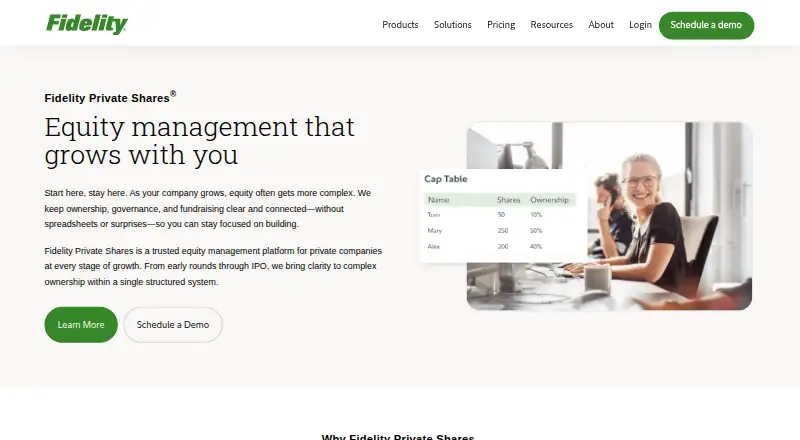
Fidelity Private Shares is a web-based equity management platform for private companies, covering ownership records, governance, and fundraising from early rounds through IPO. Its cap table brings grants, SAFEs, notes, and preferred shares together, with entries linked to supporting legal documents in a data room. Files there are automatically organized, and missing documents are flagged. Companies can model dilution and financing or exit scenarios, including with a next-round planner that exports pro forma results.
Customizable permissions let employees, lawyers, auditors, and investors see relevant equity information and diligence materials. Reports include grant history, transfers, option overhang, 83(b), and ASC 718. The platform also includes equity plan generation, board consents, electronic securities, and 83(b) generation on its free Launch plan. Launch costs nothing and is limited to up to 25 stakeholders and companies that have raised less than $1M. Startup and Growth pricing is arranged through a demo; Scale pricing is available by contacting the company. Growth and Scale subscriptions include HRIS integration, and Gusto is listed for syncing equity, HR, and payroll information. Fidelity Private Shares is headquartered in Boston, Massachusetts.
Who it suits
Fidelity Private Shares suits founders and operators managing private-company equity, along with legal teams, investors, and boards that need access to ownership and diligence materials. Its free Launch plan is aimed at companies with up to 25 stakeholders and less than $1M raised; HRIS integration is included with Growth and Scale subscriptions.
What it does well
- Tracks grants, SAFEs, notes, and preferred shares in one cap table.
- Links equity records to organized legal documents in a data room.
- Models dilution and future financing or exit scenarios.
- Custom permissions support employees, lawyers, auditors, and investors.
- Reports include 83(b) and ASC 718.
What to know first
- Launch is limited to 25 stakeholders and less than $1M raised.
- Startup and Growth pricing requires scheduling a demo.
- Scale pricing requires contacting the company.
Limits
Launch costs nothing and covers up to 25 stakeholders and companies that have raised less than $1M. Startup and Growth pricing is arranged through a demo, while Scale pricing is available by contacting the company.
Plans
| Plan | Billed and limits | Price |
|---|---|---|
| Launch | Up to 25 stakeholders · less than $1M raised · cap table management · equity plan generation · data room · board consents · scenario modeling · standard reporting · 83(b) generation · Rule 701 Exemption Check · electronic securities | Free |
| Growth | Schedule a demo · Everything in Startup · 409A valuations · priority onboarding · ASC 718 · HRIS & payroll integration | On request |
| Startup | Schedule a demo · Everything in Launch · premier support · investor updates · Form 3921 | On request |
| Scale | Contact for pricing · Tailored solutions as your company scales | On request |
As fidelityprivateshares.com lists them, read 2 Oct 2026. The maker's own page has the final word.
Getting started
- Open the Fidelity Private Shares website.
- Choose Launch for the free plan, or schedule a demo for Startup or Growth pricing.
- Contact the company for Scale pricing.
- Set up company equity records and use the cap table, data room, or scenario modeling tools.
- Add employees, lawyers, auditors, or investors with customizable permissions as needed.
Fidelity Private Shares is a web-based equity management platform for private companies. It is best suited to founders, operators, legal teams, and investors or boards coordinating ownership and company governance. Its main appeal is a free entry tier that combines cap table, governance, and financing tools; its stakeholder and fundraising caps may make it a short-lived fit for a growing company.
Overview
The platform brings equity records, governance materials, diligence files, and financing scenarios into a shared workflow. It tracks grants, SAFEs, notes, and preferred shares, with cap table entries linked to supporting documents in a data room that organizes files and flags missing items. That pairing can help teams keep ownership records and diligence materials connected, though it does not remove the need to manage the people who can access them.
Custom permissions support access for employees, lawyers, auditors, and investors. Scenario tools model dilution and financing or exit outcomes, and a next-round planner exports pro formas. This breadth suits companies that need more than a static cap table; smaller teams looking only to record ownership may not need the additional governance and planning tools.
Key features
- Equity and awards: Supports founder’s stock, common and preferred stock, options, SAFEs, convertible notes, and warrants. Advanced vesting rules, an employee portal, tax reporting, and valuation support add coverage across equity workflows.
- Governance and diligence: Board consents and customizable access permissions help share relevant records with different stakeholders. The data room links documents to cap table entries and flags missing files, a practical aid when preparing materials for review.
- Reporting and planning: Reports include grant history, transfers, option overhang, 83(b), and ASC 718. Scenario modeling and pro forma export help teams examine potential financing and exit outcomes before decisions are made.
- HR connections: Growth and Scale include HRIS integration. Gusto is named for syncing equity, HR, and payroll information; the maker also describes Finch connectivity with providers including ADP, Justworks, Paychex Flex, Paylocity, Workday, and BambooHR. This is relevant for teams seeking to connect equity administration with workforce systems, but it is not part of Launch or Startup.
- Security and help: The information security management system is certified to ISO 27001:2022, with ISO 27017:2015 controls, for protecting customer personally identifiable information in support of the services. A support center offers workflow guidance for companies, investors, employees, and lawyers, with [email protected] as a contact.
Pricing
Fidelity Private Shares uses a freemium model. Launch costs nothing and includes cap table management, equity plan generation, a data room, board consents, scenario modeling, standard reporting, 83(b) generation, a Rule 701 Exemption Check, and electronic securities. It is capped at up to 25 stakeholders and less than $1M raised, so it is a meaningful starting tier for eligible early-stage companies, not an open-ended free plan.
Startup has custom pricing through a demo request. It includes everything in Launch plus premier support, investor updates, and Form 3921. It is the step up for Launch users who need those additions, though the published plan terms do not give a price for budgeting.
Growth also has custom pricing through a demo request. It includes everything in Startup, plus 409A valuations, priority onboarding, ASC 718, and HRIS and payroll integration. It suits companies needing those valuation, reporting, and workforce-system capabilities; the added features require moving beyond the free tier.
Scale uses custom pricing through a contact request and offers tailored solutions as a company scales. It is positioned for companies needing a more tailored arrangement, while the lack of a published price means prospective customers need to request pricing before comparing costs.
Platforms
Fidelity Private Shares runs on the web. Companies seeking a mobile app should consider a service that explicitly supports mobile platforms.
Who it's for
Founders and operators who need ownership tracking alongside governance and financing workflows are the clearest fit. Legal teams can use linked records and diligence materials, while investors and boards can be given relevant access. The free tier works best for companies within its 25-stakeholder and less-than-$1M-raised limits; companies outside those bounds should assess the paid subscriptions and their custom pricing.
Pros and cons
Pros
- Broad equity coverage: Multiple share and award types, advanced vesting support, tax reporting, and valuation support suit varied private-company equity needs.
- Connected diligence workflow: Linking cap table entries to organized legal documents and missing-file flags can reduce the separation between ownership records and supporting evidence.
- Useful free starting tier: Launch includes scenario modeling, board consents, a data room, and reporting without a subscription fee, within its stated caps.
- Scales into HR and accounting workflows: Growth and Scale add HRIS integration and ASC 718, with named payroll and HR connections.
Cons
- Launch has firm boundaries: Its 25-stakeholder ceiling and less-than-$1M-raised condition limit how long some companies can rely on the free tier.
- Paid costs require a sales step: Startup and Growth pricing is handled through a demo, while Scale requires a contact request; comparing subscription costs upfront is difficult.
- Web only: The platform does not provide a listed mobile option for users who need access through Android or iOS apps.
Alternatives
Equity Compensation Management Software is a useful category comparison for readers evaluating equity administration tools more broadly. The Cap Table Management Software list is the more focused starting point if ownership records are the priority.
Cake Equity may suit a smaller company looking for a free plan with five stakeholders and cap table, stock option, and SAFE note tools; it also supports Android and iOS. Eqvista is another option for teams seeking a free cap table and ESOP tier under 20 stakeholders, with vesting schedules, stakeholder accounts, and a data room.
Vquity may fit a single company with up to 10 stakeholders seeking a free plan with all modules, or one that prefers a published monthly price for an unlimited-stakeholder plan. EquityList offers a free tier for 10 stakeholders and may suit teams comparing a free plan with a published annual Build price.
Ledgy is worth considering for a free tier capped at 50 stakeholders that includes a flexible multi-entry cap table, equity plans and grants, and simple vesting. Computershare BoardWorks is an alternative for readers focused on board software with unlimited committees, while additional users are charged. Empower Health and Welfare Benefits Administration is a separate paid option for readers comparing benefits administration. Shareworks is another paid alternative to consider.
Verdict
Choose Fidelity Private Shares if your private company needs equity records, governance materials, and financing scenario tools in one web platform. Launch provides a free starting tier, but its 25-stakeholder and less-than-$1M-raised caps are meaningful constraints; consider another option if you need mobile access, or compare custom-priced Startup, Growth, and Scale before committing to a paid plan.
Verdict
Choose Fidelity Private Shares if your private company needs equity records, governance materials, and financing scenario tools in one web platform. Launch provides a free starting tier within its stakeholder and fundraising limits. Look at Startup, Growth, or Scale when you need the additional capabilities described for those subscriptions; their prices are handled through a demo or contact request.
Questions
Is Fidelity Private Shares free?
Yes. Its Launch plan costs nothing and covers up to 25 stakeholders and companies that have raised less than $1M.
What platforms does it support?
Fidelity Private Shares is available on the web.
What does the Launch plan include?
Launch includes cap table management, equity plan generation, a data room, board consents, scenario modeling, standard reporting, 83(b) generation, Rule 701 Exemption Check, and electronic securities.
How are the paid plans priced?
Startup and Growth pricing is arranged through a demo. Scale pricing is available by contacting the company.
Does it integrate with HR systems?
Growth and Scale subscriptions include HRIS integration. Gusto is listed for syncing equity, HR, and payroll information.
Who makes Fidelity Private Shares?
The product is Fidelity Private Shares, headquartered in Boston, Massachusetts, United States.
Facts from Fidelity Private Shares's own pages
- Cap table
- The platform tracks grants, SAFEs, notes, and preferred shares in a single source of truth. · fidelityprivateshares.com, 2 Oct 2026
- Governance and access
- Customizable permissions let employees, lawyers, auditors, and investors access relevant equity information and diligence materials. · fidelityprivateshares.com, 2 Oct 2026
- Headquarters
- Boston, Massachusetts, United States · fidelityprivateshares.com, 23 Sept 2026
- HR integrations
- Growth and Scale subscriptions include HRIS integration, and the maker lists Gusto as an integration for syncing equity, HR, and payroll information. · fidelityprivateshares.com, 2 Oct 2026
- HRIS providers
- The maker’s Finch integration article lists providers including ADP, Justworks, Paychex Flex, Paylocity, Workday, BambooHR, and others; availability is stated for Growth and Scale subscriptions. · fidelityprivateshares.com, 2 Oct 2026
- Linked records
- Cap table entries can link to supporting legal documents in the data room, where files are automatically organized and missing documents are flagged. · fidelityprivateshares.com, 2 Oct 2026
- Purpose
- Fidelity Private Shares is an equity management platform for private companies, covering ownership, governance, and fundraising from early rounds through IPO. · fidelityprivateshares.com, 2 Oct 2026
- Reports
- The product offers reports including grant history, transfers, option overhang, 83(b), and ASC 718 reporting. · fidelityprivateshares.com, 2 Oct 2026
- Scenario planning
- The platform models dilution and future financing or exit scenarios, including a next-round planner with pro forma export. · fidelityprivateshares.com, 2 Oct 2026
- Security certification
- The maker’s certificate states its information security management system is certified to ISO 27001:2022, with ISO 27017:2015 controls, for protecting customer personally identifiable information in support of Fidelity Private Shares services. · fidelityprivateshares.com, 2 Oct 2026
- Support
- The support center provides workflow articles and guidance for companies, investors, employees, and lawyers, and lists [email protected] for contact. · fidelityprivateshares.com, 2 Oct 2026
- Who it serves
- The maker describes the platform as serving founders and operators, legal teams, and investors and boards. · fidelityprivateshares.com, 2 Oct 2026