Freedom251 › Equity Compensation Management Software

EquityList
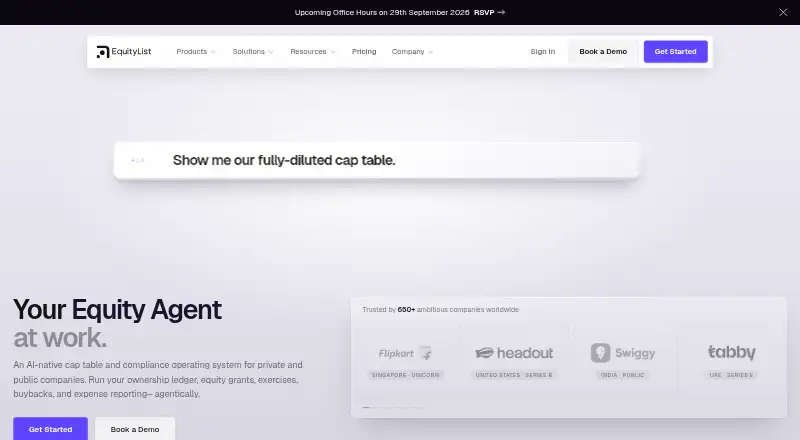
What EquityList is
EquityList is a cap table and compliance platform for private and public companies. It tracks ownership, grants, exercises, buybacks, and expense reporting. Cap tables record past transactions, model fundraising scenarios, and support multiple entities; equity awards include options, RSUs, and SARs with vesting and exercise management. HR integrations with BambooHR, Keka, Darwinbox, and GreytHR sync employee changes and payroll data. Its finance tools provide stock expense figures compliant with ASC 718, IFRS 2, and Ind AS 102. The company says data is encrypted at rest and in transit, access is controlled and logged, and its practices are certified against SOC 2 and ISO 27001 standards. The Free plan allows up to 10 stakeholders and includes 1,000 lifetime AI credits. Build and Growth have larger stakeholder allowances and bill for additional stakeholders. Free is available; Build annual billing is $100 a year. Listed-company pricing is a scope-based annual proposal.
Who it suits
EquityList says it builds for founders, lawyers, finance leads, and employees. Its products cover private and public companies.
What it does well
- Tracks ownership, grants, exercises, and buybacks
- Supports options, RSUs, and SARs
- HR integrations sync employee changes and payroll data
- Free plan includes up to 10 stakeholders
What to know first
- Free plan is capped at 10 stakeholders
- Additional stakeholders are billed on Build and Growth
- Listed-company pricing requires a scope-based proposal
Limits
Free is capped at 10 stakeholders and 1,000 AI credits for the lifetime of the plan. Build includes 35 stakeholders and Growth includes 50; both automatically bill additional stakeholders without a hard cutoff. The listed AI credit allocations are 5,000 per month for Build and 10,000 per month for Growth.
Plans
| Plan | Billed and limits | Price |
|---|---|---|
| Free | 10 stakeholders · 1,000 AI credits lifetime | Free |
| Build (annual billing) | $1,200 billed annually · 35 stakeholders included · +$35/stakeholder/yr after that · 5,000 AI credits/month | $1,200 a year |
| Build (monthly billing) | billed monthly · 35 stakeholders included · +$4/stakeholder/mo after that · 5,000 AI credits/month | $125 a month |
| Growth (monthly billing) | billed monthly · 50 stakeholders included · +$6/stakeholder/mo after that · 10,000 AI credits/month · 409A valuation not included | $265 a month |
| Growth (annual billing) | $3,500 billed annually · 50 stakeholders included · +$50/stakeholder/yr after that · 10,000 AI credits/month · 409A valuation included | $3,500 a year |
| Enterprise | Custom stakeholder count · Custom AI usage | On request |
| Public company pricing | Annual contract · Scope-based proposal · 3–5 weeks implementation · Priority support | On request |
As equitylist.co lists them, read 29 Sept 2026. The maker's own page has the final word.
Getting started
- Visit equitylist.co.
- Start with the Free plan or review Build and Growth billing options.
- Create a company cap table and record ownership or historical transactions.
- Add equity awards such as options, RSUs, or SARs and manage vesting and exercises.
- Connect a supported HRMS to sync employee changes and payroll data, if applicable.
EquityList is a web-based platform for managing company ownership, equity awards, and stock expense reporting. It is best suited to founders and finance or legal teams coordinating equity across employees and entities. Its broad coverage is a strong fit for growing companies, but stakeholder-based charges make the plan economics important to check.
Overview
EquityList combines cap table records, grants, exercises, buybacks, and expense reporting. Cap tables preserve historical transactions, model fundraising scenarios, and support multiple entities. That combination can help teams keep equity administration connected as ownership and company structures change, rather than handling each workflow separately.
The platform covers both private and public companies. Its stated audience includes founders, lawyers, finance leads, and employees, though the feature and plan mix is especially relevant to teams with recurring equity-administration and financial-reporting needs.
Key features
Equity awards and employee workflows
Grants support options, RSUs, and SARs, with vesting and exercise management for employees, advisors, and consultants. Advanced vesting support, an employee portal, tax reporting, and valuation support make EquityList more than a basic ownership ledger. HR integrations with BambooHR, Keka, Darwinbox, and GreytHR sync employee changes and payroll data, which is most useful for teams already working in one of those systems.
Finance, compliance, and access
The finance solution provides stock expense numbers compliant with ASC 718, IFRS 2, and Ind AS 102. EquityList also says it encrypts data at rest and in transit, controls and logs access, and has practices certified against SOC 2 and ISO 27001 standards. SAML-based single sign-on is supported, including setup with providers such as Azure Active Directory. These capabilities suit teams with formal reporting and access-control needs.
Pricing
The Free plan costs nothing and includes up to 10 stakeholders and 1,000 AI credits for the lifetime of the account. Email and Intercom support, community access, and bi-weekly office hours are included. It is a practical way to start, but the stakeholder ceiling is low for a company with a larger ownership group.
Build costs $100 a year with annual billing, billed $1,200 billed annually, or $125 a month with monthly billing, billed billed monthly. Both versions include 35 stakeholders and 5,000 AI credits/month. Additional stakeholders cost +$35/stakeholder/yr on annual billing or +$4/stakeholder/mo on monthly billing. The monthly option costs more at the listed rate, while annual billing commits the buyer to a year; either can work for teams that need more than Free’s 10 stakeholders.
Growth costs $265 a month with monthly billing, billed billed monthly, or $292 a year with annual billing, billed $3,500 billed annually. Both include 50 stakeholders and 10,000 AI credits/month. Additional stakeholders cost +$6/stakeholder/mo monthly or +$50/stakeholder/yr annually. The monthly plan excludes 409A valuation, while the annual plan includes it; that difference matters when comparing the headline prices. Growth also includes priority support and concierge onboarding, making it the stronger fit for teams needing more stakeholders and guided setup.
Build and Growth automatically bill additional stakeholders without a hard cutoff, so expanding a cap table raises the bill rather than blocking use at the included count. Enterprise has custom stakeholder and AI usage limits with custom pricing. Public-company pricing is an annual, scope-based proposal, with a 3–5 weeks implementation and priority support. That route is aimed at listed companies needing a tailored engagement rather than a fixed-price subscription.
Platforms
EquityList is available on the web.
Who it's for
EquityList is a good match for private-company founders and finance or legal teams that need ownership records, award administration, and stock expense reporting in one platform. Its multiple-entity support and named HR integrations are useful for teams managing more than a simple single-company cap table. Listed companies can consider its scope-based proposal, while very small teams may find the Free tier sufficient only if they remain within 10 stakeholders.
Pros and cons
- Pros: Cap tables, awards, buybacks, and expense reporting sit in one platform, including support for multiple entities and historical transactions.
- Pros: Compliance-oriented stock expense reporting and SAML SSO address needs beyond basic equity tracking.
- Pros: Free includes support channels and office hours, while Growth adds priority support and concierge onboarding.
- Cons: Free is limited to 10 stakeholders, and paid plans charge for additional stakeholders, so costs can rise as ownership expands.
- Cons: Growth’s 409A valuation inclusion differs by billing term: it is excluded from monthly billing and included with annual billing.
- Cons: EquityList is web-only, so teams seeking native mobile or desktop apps should compare alternatives.
Alternatives
Cake Equity is worth considering for teams wanting Android or iOS access alongside web, or a free cap table and stock options tier for up to 5 stakeholders that also includes SAFE notes.
Eqvista is another freemium choice, with a free cap table and ESOP management tier for fewer than 20 stakeholders that also includes vesting schedules, stakeholder accounts, and a data room.
Vquity may suit a small team looking for a free single-company plan for up to 10 stakeholders with all modules, or a monthly plan with unlimited stakeholders.
Fidelity Private Shares offers a free Launch plan for up to 25 stakeholders and includes cap table management, equity plan generation, and scenario modeling.
Ledgy offers a free Launch plan capped at 50 stakeholders, with a multi-entry cap table, equity plans and grants, and simple vesting.
Computershare BoardWorks is an alternative for teams seeking board software with all modules included and unlimited committees; additional users are charged.
Empower Health and Welfare Benefits Administration is a paid alternative.
Global Shares is a paid alternative with a custom enterprise offering.
For broader comparisons, see Equity Compensation Management Software and Cap Table Management Software.
Verdict
Choose EquityList if your team needs cap table management, equity awards, and standards-aligned stock expense reporting together, particularly across multiple entities. Its feature range and HR integrations are compelling for growing finance and legal operations. Look elsewhere if you need mobile apps or a predictable bill that does not increase with stakeholder count.
Verdict
EquityList covers cap tables, equity awards, and stock expense reporting, with a free tier and paid plans. Check the stakeholder limits and billing terms that apply to your plan.
Questions
Is EquityList free?
Yes. The Free plan costs nothing and includes 10 stakeholders and 1,000 AI credits for the lifetime of the plan.
What does EquityList cost?
The pricing note says paid plans start at $100/mo with annual billing. The plan list also shows Build and Growth monthly and annual options, while Enterprise and public-company pricing have no fixed listed price.
Which equity awards does it support?
The grants product supports options, RSUs, and SARs, with vesting and exercise management for employees, advisors, and consultants.
Which HR systems integrate with EquityList?
The HR solution names BambooHR, Keka, Darwinbox, and GreytHR integrations for syncing employee changes and payroll data.
Is EquityList available for public companies?
Yes. EquityList describes its operating system as serving private and public companies. Listed-company pricing is an annual, scope-based proposal.
How does EquityList describe its security practices?
The company says data is encrypted at rest and in transit, access is controlled and logged, and its practices are certified against SOC 2 and ISO 27001 standards.
Facts from EquityList's own pages
- Cap tables
- Its cap table product records historical transactions, models fundraising scenarios, and supports multiple entities. · equitylist.co, 29 Sept 2026
- Compliance
- The finance solution says it provides stock expense numbers compliant with ASC 718, IFRS 2, and Ind AS 102. · equitylist.co, 29 Sept 2026
- Equity awards
- The grants product supports options, RSUs, and SARs, with vesting and exercise management for employees, advisors, and consultants. · equitylist.co, 29 Sept 2026
- Equity management
- The platform tracks ownership, grants, exercises, buybacks, and expense reporting. · equitylist.co, 29 Sept 2026
- Founded
- 2023 · equitylist.co, 28 Sept 2026
- Headquarters
- Gurugram, Haryana, India · equitylist.co, 28 Sept 2026
- HRMS integrations
- The HR solution names BambooHR, Keka, Darwinbox, and GreytHR integrations for syncing employee changes and payroll data. · equitylist.co, 29 Sept 2026
- Intended users
- The company says it builds for founders, lawyers, finance leads, and employees, and its product pages cover private and public companies. · equitylist.co, 29 Sept 2026
- Listed-company pricing
- Listed-company pricing is presented as an annual, scope-based proposal rather than a fixed price list. · equitylist.co, 29 Sept 2026
- Plan limits
- Free is capped at 10 stakeholders; the pricing page says Build and Growth automatically bill additional stakeholders without a hard cutoff. · equitylist.co, 29 Sept 2026
- Product
- EquityList describes itself as an AI-native cap table and compliance operating system for private and public companies. · equitylist.co, 29 Sept 2026
- Security
- EquityList states that data is encrypted at rest and in transit, access is controlled and logged, and its practices are certified against SOC 2 and ISO 27001 standards. · equitylist.co, 29 Sept 2026
- SSO
- A product update describes SAML-based single sign-on, including setup with a provider such as Azure Active Directory. · equitylist.co, 29 Sept 2026
- Support
- The Free plan includes email and Intercom support, community access, and bi-weekly office hours; Growth includes priority support and concierge onboarding. · equitylist.co, 29 Sept 2026