Freedom251 › Retirement Planning Software

FI Calc
What FI Calc is
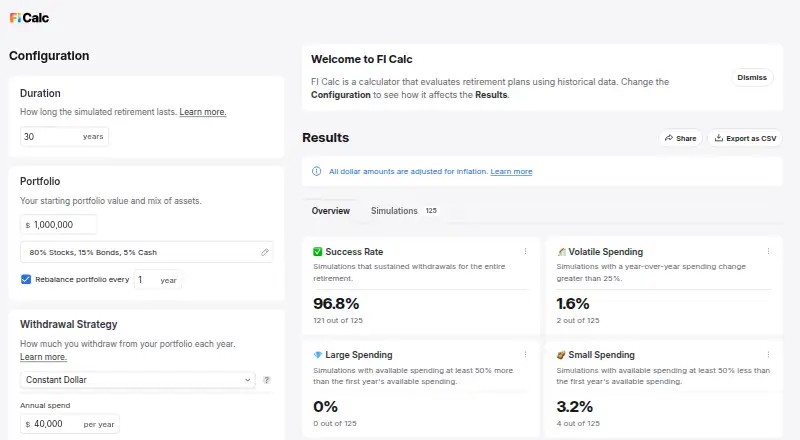
FI Calc is a free web calculator for evaluating retirement plans and withdrawal strategies against historical data. It runs simulations using annual figures from 1871 through 2024, compiled from Robert Shiller’s data set; past results do not guarantee future performance. Users can model equities, bonds, and cash, adjust rebalancing and allocations over time, and include income such as wages or Social Security. The calculator also supports extra withdrawals for future expenses. Its tools include income and savings-growth projections, withdrawal planning, Social Security modeling, and scenario analysis. Users can export all simulations or a single simulation as a CSV for spreadsheet analysis. Inputs are processed in the browser. Saved or shared calculations are encoded in URLs that may reach the hosting provider, site services, and link recipients. Google Analytics also receives usage information, including page URLs that may contain saved inputs. FI Calc does not automatically account for taxes or required minimum distributions and does not currently support Monte Carlo simulations. Its creator, James, says he started the project in 2018. The maker says it does not provide financial advice and recommends consulting a licensed financial professional before making financial decisions.
Who it suits
FI Calc suits people who want to explore retirement and withdrawal scenarios using historical data, including possible income and future expenses. It may be useful to people who want CSV exports for spreadsheet analysis and understand its tax and simulation limits.
What it does well
- Free web access to the calculator.
- Models equities, bonds, cash, and changing allocations.
- Includes wages or Social Security as income.
- Exports all simulations or a single simulation as CSV.
- Supports withdrawal planning and scenario analysis.
What to know first
- Does not automatically account for taxes or RMDs.
- Does not currently support Monte Carlo simulations.
- Saved calculations are encoded in URLs.
- Historical results do not guarantee future performance.
Limits
The free plan provides calculator access and is supported by donations. FI Calc does not automatically model taxes or required minimum distributions, and it does not support Monte Carlo simulations.
Plans
| Plan | Billed and limits | Price |
|---|---|---|
| Free | Calculator access · supported by donations | Free |
As ficalc.app lists them, read 4 Oct 2026. The maker's own page has the final word.
Getting started
- Open the FI Calc website in a web browser.
- Use the free calculator to enter retirement and portfolio assumptions.
- Add income or future expense withdrawals and adjust allocations or rebalancing.
- Run simulations and export an individual result or all results as CSV.
FI Calc is a free web calculator for examining retirement plans against a long record of actual market history. It is best suited to people comparing spending, income and portfolio choices who can work without built-in tax or probability modeling. The result is a useful exploratory tool, but not a complete financial-planning system.
Overview
FI Calc replays retirement strategies against annual data from 1871 through 2024, compiled from Robert Shiller’s data set. That historical perspective lets you see how a plan would have behaved through specific past market environments, which is valuable when testing withdrawal rules and allocation changes. It cannot establish what future returns will be, and the maker explicitly says historical results do not guarantee future performance.
James, the creator, says he began the project in 2018. FI Calc is not financial advice; anyone making consequential decisions should consult a licensed financial professional.
Key features
Portfolio and cash-flow scenarios
You can combine equities, bonds and cash, set rebalancing rules, and change allocations over time. The calculator also accepts additional future expenses and income, including wages and Social Security. Income projections, savings-growth projections, withdrawal planning and scenario analysis make it possible to compare a range of retirement paths instead of testing a single fixed withdrawal rate.
Export and analysis
All simulations or an individual simulation can be exported as a CSV file for analysis in the spreadsheet application you choose. That is a practical strength for readers who want to compare runs, retain a record, or add their own calculations outside the calculator.
Important omissions
Taxes and required minimum distributions are not automatically modeled, so the output can overstate spendable income for plans where those items drive cash flow. FI Calc also has no Monte Carlo simulation. Readers who need probability ranges or tax-aware projections will need another tool or their own spreadsheet work.
Privacy and sharing
Inputs are processed in the browser, but saved and shared calculations are encoded in URLs. Those URLs may reach the hosting provider, site services and anyone who receives a link. Google Analytics also receives usage information, including page URLs that may contain saved inputs. Avoid placing sensitive personal figures in shareable calculations unless you accept that exposure.
Pricing
| Plan | Price | Includes | Best for |
|---|---|---|---|
| Free | free | Calculator access; supported by donations | Anyone wanting unrestricted-cost exploratory retirement simulations |
There is no free trial because the product is already free, and no paid tier, seat charge, renewal term or usage quota is stated. The trade-off is capability rather than price: users accept the missing tax and Monte Carlo models and the browser-based sharing and analytics practices.
Platforms
FI Calc runs on the web. No desktop or mobile app platform is provided.
Who it's for
Choose FI Calc if you want to compare historical retirement outcomes while adjusting asset mixes, rebalancing, changing allocations, income and expenses, then move the results into a spreadsheet. It is especially appropriate for self-directed planners who understand that backtesting is illustrative rather than predictive.
Look elsewhere if taxes, required minimum distributions or Monte Carlo probabilities are central to your plan, or if URL-encoded saved inputs and analytics create an unacceptable privacy concern.
Pros and cons
Pros
- Long historical window: annual data from 1871–2024 provides many past market environments for strategy comparisons.
- Flexible scenarios: equities, bonds, cash, rebalancing, allocation changes, wages, Social Security and future expenses can be combined.
- Useful exports: CSV output for all or individual simulations supports deeper spreadsheet analysis.
- No subscription cost: the sole plan costs 0.00 USD and is supported by donations.
Cons
- No tax or RMD automation: after-tax spending plans require manual adjustments.
- No Monte Carlo: it cannot provide probability-based outcome ranges.
- Sharing privacy exposure: saved inputs travel in URLs and page URLs may be collected by Google Analytics.
- Historical limits: past-market results are not forecasts or guarantees.
Alternatives
Boldin is the stronger choice for a broader freemium planning workspace, with Android, iOS and web access, 100-plus inputs, interactive explorers, charts and limited Boldin AI questions on its free Basic plan.
Flexible Retirement Planner fits users seeking a free personal-use calculator across Linux, macOS, Windows and the web.
ProjectionLab is preferable when you want forecasting, flexible modeling, historical backtesting and Monte Carlo simulations, with Android, iOS and web support.
RetireePlan suits readers who want a free-forever, open-source tool available on desktop, web, API and self-hosted setups.
driftcurve is an option for self-hosting and local use without accounts in its default mode.
Fidelity Planning & Guidance Center provides a free web plan without a fee to generate a plan, though investment and transaction costs may still apply.
FIRECalc offers a free core retirement calculator, with supporter registration providing some additional features on request.
Retireator is a free, open-source retirement simulator for the web and Windows.
Browse more options in Retirement Planning Software.
Verdict
FI Calc is a strong pick for cost-conscious, self-directed planners who want adjustable historical backtesting and CSV exports. Choose it for transparent scenario exploration; choose another planner when tax treatment, required distributions, Monte Carlo probabilities or stricter control over saved-input privacy are essential.
Verdict
FI Calc offers historical-data retirement simulations with configurable assets, income, and withdrawals, plus CSV export. Its tax and Monte Carlo limits matter, and its URL-based sharing and analytics have privacy implications for saved inputs.
Questions
How much does FI Calc cost?
The Free plan costs nothing and provides calculator access, supported by donations.
What platforms can I use it on?
FI Calc is available on the web.
What historical data does it use?
It uses annual historical data from 1871 through 2024, compiled from Robert Shiller’s data set.
Can I export simulation results?
Yes. You can export all simulations or an individual simulation as a CSV file for spreadsheet analysis.
Does FI Calc model taxes or required minimum distributions?
It does not automatically account for taxes or required minimum distributions.
Who created FI Calc?
Its FAQ identifies the creator as James and says he started the project in 2018.
Facts from FI Calc's own pages
- Analytics
- FI Calc uses Google Analytics, which receives usage information including page URLs that may contain saved calculation inputs. · ficalc.app, 4 Oct 2026
- Backtesting
- It runs retirement simulations using historical data, and the maker says results do not guarantee future performance. · ficalc.app, 4 Oct 2026
- Creator and history
- The FAQ identifies the creator as James and says he started the project in 2018. · ficalc.app, 4 Oct 2026
- Financial advice
- FI Calc says it does not provide financial advice and advises consulting a licensed financial professional before making financial decisions. · ficalc.app, 4 Oct 2026
- Historical data
- The calculator uses annual historical data from 1871 through 2024, compiled from Robert Shiller’s data set. · ficalc.app, 4 Oct 2026
- Income and withdrawals
- The calculator supports additional withdrawals for future expenses and income such as wages or Social Security. · ficalc.app, 4 Oct 2026
- Integrations
- The maker describes CSV export for further analysis in a spreadsheet application of the user's choice. · ficalc.app, 4 Oct 2026
- Portfolio assets
- Users can model equities, bonds, and cash, and configure rebalancing and changing allocations over time. · ficalc.app, 4 Oct 2026
- Privacy
- Calculator inputs are processed in the browser, and saved or shared calculations are encoded in URLs that may be received by the hosting provider, site services, and link recipients. · ficalc.app, 4 Oct 2026
- Purpose
- FI Calc uses historical data to evaluate retirement plans and withdrawal strategies. · ficalc.app, 4 Oct 2026
- Results export
- Users can export all simulations or an individual simulation as a CSV file. · ficalc.app, 4 Oct 2026
- Simulation limits
- FI Calc does not currently support Monte Carlo simulations. · ficalc.app, 4 Oct 2026
- Support
- The maker invites users to contact them by email at [email protected] or on X at @ficalc. · ficalc.app, 4 Oct 2026
- Tax and RMD limits
- FI Calc does not automatically account for taxes or required minimum distributions. · ficalc.app, 4 Oct 2026
Where FI Calc stands on Freedom251
- Retirement Planning Software#6 of 26