Freedom251 › Retirement Planning Software
driftcurve
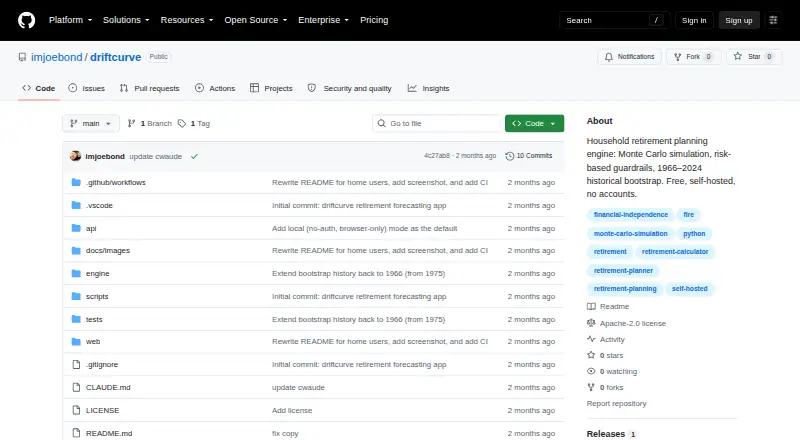
What driftcurve is
driftcurve is a free, open-source household retirement planning engine for modeling finances and exploring possible outcomes. It can represent multiple household members, account types, debts, mortgages, pensions, Social Security, and property sales. Its default Monte Carlo simulations resample annual market data from 1966–2024 across equities, Treasuries, residential real estate, inflation, and Bitcoin. Users can shift historical returns toward their own long-run targets or set fixed annual assumptions. Risk-based spending guardrails solve for monthly spending and suggest changes based on portfolio thresholds and probability of success; a Compare page shows two scenarios on one chart. Projections include income and savings growth, withdrawals, basic tax modeling, and Social Security, but account synchronization is not available. In local mode, data and saved scenarios stay in browser localStorage, while forecasts run through a Python backend. An optional multi-user mode provides accounts and stores profiles and scenarios server-side. The project is under Apache License 2.0 and describes itself as an educational modeling tool, not a licensed financial, investment, tax, or legal adviser.
Who it suits
It suits households exploring retirement or financial-independence scenarios, including people who want to model multiple household members and compare plans. It is an educational modeling tool, not professional financial, tax, investment, or legal advice.
What it does well
- Models multiple household members and financial account types.
- Includes risk-based monthly spending guardrails.
- Compares two scenarios on one chart.
- Free, open source, and licensed under Apache 2.0.
What to know first
- No account synchronization is available.
- Guardrails require a retirement year and positive liquid portfolio.
- Guardrail computations take about 20–45 seconds.
- Local setup requires Python and running the app.
Limits
The free plan is self-hosted, has no subscription, and uses no accounts in default local mode. Guardrail calculations require a retirement year and positive liquid portfolio; the README says a computation takes about 20–45 seconds.
Plans
| Plan | Billed and limits | Price |
|---|---|---|
| Free | self-hosted · no subscription · no account in local mode | Free |
As github.com lists them, read 15 Oct 2026. The maker's own page has the final word.
Getting started
- Open the project website on GitHub.
- Create a Python virtual environment.
- Install the requirements.
- Run the app with Uvicorn.
- Open the app at localhost:8000.
Overview
driftcurve is a free, open-source retirement modeling tool for households and people planning financial independence. It is best for users who want to model a household’s finances and compare assumptions, and are comfortable running a locally hosted app. Its breadth is a strength; basic tax modeling and setup requirements narrow its role.
Key features
Rather than treating retirement as a single portfolio, driftcurve supports multiple household members, account types, debts, mortgages, pensions, Social Security, and property sales. It also projects income, savings growth, and withdrawals. That makes it relevant when a plan depends on several people and types of assets or obligations; basic tax modeling is a meaningful limit for anyone who needs detailed tax planning. Account synchronization is not included, so users should expect to manage inputs themselves.
Default Monte Carlo simulations resample annual market data from 1966–2024, spanning equities, Treasuries, residential real estate, inflation, and Bitcoin. Users can recenter historical returns to their own long-run targets or set static annual assumptions. These options let a planner examine outcomes under different assumptions, but they do not make forecasts promises about future performance.
Risk-based spending guardrails solve for monthly spending and tie adjustments to portfolio thresholds and probability of success. This can help users explore withdrawal decisions with explicit conditions. The guardrails require a retirement year and a positive liquid portfolio, and a computation takes about 20–45 seconds, which can make repeated scenario adjustments less immediate.
A Compare page puts two scenarios on one chart, a useful way to inspect the effect of changing assumptions. In default local mode, household data and saved scenarios remain in browser localStorage, with no account or server-side database persistence; forecasts still run through the Python backend. Optional multi-user mode adds email/password accounts, server-side sessions, and profiles and scenarios stored in driftcurve.db. The documented API covers forecasts and guardrails, with authentication, profile, and scenario endpoints for multi-user mode. This flexibility favors technically comfortable users over people seeking a fully managed, account-based service.
Pricing
The Free plan costs nothing, with no subscription. It is self-hosted and has no accounts in default local mode. It includes income projection, savings growth projection, withdrawal planning, basic tax modeling, Social Security modeling, and scenario analysis. There is no free trial because the plan is free, and no seat or usage quota is stated. Its main trade-off is operational: setup involves creating a Python virtual environment, installing requirements, running the app with Uvicorn, and opening it at localhost:8000. The project is open source under the Apache License 2.0.
driftcurve is a modeling and educational tool, not a licensed financial, investment, tax, or legal advisor. Its outputs should not be treated as professional advice.
Platforms
driftcurve is available as a web app, API, and self-hosted software. The quick start runs the app locally at localhost:8000, so the self-hosted route suits users willing to handle a Python setup; it is less suited to anyone who expects a ready-to-use hosted service.
Who it's for
Choose driftcurve if you want to model several household members, debts, property, pensions, and retirement income together, and value control over return assumptions and scenario comparisons. It is particularly relevant to financial-independence planning. Look elsewhere if you need detailed tax modeling, account synchronization, or professional financial advice, or do not want to set up software locally.
Pros and cons
- Pro: Household inputs span people, assets, debts, and property, giving multi-part retirement scenarios more context than a portfolio-only view.
- Pro: Historical resampling, return recentering, and static assumptions provide distinct ways to examine market assumptions.
- Pro: Local storage keeps saved household data and scenarios in the browser in default mode, without account or server-side database persistence.
- Con: Basic tax modeling and no account synchronization leave users to handle important tax detail and keep inputs current.
- Con: Local Python setup and 20–45-second computations add friction, while guardrails also require a retirement year and positive liquid portfolio.
Alternatives
Boldin is worth considering if you prefer Android, iOS, or web access and want a free Basic plan with 100+ inputs, two interactive explorers, 10+ charts, and up to five Boldin AI questions per day; it also offers a free trial.
Flexible Retirement Planner is a free option for personal non-commercial use across Linux, macOS, web, and Windows, and may suit users who want broader desktop platform coverage.
ProjectionLab offers a free Basic plan with forecasting, financial planning, Monte Carlo simulations, historical backtesting, and flexible modeling, plus a free trial. Pick it if those named planning tools or Android and iOS access are a better fit.
RetireePlan is another free, open-source option, with API, self-hosted, web, and desktop platforms.
FI Calc is a free web calculator supported by donations; consider it for calculator access rather than driftcurve’s household modeling and self-hosted setup.
Fidelity Planning & Guidance Center is a free web plan generator, though investment expenses and account transaction fees may still apply.
FIRECalc provides a free core retirement calculator, with some additional features available on request through supporter registration.
Retireator is a free, open-source retirement simulator for web and Windows.
For a wider shortlist, see Retirement Planning Software. Database Schema Comparison Tools covers a separate software category.
Verdict
driftcurve is a strong fit for technically comfortable households and financial-independence planners who want a free, open-source way to model varied household finances and test retirement scenarios. Its main reasons to choose it are broad inputs, flexible return assumptions, and local data storage. Choose another tool if you need deeper tax support, synchronized accounts, or a simpler setup.
Verdict
driftcurve brings broad household inputs, return assumptions, and scenario comparison into a free retirement modeling tool. Keep in mind its guardrail requirements and that its forecasts are educational, not professional advice.
Questions
How much does driftcurve cost?
The Free plan costs nothing. It has no subscription and is self-hosted.
Is driftcurve open source?
Yes. The project is licensed under Apache License 2.0.
What platforms does it support?
Its listed platforms are API, self-hosted, and web.
Does driftcurve sync financial accounts?
No account synchronization is provided.
How is household data handled?
In default local mode, household data and saved scenarios stay in browser localStorage, with no account or server-side database persistence. Optional multi-user mode stores profiles and scenarios in driftcurve.db.
Does driftcurve provide financial advice?
Its maker describes it as a modeling and educational tool, not a licensed financial, investment, tax, or legal advisor.
Facts from driftcurve's own pages
- Account coverage
- Inputs include traditional, Roth, taxable, cash, real-estate and cryptocurrency assets. · github.com, 15 Oct 2026
- Apache permissions
- Apache 2.0 grants perpetual, worldwide, royalty-free rights to reproduce, modify, display, perform, sublicense and distribute the work subject to its conditions. · apache.org, 15 Oct 2026
- API
- The documented API includes forecast and guardrails endpoints, plus authentication, profile, and scenario endpoints for multi-user mode. · github.com, 7 Oct 2026
- Authentication security
- The multi-user implementation hashes passwords with PBKDF2-SHA256 and uses server-side session cookies. · github.com, 15 Oct 2026
- Calculation limit
- Guardrails require a retirement year and positive liquid portfolio, and the README says a computation takes about 20–45 seconds. · github.com, 7 Oct 2026
- Debt and income inputs
- The scenario model includes mortgages, HELOCs, student loans, pensions, Social Security and property sales. · github.com, 15 Oct 2026
- Dependencies
- The project declares FastAPI, Uvicorn, aiofiles and SQLAlchemy as runtime dependencies. · github.com, 15 Oct 2026
- Developer API
- The repository documents /config, /forecast, /guardrails, authentication, profile and scenario endpoints. · github.com, 15 Oct 2026
- Forecast caveat
- The maker says forecasts are projections based on historical data and user assumptions, not predictions, guarantees or professional financial advice. · github.com, 15 Oct 2026
- Guardrail API
- POST /guardrails accepts the same scenario body as /forecast and returns spending, thresholds, achieved probabilities and configuration. · github.com, 15 Oct 2026
- Guardrail defaults
- The documented defaults target 0.80 probability of success, with upper and lower trigger probabilities of 0.99 and 0.25. · github.com, 15 Oct 2026
- Guardrail limitation
- Guardrail calculations require a retirement year and a positive liquid portfolio. · github.com, 15 Oct 2026
- Guardrail speed
- The README estimates a guardrail computation at roughly 20–45 seconds. · github.com, 15 Oct 2026
- Hosted mode
- An optional multi-user mode supports email/password accounts, server-side sessions, and profiles and scenarios stored in driftcurve.db. · github.com, 7 Oct 2026
- Household modeling
- The model supports multiple people with separate retirement dates and savings rates. · github.com, 15 Oct 2026
- Installation
- The quick start creates a Python virtual environment, installs requirements and runs Uvicorn on localhost:8000. · github.com, 15 Oct 2026
- Intended use
- The README presents driftcurve for household retirement planning, including financial-independence planning scenarios. · github.com, 7 Oct 2026
- Licence
- The project is released under the Apache License 2.0. · github.com, 15 Oct 2026
- License
- The project is open source under the Apache License 2.0. · github.com, 7 Oct 2026
- Limit: no guarantee
- The licence and README disclaim warranties and liability, and the maker warns that outputs can be materially wrong. · github.com, 15 Oct 2026
- Limit: optimistic history
- The README characterizes the 1966–2024 period as still optimistic, with a median 90%-equity/10%-bond blended CAGR of about 10.2% annually. · github.com, 15 Oct 2026
- Local privacy
- In default local mode, household information and saved scenarios remain in browser localStorage and are not written to a database. · github.com, 15 Oct 2026
- Market series
- The historical simulation covers S&P 500, 10-year Treasuries, residential real estate, CPI and Bitcoin returns. · github.com, 15 Oct 2026
- Method context: cash flows
- Kitces explains that Social Security, pensions, rental income, part-time work and property changes can materially alter portfolio withdrawals. · kitces.com, 15 Oct 2026
Where driftcurve stands on Freedom251
- Retirement Planning Software#1 of 26
- Database Schema Comparison Tools#1 of 25