Freedom251 › Text-to-Speech Software
Festival Speech Synthesis System
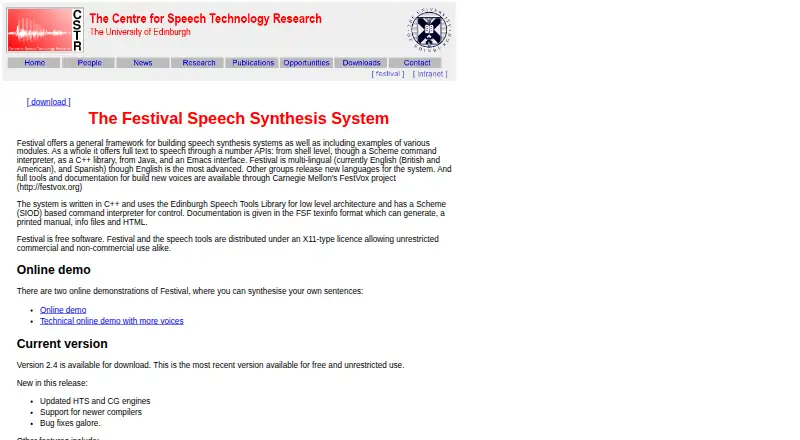
What Festival Speech Synthesis System is
Festival Speech Synthesis System is a framework for building speech synthesis systems and provides full text-to-speech functionality. It can be used through shell commands, a Scheme interpreter, C++ library, Java, and Emacs. Listed languages are British and American English, Spanish, and Welsh, with English described as the most advanced. Waveform options include Multisyn, HTS, Clustergen, Clunits, diphone synthesis, and MBROLA database support. Language modules can be configured for phonesets, lexicons, letter-to-sound rules, tokenizing, part-of-speech tagging, intonation, and duration. Festival lists SABLE markup, client/server operation, and scripting interfaces. The free distribution includes C++ source, a SIOD interpreter, Scheme library, Edinburgh Speech Tools, and documentation. It runs on Linux, macOS, Windows, API, and self-hosted setups. Running it requires a C++ compiler and GNU Make. Its X11-type license allows commercial and non-commercial use, but some voices and the OALD UK lexicon have separate restrictions.
Who it suits
Festival suits developers building or customizing speech systems who need source code, configurable language modules, and multiple interfaces. Review individual voice and lexicon licenses before commercial deployment.
What it does well
- Full text-to-speech framework
- Multiple synthesis engines
- Configurable language modules
- Source code included
- Commercial use generally allowed
What to know first
- English is the most advanced language
- Requires C++ compiler and GNU Make
- Some voices have license restrictions
- OALD UK lexicon is non-commercial
Plans
| Plan | Billed and limits | Price |
|---|---|---|
| Festival 2.4 | Free software; voice and lexicon licenses may have restrictions | Free |
As cstr.ed.ac.uk lists them, read 12 Oct 2026. The maker's own page has the final word.
Verdict
Festival provides an extensible speech framework with many interfaces, synthesis choices, and configuration controls. Its build requirements and voice-specific licensing mean implementation details need review before deployment.
Facts from Festival Speech Synthesis System's own pages
- API access
- Yes · cstr.ed.ac.uk, 20 Sept 2026
- Build requirements
- Running Festival requires a C++ compiler and GNU Make. · cstr.ed.ac.uk, 12 Oct 2026
- Commercial use
- Yes · cstr.ed.ac.uk, 20 Sept 2026
- Configuration
- Language modules can be configured for phonesets, lexicons, letter-to-sound rules, tokenizing, part-of-speech tagging, intonation, and duration. · cstr.ed.ac.uk, 12 Oct 2026
- Free plan
- Yes · cstr.ed.ac.uk, 20 Sept 2026
- Headquarters
- Edinburgh, Scotland, United Kingdom · cstr.ed.ac.uk, 28 Sept 2026
- Interfaces
- It provides interfaces through shell commands, a Scheme interpreter, C++ library, Java, and Emacs. · cstr.ed.ac.uk, 12 Oct 2026
- Languages
- The site lists British and American English, Spanish, and Welsh text-to-speech, and says English is the most advanced. · cstr.ed.ac.uk, 12 Oct 2026
- License
- Festival and the speech tools use an X11-type license that allows commercial and non-commercial use. · cstr.ed.ac.uk, 12 Oct 2026
- Maintainer context
- The Centre for Speech Technology Research is an interdisciplinary University of Edinburgh research centre founded in 1984. · cstr.ed.ac.uk, 12 Oct 2026
- Markup and integration
- The system lists SABLE markup, Emacs, client/server, and scripting interfaces. · cstr.ed.ac.uk, 12 Oct 2026
- Platforms
- The download page requires a Unix-like environment and gives Linux, FreeBSD, OSX, and Cygwin under Windows as examples. · cstr.ed.ac.uk, 12 Oct 2026
- Purpose
- Festival is a framework for building speech synthesis systems and provides full text-to-speech functionality. · cstr.ed.ac.uk, 12 Oct 2026
- Source distribution
- The distribution includes full C++ source, a SIOD interpreter, Scheme library, Edinburgh Speech Tools, and documentation. · cstr.ed.ac.uk, 12 Oct 2026
- Support
- The project page links to Festival related mailing lists hosted by FestVox. · cstr.ed.ac.uk, 12 Oct 2026
- Voice building
- The project points to Carnegie Mellon’s FestVox project for tools and documentation to build new voices. · cstr.ed.ac.uk, 12 Oct 2026
- Voice engines
- Included waveform synthesis options include Multisyn, HTS, Clustergen, Clunits, diphone-based synthesis, and MBROLA database support. · cstr.ed.ac.uk, 12 Oct 2026
- Voice restrictions
- The download page notes that some voices have license restrictions and that the OALD UK lexicon is restricted to non-commercial use. · cstr.ed.ac.uk, 12 Oct 2026
Where Festival Speech Synthesis System stands on Freedom251
- Text-to-Speech Software#19 of 223
- Text-to-speech tools#83 of 232