Freedom251 › Physics Simulation Software
FDTDX
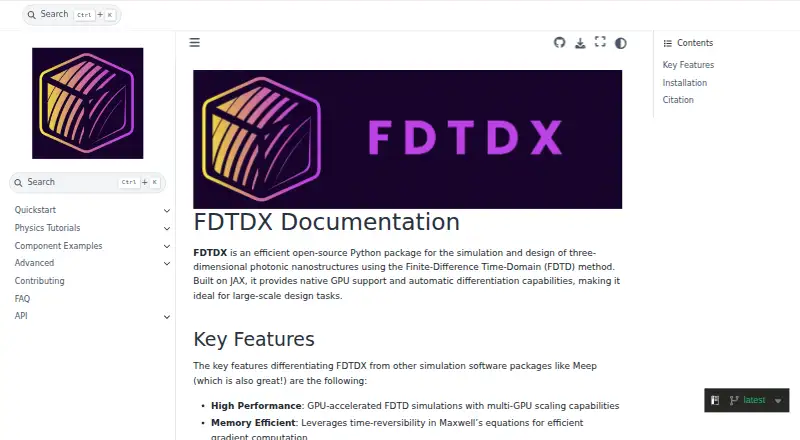
What FDTDX is
FDTDX is a free, open-source Python package for simulating and designing three-dimensional photonic nanostructures with the finite-difference time-domain method. Built on JAX, it provides automatic differentiation and gradient-based optimization, with GPU-accelerated simulations and multi-GPU scaling capabilities. The project says it can handle simulations with billions of grid cells and uses time-reversibility in Maxwell’s equations to reduce the cost of gradient computation. Its API supports positioning and sizing objects with absolute or relative coordinates, and includes functions for importing GDS polygons and working with GDS layer stacks and ports. The MIT-licensed package is available for research, development, and commercial use. Installation is documented with `pip install fdtdx`; JAX GPU acceleration packages are recommended for NVIDIA GPUs, AMD GPUs, and TPUs. Documentation includes interactive Jupyter quickstarts, physics tutorials, component examples, best-practice guidance, and an API reference. Community support is available through GitHub issues and discussions. The FAQ describes FDTDX as relatively new and notes that bugs may occur despite testing. Listed platforms are Linux and self-hosted.
Who it suits
FDTDX suits researchers and developers working on photonic nanostructure simulation or design, including commercial work. Its documented platform information lists Linux and self-hosted use.
What it does well
- Free for research, development, and commercial use.
- Supports automatic differentiation and gradient-based optimization.
- Offers GPU acceleration and multi-GPU scaling.
- API includes GDS polygon and layer-stack functions.
- Documentation includes Jupyter quickstarts and physics tutorials.
What to know first
- The FAQ notes that bugs may occur.
- Listed platforms are Linux and self-hosted.
- The project describes itself as relatively new.
Limits
The listed FDTDX plan is free and open source for research, development, and commercial use. Its FAQ says bugs may occur despite testing because the project is relatively new.
Plans
| Plan | Billed and limits | Price |
|---|---|---|
| FDTDX | Open source · freely available for research, development, and commercial use | Free |
As fdtdx.readthedocs.io lists them, read 4 Oct 2026. The maker's own page has the final word.
Getting started
- Use a Linux environment for a self-hosted installation.
- Install the package with `pip install fdtdx`.
- For GPU acceleration, use the recommended JAX package option for NVIDIA GPUs, AMD GPUs, or TPUs.
- Start with an interactive Jupyter quickstart, physics tutorial, or component example.
- Consult the API reference and best-practice documentation as needed.
- Use GitHub issues or discussions for community support.
Verdict
FDTDX provides a JAX-based workflow for photonic nanostructure simulation and optimization, with GPU support and GDS-related API functions. Its FAQ warns that the relatively new project may still have bugs.
Questions
How much does FDTDX cost?
The FDTDX plan costs nothing.
Is FDTDX open source?
Yes. It is available under the MIT license for research, development, and commercial use.
Which platforms are listed?
Linux and self-hosted.
Does it support GPU acceleration?
The project describes GPU-accelerated simulations with multi-GPU scaling. It recommends JAX GPU acceleration packages for NVIDIA GPUs, AMD GPUs, and TPUs.
How do I install FDTDX?
The documented installation command is `pip install fdtdx`.
Where can users get support?
Community support is available through GitHub issues and discussions.
Facts from FDTDX's own pages
- Accelerators
- The project recommends JAX GPU acceleration packages for NVIDIA GPUs, AMD GPUs, and TPUs. · github.com, 3 Oct 2026
- API
- Objects can be positioned and sized using absolute or relative coordinates. · fdtdx.readthedocs.io, 4 Oct 2026
- Assessment tools
- No · fdtdx.readthedocs.io, 23 Sept 2026
- Audience
- The project presents FDTDX for research, development, and commercial use in photonic nanostructure simulation and design. · fdtdx.readthedocs.io, 3 Oct 2026
- Authoring tools
- Yes · fdtdx.readthedocs.io, 23 Sept 2026
- Data export
- Yes · fdtdx.readthedocs.io, 23 Sept 2026
- Delivery mode
- desktop · fdtdx.readthedocs.io, 23 Sept 2026
- Documentation
- The project provides an API reference, tutorial guides, and best-practice documentation. · github.com, 3 Oct 2026
- Free plan
- Yes · fdtdx.readthedocs.io, 23 Sept 2026
- GPU integrations
- The project README lists JAX installation options for NVIDIA GPUs, AMD GPUs, and TPUs. · github.com, 4 Oct 2026
- GPU support
- The project describes GPU-accelerated simulations with multi-GPU scaling capabilities. · fdtdx.readthedocs.io, 3 Oct 2026
- Guides
- Documentation includes interactive Jupyter quickstarts, physics tutorials, component examples, and an API reference. · fdtdx.readthedocs.io, 4 Oct 2026
- Installation
- The maker provides a pip installation command and an editable installation path for development. · fdtdx.readthedocs.io, 4 Oct 2026
- Integrations
- The API includes functions for importing GDS polygons and working with GDS layer stacks and ports. · fdtdx.readthedocs.io, 3 Oct 2026
- Intended users
- The project describes FDTDX as freely usable for research, development, and commercial work involving photonic nanostructures. · fdtdx.readthedocs.io, 4 Oct 2026
- JAX
- FDTDX is built on JAX and provides automatic differentiation for gradient-based optimization. · fdtdx.readthedocs.io, 3 Oct 2026
- JAX foundation
- FDTDX is built on JAX and provides automatic differentiation and native GPU support. · fdtdx.readthedocs.io, 4 Oct 2026
- Lesson library
- No · fdtdx.readthedocs.io, 23 Sept 2026
- License and cost
- FDTDX is freely available for research, development, and commercial use under the MIT license. · github.com, 3 Oct 2026
- License and use
- The project says it is freely available for research, development, and commercial use; its GitHub repository lists an MIT license. · github.com, 4 Oct 2026
- Limitations
- The FAQ describes FDTDX as relatively new and says bugs may occur despite testing. · fdtdx.readthedocs.io, 4 Oct 2026
- Memory
- FDTDX uses time-reversibility in Maxwell’s equations for memory-efficient gradient computation. · fdtdx.readthedocs.io, 4 Oct 2026
- Optimization
- It provides built-in gradient-based optimization for complex 3D structures. · fdtdx.readthedocs.io, 4 Oct 2026
- Performance
- The project describes GPU-accelerated simulations with multi-GPU scaling capabilities. · fdtdx.readthedocs.io, 4 Oct 2026
Where FDTDX stands on Freedom251
- Physics Simulation Software#21 of 89