Freedom251 › Legal Case Analytics Software

Ex Parte
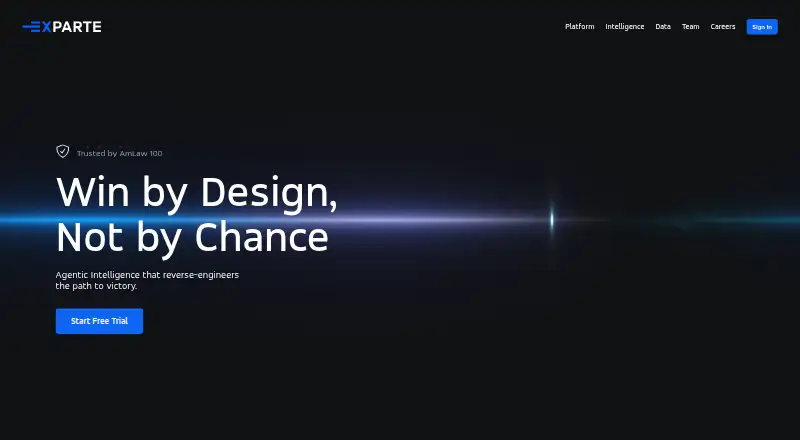
What Ex Parte is
Ex Parte is a web-based litigation intelligence platform that identifies vulnerabilities affecting legal cases. It provides a secure, permissioned workspace for each matter, with reports that connect findings to source pages, lines and citations. Its specialized agents examine examiner search logs, prosecution history amendments, and gaps between complaint allegations and patent specifications. The company says a quality-review agent checks each finding against primary sources before delivery. The platform draws on patent, court, scientific and business records, including USPTO file wrappers, PTAB proceedings, PACER filings, court opinions and dockets, IEEE Xplore, ACM Digital Library, PubMed and SEC EDGAR. Ex Parte describes a graph containing more than 2 billion entities and another mapping more than 2 billion relationships among patents, parties, counsel, judges and outcomes. A free trial does not require a credit card. Trial use is for internal evaluation, may be rate-limited or suspended, and has no service levels or support. Trial users must avoid sensitive or regulated data, and generated outputs may contain errors, are not legal advice and need independent verification.
Who it suits
Ex Parte identifies law firms, corporate counsel, litigation finance, hedge funds, insurers and universities as audiences for its intelligence. Its trial is for internal evaluation, not a supported service for sensitive or regulated data.
What it does well
- Matter workspaces link findings to source locations
- Agents analyze patent prosecution and case materials
- Findings receive primary-source QA checks
- Free trial requires no credit card
- Privacy policy describes encryption in transit
What to know first
- Trial may be suspended or rate-limited
- Trial includes no service levels or support
- Trial users must not submit sensitive data
- Outputs may contain errors and require verification
Limits
The free trial is for internal evaluation and may be rate-limited or suspended. Trial terms provide no service levels or support, prohibit sensitive or regulated data, and say outputs may contain errors and must be independently verified.
Getting started
- Visit https://www.exparte.com/.
- Request a free trial without a credit card.
- Use a verified law firm or corporate domain for immediate trial approval.
- Set up a secure, permissioned workspace for a matter.
- Use trial services for internal evaluation and independently verify generated outputs.
Ex Parte is an agentic litigation-intelligence platform for finding vulnerabilities in federal cases. It suits law firms, corporate counsel, litigation-finance teams, investors, insurers, and universities handling matters where legal, technical, and financial records intersect. Its source-linked forensic work is promising for disciplined review, but trial restrictions and the need to verify every probabilistic output make it unsuitable for unsupervised legal decisions.
Overview
Each matter receives a secure, permissioned workspace. Reports tie findings to source pages, lines, and citations, so a reviewer can move from an analytical conclusion back to the underlying record. That audit trail is a practical strength when several lawyers or analysts must challenge and validate the same issue.
Ex Parte draws from USPTO file wrappers, PTAB proceedings, PACER filings, court opinions and dockets, IEEE Xplore, ACM Digital Library, PubMed, and SEC EDGAR. The company describes an entity graph containing more than 2 billion entities and a knowledge graph mapping more than 2 billion relationships among patents, parties, counsel, judges, and outcomes. This breadth is relevant to matters spanning patents, litigation history, science, and corporate information, although scale alone does not prove that an individual conclusion is correct.
Key features
Forensic case analysis
Domain-specific agents review examiner search logs, prosecution-history amendments, and mismatches between complaint allegations and patent specifications. Those checks target weaknesses that can be missed in a general document search, making the platform particularly relevant to patent disputes and cases requiring technical scrutiny.
Quality review and traceability
A dedicated quality-assurance agent is intended to check each finding against primary sources before delivery. Source-page, line, and citation links then give counsel a concrete verification path. The process supports review; it does not remove the need for a qualified person to confirm the interpretation.
Analytics and graph context
Judge, outcome, attorney, party, and case-trend analytics add comparative context to matter work. The mapped relationships among legal actors and outcomes can help teams frame questions for diligence, litigation strategy, or financing, rather than relying only on the documents in one docket.
Pricing
Ex Parte uses paid, custom pricing. Enterprise subscriptions are governed by a separately negotiated Master Services Agreement, so buyers should expect commercial, service, and usage terms to be settled during procurement rather than selected from a public tier.
Free trial
The trial requires no credit card, and verified law-firm and corporate domains receive immediate approval. It is for internal evaluation, can be rate-limited or suspended, and includes no service levels or support. Trial users must not submit sensitive or regulated data; no data-processing addendum or security warranty applies. Customer input may be permanently deleted after the trial period. Generated outputs are probabilistic, may contain errors, are not legal advice, and must be independently verified. These conditions make the trial useful for controlled demonstrations and workflow assessment, not live matters containing protected information.
Platforms
Ex Parte is delivered through the web. The maker, Ex Parte, Inc., is based in Bethesda, Maryland, and the product covers federal jurisdiction.
Who it's for
Law firms and corporate legal departments are the clearest fit when a matter needs permissioned collaboration and citation-level checking. Litigation-finance groups, hedge funds, insurers, and universities may value the judge, outcome, party, and trend analytics for diligence and portfolio decisions. Teams seeking a hands-off answer, guaranteed support during evaluation, or permission to upload regulated data should look elsewhere.
Pros and cons
- Pros: Matter-specific permissioned workspaces separate projects and access.
- Pros: Findings link to pages, lines, and citations, enabling direct source review.
- Pros: Specialized checks cover prosecution history, examiner searches, and patent-specification discrepancies.
- Pros: The corpus spans court, patent, scientific, technical, and corporate sources, with judge and outcome analytics.
- Cons: Pricing is custom, so budget comparison requires a sales process.
- Cons: Trial use may be suspended or rate-limited and has no service levels or support.
- Cons: Trial restrictions prohibit sensitive or regulated data and provide no security warranty or data-processing addendum.
- Cons: Outputs can be wrong and require independent verification before they influence legal work.
Alternatives
For a broader starting point, browse Legal Case Analytics Software.
Choose Docket Alarm instead if a freemium service with web and API access matters: its free plan allows five weekly actions, while pay-as-you-go pricing is 39.99 USD.
LegalLink is the better choice for Australian case access, with a 219.90 AUD annual Standard plan that includes monthly AI consultations and case summaries.
Pick UpLaw when a public legal corpus and a free research account are the priority; its Economy plan costs $43.19 a month.
Cubictree Litigation Data Analytics is an alternative paid product available on web, mobile, API, and self-hosted deployments.
CLARA Litigation is another paid option with web and API access.
Premonition is a paid alternative offered through web and API platforms.
CaseParity fits readers seeking freemium, one-time consumer public-record reports, including misdemeanor and felony options.
Fortuna Legal is a paid web-based alternative.
Verdict
Choose Ex Parte if your team needs citation-traceable vulnerability analysis across complex federal matters and can provide expert verification. Its focused agents and broad cross-domain graph are the main reasons to consider it. Look elsewhere if you need transparent self-serve pricing, supported trial operations, permission to use sensitive data during evaluation, or outputs that can be accepted without independent checking.
Verdict
Ex Parte brings together case-related records and analysis in matter workspaces with cited findings. Its free trial has substantial use and data restrictions, and its outputs need independent checking; enterprise subscriptions use separately negotiated terms.
Questions
Does Ex Parte have a free plan?
A free trial is available without a credit card. The listed pricing model is paid, with pricing on request.
How much does Ex Parte cost?
Pricing is on request. Paid enterprise subscriptions are governed by a separately negotiated Master Services Agreement.
Which platforms are supported?
Ex Parte is listed for web.
Who makes Ex Parte?
The maker is Ex Parte, Inc., based in Bethesda, Maryland, USA.
What data sources does it use?
Listed sources include USPTO file wrappers, PTAB proceedings, PACER filings, court opinions and dockets, IEEE Xplore, ACM Digital Library, PubMed, and SEC EDGAR.
What are the trial restrictions?
Trial use is for internal evaluation and may be rate-limited or suspended. It has no service levels or support, and users must not submit sensitive or regulated data.
Facts from Ex Parte's own pages
- Company and location
- The site identifies the maker as Ex Parte, Inc. and lists its address as 7315 Wisconsin Avenue, Suite 400W, Bethesda, Maryland 20814, USA. · exparte.com, 5 Oct 2026
- Data sources
- The company says its continuously enriched graph integrates USPTO, PTAB, PACER, court and ITC records, IEEE Xplore, ACM Digital Library, PubMed, SEC EDGAR, standards bodies, conference proceedings, and historical web archives. · exparte.com, 5 Oct 2026
- Enterprise terms
- The terms say paid enterprise subscriptions are governed by a separate, negotiated Master Services Agreement. · exparte.com, 5 Oct 2026
- Forensic analysis
- Its domain-specific agents analyze examiner search gaps, prosecution-history amendments and estoppels, and mismatches between complaint allegations and patent specifications; a QA agent checks findings against primary sources. · exparte.com, 5 Oct 2026
- Headquarters
- Bethesda, Maryland, USA · exparte.com, 28 Sept 2026
- Intended users
- The site identifies law firms, corporate counsel, litigation finance, hedge funds, insurers, and universities as audiences for its intelligence. · exparte.com, 5 Oct 2026
- Mapped relationships
- The site describes a knowledge graph with more than 2 billion relationships connecting patents, parties, counsel, judges, and outcomes. · exparte.com, 5 Oct 2026
- Matter workspaces
- It provides a secure, permissioned workspace for each matter, with reports linking findings to source pages, lines, and citations. · exparte.com, 5 Oct 2026
- Output caveat
- The trial terms say generated outputs are probabilistic, may contain errors, do not constitute legal advice, and must be independently verified. · exparte.com, 4 Oct 2026
- Privacy
- The privacy policy says the company does not sell personal information or use it for cross-context behavioral advertising. · exparte.com, 5 Oct 2026
- Product
- Ex Parte describes itself as an agentic litigation intelligence platform that identifies vulnerabilities in legal cases. · exparte.com, 4 Oct 2026
- Purpose
- Ex Parte describes itself as an agentic litigation-intelligence platform that identifies vulnerabilities affecting legal outcomes. · exparte.com, 5 Oct 2026
- Quality review
- The company says a dedicated QA agent checks every finding against primary sources before delivery. · exparte.com, 4 Oct 2026
- Scale
- The company describes its entity graph as containing more than 2 billion entities and its knowledge graph as mapping more than 2 billion relationships. · exparte.com, 4 Oct 2026
- Security
- The privacy policy says Ex Parte uses encryption in transit, restricted access, and periodic security assessments. · exparte.com, 5 Oct 2026
- Security and privacy
- The privacy policy says Ex Parte uses encryption in transit, restricted access, and periodic security assessments, and does not sell personal information. · exparte.com, 4 Oct 2026
- Trial access
- The homepage offers a free trial and says verified law-firm and corporate domains receive immediate approval with no credit card required. · exparte.com, 5 Oct 2026
- Trial data restrictions
- Trial users must not submit sensitive or regulated data, and the terms say no data-processing addendum, security warranty, or other compliance commitment applies to trial services. · exparte.com, 5 Oct 2026
- Trial limitations
- Trial services are for internal evaluation, may be rate-limited or suspended, and have no service levels or support under the trial terms. · exparte.com, 4 Oct 2026
- Trial limits
- Trial access is for internal evaluation, may be suspended or rate-limited, and outputs may contain errors and must be independently verified. · exparte.com, 5 Oct 2026
- Trial support
- The trial terms provide no service levels or support and say customer input may be permanently deleted after the trial period. · exparte.com, 5 Oct 2026
Where Ex Parte stands on Freedom251
- Legal Case Analytics Software#11 of 25