Freedom251 › Legal Case Analytics Software

CLARA Litigation
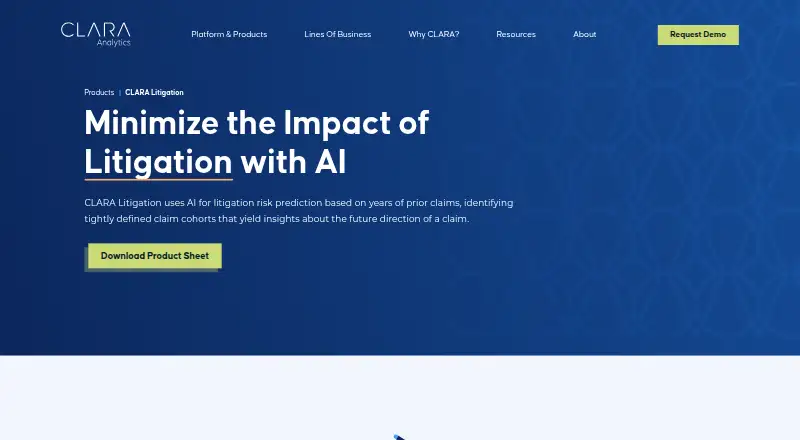
What CLARA Litigation is
CLARA Litigation uses AI to estimate litigation risk from earlier claims and identify groups of claims that can help indicate how a claim may develop. Its risk scores help adjusters spot claims that may become more costly or complex and consider changing counsel or pursuing settlement. The product identifies factors linked to rising claim costs and recommends ways intended to reduce attorney involvement and litigation rates. It rates attorneys based on previous claim outcomes, performance, and cost, with tools to compare defense and plaintiff attorneys and review the factors behind individual scores. Users can search attorneys by score, location, and expertise, with contact information that is frequently updated. It is described for workers’ compensation, commercial auto, and general liability claims, with claim adjusters and legal teams identified as intended users. Access is through a cloud module or pre-built APIs; named integrations include Guidewire ClaimCenter and Origami Risk. CLARA says setup takes 8–12 weeks after receiving historical data. Pricing is on request, and the site offers a personalized demo and customized ROI analysis.
Who it suits
It suits claim adjusters and legal teams handling workers’ compensation, commercial auto, or general liability claims. Teams seeking litigation-risk and attorney analytics can use its scores and comparisons to inform claim handling and counsel selection.
What it does well
- Estimates litigation risk from prior claims.
- Scores and compares defense and plaintiff attorneys.
- Searches attorneys by score, location, and expertise.
- Offers cloud access and pre-built APIs.
- Supports three listed claim types.
What to know first
- Pricing is on request.
- Setup takes 8–12 weeks after historical data arrives.
- No free plan or trial terms are stated.
Limits
The listed deployment period is 8–12 weeks after historical data is received. Pricing is on request.
Getting started
- Open the CLARA Litigation product page.
- Request a personalized live demo and customized ROI analysis through the demo form.
- Discuss pricing and a deployment plan with CLARA.
- Provide historical data for model tuning and alert configuration.
- Use the cloud module or pre-built APIs to connect claims access.
- Complete adjuster training during the 8–12 week deployment.
CLARA Litigation is claims analytics software for insurers and claims teams working in workers’ compensation, commercial auto, or general liability. It is best suited to adjusters and legal teams weighing claim intervention, counsel, and settlement decisions. Its appeal is the combination of claim-risk signals and attorney analysis; buyers must allow 8–12 weeks for deployment and request custom pricing.
Overview
CLARA Litigation uses patterns in prior claims to identify cohorts that may indicate how a claim will develop. It flags drivers of cost escalation and provides recommendations intended to reduce attorney involvement and litigation rates. The practical case is operational: adjusters can use risk scores to prioritize claims that may become more expensive or complex, then consider whether to change counsel or pursue settlement. These are decision aids, not a replacement for claim-handling judgment.
The product is focused on three lines of business—workers’ compensation, commercial auto, and general liability—and supports work across multiple jurisdictions. It is not a general legal research product; its value is strongest where claims teams can apply its analytics to live handling decisions.
Key features
Claim and litigation risk
CLARA rates attorney involvement and litigation likelihood and shows factors contributing to its scores. That can help teams see why a claim is being flagged rather than relying on a risk indicator alone. The recommendations target lower attorney involvement and litigation rates, so buyers should treat them as prompts for review rather than assured outcomes.
Attorney scoring and search
Attorney scores draw on outcomes from prior claims and factors including performance and cost. Users can compare defense and plaintiff attorneys, inspect contributing factors and individual scores, and search by score, location, expertise, and other factors. Frequently updated contact information adds practical value when teams are evaluating counsel. This is a stronger fit for organizations that need attorney selection alongside claim-risk analysis than for buyers seeking only a standalone case-law database.
Deployment and integration
The cloud platform can be accessed through a module or integrated with existing systems using pre-built APIs. CLARA names Guidewire ClaimCenter and Origami Risk as prebuilt integrations. Deployment takes 8–12 weeks after historical data is received, covering model tuning, alert configuration, and adjuster training. That onboarding provides time to configure the product for a claims operation, but makes it a planned implementation rather than an immediate, self-service purchase.
CLARA says its platform is HIPAA compliant, receives annual SOC 2 certification, and encrypts data to meet or exceed industry standards. Buyers can request a personalized live demo and customized ROI analysis. The company became an independent claims-AI business in 2017 and launched CLARA Litigation in 2018.
Pricing
CLARA Litigation is paid software with custom pricing. There is no free plan or free trial; purchase evaluation begins with a demo request. This route suits organizations considering a claims deployment that may need a tailored ROI discussion, but gives smaller teams no published entry price or trial period to assess before engaging.
Platforms
CLARA Litigation supports web access and API integration. The cloud module offers direct access for adjusters, while APIs let teams connect it to existing systems. The named Guidewire ClaimCenter and Origami Risk integrations may matter to buyers using either platform; no other platform details are established.
Who it's for
Claim adjusters and legal teams handling workers’ compensation, commercial auto, and general liability claims are the clearest fit. It is particularly relevant to organizations that want to combine early claim-risk review with attorney comparison and selection. Teams that need immediate deployment, transparent self-service pricing, or general-purpose legal research should look elsewhere.
Pros and cons
Pros
- Claim and attorney analytics in one workflow: Risk indicators, contributing factors, attorney comparisons, and search can inform related handling and counsel decisions.
- Useful selection criteria: Attorney evaluation includes prior outcomes, performance, cost, location, and expertise, with frequently updated contact information.
- Integration options: Cloud access and pre-built APIs, including named Guidewire ClaimCenter and Origami Risk integrations, support different claims workflows.
- Structured onboarding: The 8–12 week rollout includes model tuning, alert configuration, and adjuster training.
Cons
- Long setup: Deployment begins after historical data is received and takes weeks, so it is not suited to teams seeking a rapid start.
- Opaque entry cost: Custom pricing and no free trial make it harder for smaller buyers to evaluate cost before a sales conversation.
- Narrow claims focus: Its stated scope is three lines of business, limiting its fit for teams seeking broader legal analytics.
Alternatives
Docket Alarm is a better fit for buyers seeking docket and document research with a free starting option: its free plan allows five actions per week across searches, docket views, and document views, excluding government-purchased documents such as PACER filings. LegalLink suits users focused on Australian legal research and insights; its Standard plan costs A$219.90 a year and includes 50 AI consultations and 20 case summaries per month, plus unlimited Australian case access, law firm details, and judge preference insights.
UpLaw is an option for users who want to search and read a public legal corpus, with a free account adding a larger daily research quota, saving, comments, and cross-device sync. Cubictree Litigation Data Analytics is another paid litigation-data analytics option. Ex Parte is a paid web option with a free trial. Premonition is a paid option with API and web platforms. CaseParity offers freemium consumer reports, including one-time misdemeanor and felony reports at 99.00 USD and 199.00 USD respectively. Fortuna Legal is a paid web alternative. For a broader category directory, see Legal Case Analytics Software.
Verdict
CLARA Litigation is a strong candidate for claims adjusters and legal teams handling its three target lines who want claim-risk analysis tied to attorney scoring, comparison, and search. Its main reason to choose it is that combined view, supported by cloud access and API integration. Look elsewhere if custom pricing, a deployment of 8–12 weeks, or its limited line-of-business scope does not suit your operation.
Verdict
CLARA Litigation combines claim-risk analysis with attorney scoring and search for three listed lines of business. Buyers should account for the stated setup period and request pricing and a demo.
Questions
How much does CLARA Litigation cost?
Pricing is on request.
Is there a free plan or trial?
The product page offers a demo request. It does not give free plan or free trial terms.
Which platforms does it support?
The listed platforms are API and web.
Which claims does it cover?
It is described for workers’ compensation, commercial auto, and general liability claims.
Can it connect with existing claims systems?
Adjusters can use pre-built APIs, and named integrations include Guidewire ClaimCenter and Origami Risk.
Who makes CLARA Litigation?
CLARA Analytics makes the product. The company says it became independent and focused on claims AI in 2017, and launched CLARA Litigation in 2018.
Facts from CLARA Litigation's own pages
- Access and integration
- Adjusters can access claims through a cloud-based module or use pre-built APIs to integrate with existing systems. · claraanalytics.com, 7 Oct 2026
- Attorney analytics
- The product rates attorney involvement and litigation likelihood and shows contributing factors and individual attorney scores. · claraanalytics.com, 8 Oct 2026
- Attorney comparisons
- Users can compare defense and plaintiff attorneys’ past performance to inform legal strategy. · claraanalytics.com, 8 Oct 2026
- Attorney scoring
- It scores attorneys using outcomes on prior claims and factors such as performance and cost. · claraanalytics.com, 7 Oct 2026
- Attorney search
- Users can evaluate attorneys by score, location, expertise, and other factors, with frequently updated contact information. · claraanalytics.com, 7 Oct 2026
- Attorney selection
- Users can evaluate attorneys by score, location, and expertise, with frequently updated contact information. · claraanalytics.com, 8 Oct 2026
- Claim analysis
- The product detects drivers of claim cost escalation and provides recommendations intended to reduce attorney involvement and litigation rates. · claraanalytics.com, 7 Oct 2026
- Claim handling
- Litigation risk scores help adjusters identify claims likely to grow in cost and complexity and decide whether to change counsel or pursue settlement. · claraanalytics.com, 8 Oct 2026
- Claim types
- CLARA Litigation is described for workers’ compensation, commercial auto, and general liability claims. · claraanalytics.com, 7 Oct 2026
- Company background
- CLARA Analytics says it became an independent company focused on claims AI in 2017 and launched CLARA Litigation in 2018. · claraanalytics.com, 7 Oct 2026
- Company history
- CLARA’s company timeline says it became an independent company focused on claims AI in 2017 and launched CLARA Litigation in 2018. · claraanalytics.com, 8 Oct 2026
- Deployment
- CLARA says its cloud platform can be running 8–12 weeks after receiving historical data, including model tuning, alert configuration, and hands-on adjuster training. · claraanalytics.com, 8 Oct 2026
- Founded
- 2015 · claraanalytics.com, 28 Sept 2026
- Headquarters
- Sunnyvale, California, USA · claraanalytics.com, 28 Sept 2026
- Integration
- Adjusters can access claims through a cloud module or use pre-built APIs to integrate CLARA with existing systems. · claraanalytics.com, 8 Oct 2026
- Intended users
- The product page identifies claim adjusters and legal teams as ideal users, and describes legal panel managers as users of attorney scorecards. · claraanalytics.com, 8 Oct 2026
- Lines of business
- The product is described for workers’ compensation, commercial auto, and general liability claims. · claraanalytics.com, 8 Oct 2026
- Named integrations
- CLARA lists integrations with Guidewire Cloud ClaimCenter and Origami Risk’s claims management platform. · claraanalytics.com, 8 Oct 2026
- Pricing and trial
- The opened product pages offer a demo request but state no price, free plan, or free trial terms. · claraanalytics.com, 8 Oct 2026
- Purpose
- CLARA Litigation uses AI and prior claims to predict litigation risk and identify claim cohorts that can indicate how claims may develop. · claraanalytics.com, 8 Oct 2026
- Security
- CLARA states that it is HIPAA compliant, has annual SOC 2 certification, and encrypts data to meet or exceed industry standards. · claraanalytics.com, 8 Oct 2026
- Support and purchase route
- The site offers a personalized live demo and customized ROI analysis through a demo request form. · claraanalytics.com, 7 Oct 2026
Where CLARA Litigation stands on Freedom251
- Legal Case Analytics Software#13 of 25