Freedom251 › Legal Research Software

Docket Alarm
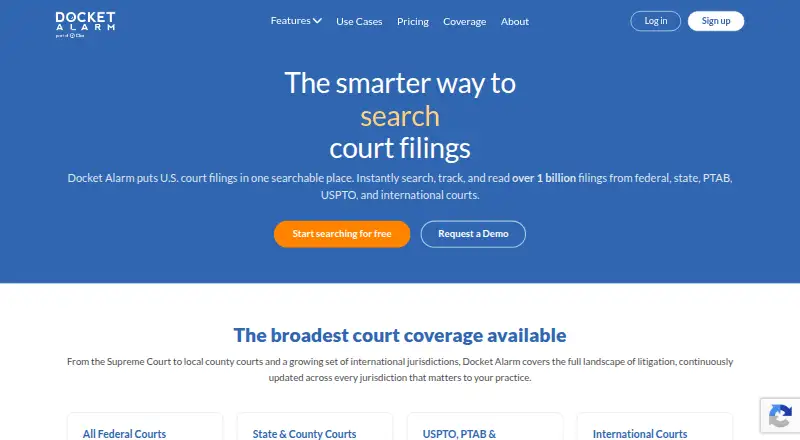
What Docket Alarm is
Docket Alarm is a litigation research and monitoring platform for searching, tracking, and analyzing court dockets and documents. The maker says its collection includes over 1 billion dockets and documents from courts in the United States and beyond. Search supports full text, Boolean queries, phrase search, and filters for court, date range, judge, party, attorney, and case type. Users can read indexed filings, connect directly to PACER, or bulk download a case’s documents. Tracking for cases, parties, attorneys, firms, keywords, and Nature of Suit categories can send email updates up to 16 times a day. Talk to Docket answers natural-language questions about a docket and cites entries and documents. Litigation and motion analytics show grant and denial rates, time to decision, and outcome trends by court and judge. The REST API supports searching, retrieving, and tracking cases, along with natural-language questions. Plans range from a free tier limited to five weekly actions to monthly paid options; PACER and state court document fees may be separate.
Who it suits
The maker positions Research & Monitoring for legal professionals, including litigators, IP counsel, and business development teams. Its API and Enterprise plan also provide options for teams and integrations.
What it does well
- Search includes Boolean, phrase, and full-text queries.
- Email alerts can arrive up to 16 times daily.
- Talk to Docket cites entries and documents.
- Litigation analytics cover motion outcomes and decision times.
- ECF integration can deliver tracked filings at no cost.
What to know first
- Free plan allows five actions per week.
- Free plan excludes government-purchased documents such as PACER filings.
- PACER and state court fees are separate on Flat-Fee.
- Pay-As-You-Go charges per document and case alert.
Limits
The free plan permits five actions per week across searches, docket views, and document views, and excludes government-purchased documents such as PACER filings. Pay-As-You-Go charges $4 per document, $3/day for case alerts, and $3 per case update; Flat-Fee excludes separately billed PACER and state court document fees.
Plans
| Plan | Billed and limits | Price |
|---|---|---|
| Free | 5 actions per week · no credit card · excludes government-purchased documents | Free |
| Pay-As-You-Go | per month + per-use fees · unlimited search · $4/document · $3/day case alerts · $3/case update · PACER fees may apply | $39.99 a month |
| Flat-Fee | per user / month · unlimited search · unlimited document access · unlimited alerts and tracking · PTAB and TTAB analytics · PACER and state document fees separate | $99 a month |
| Enterprise | volume-based per-seat pricing · teams of 5+ attorneys · litigation analytics · motion analytics · SSO · dedicated account manager | On request |
As docketalarm.com lists them, read 14 Oct 2026. The maker's own page has the final word.
Getting started
- Open https://www.docketalarm.com/.
- Choose the free plan or a paid plan based on your search and document needs.
- Use the web platform or API to search cases and dockets.
- Set up tracking for cases, parties, attorneys, firms, keywords, or Nature of Suit categories.
- Connect a court filing account through the ECF integration if you want tracked filings delivered in Docket Alarm.
Docket Alarm is a litigation intelligence platform for searching, monitoring and analyzing court dockets and documents. It is best suited to legal professionals who need ongoing case intelligence, particularly litigators, IP counsel and business development teams. Its breadth is a strong fit for sustained research, but document charges and court fees can make the wrong plan costly.
Overview
The service combines case and docket search with document access, monitoring, analytics and an API. Docket Alarm says it provides access to more than 1 billion dockets and documents from courts in the United States and beyond. Coverage includes U.S. federal courts, 43+ U.S. states, USPTO, PTAB, TTAB, ITC and international courts. Both case law and docket search are supported.
Search offers full text, Boolean queries and phrase search, with filters for court, date range, judge, party, attorney and case type. That flexibility is useful for narrowing broad litigation research to a particular court, participant or period; the platform is more compelling for users who need repeatable searches and ongoing matter intelligence than for occasional lookups.
Key features
Monitoring and documents
Users can track cases, parties, attorneys, firms, keyword searches and Nature of Suit categories, with email updates up to 16 times a day. That frequency can help teams stay current on active matters. Document access includes indexed filings, a direct connection to PACER and bulk downloads of a case’s documents. Government-purchased documents are excluded from the free plan, and PACER and state court document fees are billed separately on Flat-Fee, so document-heavy work still requires a court-fee budget.
Analysis and case tools
Litigation and motion analytics surface grant and denial rates, average time to decision and outcome trends by court and judge. Those measures can inform litigation research, though they are not a substitute for evaluating the circumstances of an individual case. Timeline, which the maker describes as patented, turns docket entries into a visual case chronology. Talk to Docket answers natural-language questions about a docket and cites entries and documents, giving users a way to check the answer against underlying material.
API and filing integration
The REST API can search cases, retrieve dockets and documents, track cases or saved searches, and answer natural-language questions about cases. It is relevant to teams that want to incorporate docket data into their own workflows rather than rely solely on the web interface. ECF integration connects a court filing account and delivers tracked case filings inside Docket Alarm at no cost. Payment details are encrypted with AES-256, handled by a PCI-certified payment processor and inaccessible to Docket Alarm employees.
Pricing
The free plan costs nothing and allows 5 actions per week across searches, docket views and document views. It excludes government-purchased documents such as PACER filings, making it a limited way to evaluate occasional research rather than a practical option for steady use.
Pay-As-You-Go costs $39.99 a month, billed per month, plus per-use fees. Search is unlimited, but documents cost $4 each, case alerts cost $3/day, and each case update costs $3. This structure may suit sporadic users who value unlimited searching but retrieve few documents and monitor few cases; frequent document access or alerts can quickly add charges.
Flat-Fee costs $99 a month, billed per user / month, and includes unlimited search, document access, alerts and tracking. It is the clearer fit for an individual with regular monitoring and document needs, but PACER and state court document fees remain separate. Enterprise has custom pricing, billed volume-based with favorable per-seat pricing, for teams of 5 or more. It adds litigation and motion analytics, SSO and a dedicated account manager, making it the team-oriented option. The pricing page also offers a support team for plan comparison.
Platforms
Docket Alarm is available on web and through an API. The API’s search, retrieval, tracking and question-answering functions make it relevant where docket research needs to connect to other systems.
Who it's for
Litigators can use the service to follow matters and examine court and judge trends; IP counsel can monitor relevant parties and filings; business development teams can track firms, attorneys and litigation activity. It is less suited to people who need only a few public-record lookups, especially if they expect frequent paid document retrieval under the per-use plan.
Pros and cons
- Pros: Broad docket and document coverage, with search filters and monitoring across cases, parties, firms, attorneys and keywords, supports continuing litigation research.
- Pros: Analytics, a visual chronology and cited natural-language answers bring several ways to assess and review docket activity.
- Pros: The API and no-cost ECF delivery can fit research into technical and filing workflows.
- Cons: Pay-As-You-Go adds charges for documents, alert days and case updates, so active monitoring can cost more than the monthly price suggests.
- Cons: Flat-Fee does not absorb PACER or state court document fees, and the free plan excludes government-purchased documents.
- Cons: The free plan’s 5 weekly actions are a narrow allowance for anyone doing regular research.
Alternatives
For a different legal research emphasis, compare Legal Case Analytics Software, Legal Docketing Software and Legal Research Software.
LegalLink is a web-based freemium option with a Standard plan at A$219.90 a year, including 50 AI consultations and 20 case summaries per month, plus unlimited Australian case access, law firm details and judge preference insights; choose it when those Australian research resources are the priority. UpLaw offers a free public legal corpus and a free account with a larger daily research quota, saving, comments and cross-device sync, making it an option for readers who want a broad public-corpus research starting point. Ex Parte is a paid web alternative with a free trial. Premonition is a paid alternative available on web and API. CaseParity offers freemium access and one-time public-records reports priced by charge severity, including misdemeanor and felony reports; consider it for that report-focused use. TheProfesseer sells one-time court or tribunal datasets, so it may suit a buyer seeking a dataset rather than ongoing monitoring. Cubictree Litigation Data Analytics is a paid option for web, iOS and Android. Fortuna Legal is another paid alternative on web.
Docket Alarm says it is part of Clio; Clio acquired vLex in 2025, bringing Docket Alarm into Clio.
Verdict
Docket Alarm is a strong choice for legal professionals who need broad docket search, frequent monitoring and tools to analyze litigation activity in one platform. Choose it when those ongoing capabilities justify the plan and any separate court charges; look elsewhere if your needs are occasional or your document and alert use would make per-use fees hard to control.
Verdict
Docket Alarm combines docket search, monitoring, document access, analytics, and an API. Check the action limits, per-use charges, and separate court fees against your research needs.
Questions
Is Docket Alarm free?
Yes. Its Free plan costs nothing and allows five actions per week across searches, docket views, and document views.
What does the Free plan exclude?
It excludes government-purchased documents such as PACER filings.
What platforms are available?
Docket Alarm lists web and API platforms.
How much do the paid plans cost?
Pay-As-You-Go is $39.99 a month, plus per-use fees. Flat-Fee is $99 a month per user; Enterprise pricing is volume-based and not listed.
Does Docket Alarm provide case law and docket search?
Yes. Case law search and docket search are available, with coverage that includes U.S. federal courts, 43+ states, several U.S. agencies and tribunals, and international courts.
Who owns Docket Alarm?
Docket Alarm says it is part of Clio, which acquired vLex in 2025, bringing Docket Alarm into Clio.
Facts from Docket Alarm's own pages
- AI assistant
- Talk to Docket answers docket questions in plain English and cites the docket entries and documents supporting its answers. · docketalarm.com, 14 Oct 2026
- Alerts
- Users can track cases, parties, attorneys, firms, keyword searches and Nature of Suit categories, with updates by email up to 16 times a day. · docketalarm.com, 7 Oct 2026
- Alerts and tracking
- Users can track cases, parties, attorneys, courts or keywords and receive notifications when filings arrive. · docketalarm.com, 14 Oct 2026
- Analytics
- Litigation and motion analytics show motion grant and denial rates, average time to decision, and outcome trends by court and judge. · docketalarm.com, 7 Oct 2026
- API
- The REST API can search cases, retrieve dockets and documents, track cases or saved searches, and answer natural-language questions about cases. · docketalarm.com, 7 Oct 2026
- API capabilities
- Documented API workflows include login, full-text search, direct PACER search, docket retrieval, document retrieval, tracking and push notifications. · docketalarm.com, 14 Oct 2026
- API client
- Docket Alarm documents a Python client library and sample test program for API development. · docketalarm.com, 14 Oct 2026
- API documentation depth
- The API documentation describes version 1.14, released in 2013 and last updated in July 2024, with endpoint examples and authentication guidance. · docketalarm.com, 14 Oct 2026
- Bulk downloads
- Users can download an entire case docket as one bundle instead of retrieving filings individually. · docketalarm.com, 14 Oct 2026
- Company
- Docket Alarm says it is part of Clio and that Clio acquired vLex in 2025, bringing Docket Alarm into Clio. · docketalarm.com, 7 Oct 2026
- Company identity
- Crunchbase identifies the legal name as Docket Alarm, Inc., founded in 2012, headquartered in New York and employing 1–10 people. · crunchbase.com, 14 Oct 2026
- Court coverage
- The service says it covers all federal courts, 45-plus states, USPTO, PTAB, TTAB, ITC and expanding international jurisdictions. · docketalarm.com, 14 Oct 2026
- Court data
- The maker says the platform provides access to over 1 billion dockets and documents from courts in the United States and beyond. · docketalarm.com, 7 Oct 2026
- Document access
- The platform stores filings such as complaints, motions, orders and expert reports, indexes them for full-text search and provides downloads. · docketalarm.com, 14 Oct 2026
- Documents
- Users can read indexed court filings, connect directly to PACER, and bulk download a case’s documents. · docketalarm.com, 7 Oct 2026
- Extra court fees
- PACER and state court document fees are billed separately on the Flat-Fee plan, and the free plan excludes government-purchased documents. · docketalarm.com, 7 Oct 2026
- Founder transition
- LawNext reported on November 30, 2023 that founder Michael Sander left after the vLex acquisition; the article said the product was collecting more than 350,000 U.S. dockets and documents daily. · lawnext.com, 14 Oct 2026
- Integration
- The ECF integration lets users connect a court filing account so tracked case filings can be delivered inside Docket Alarm at no cost. · docketalarm.com, 7 Oct 2026
- Integrations
- GetApp lists Zapier, Clio and Google Calendar integrations. · getapp.com, 14 Oct 2026
- Intended users
- The maker says Research & Monitoring is built for legal professionals and specifically describes uses for litigators, IP counsel and business development teams. · docketalarm.com, 7 Oct 2026
- Limit: billing complaints
- BBB records complaints alleging unexpected $99 charges, duplicate document fees and charges continuing after cancellation; one 2026 complaint records a refund resolution. · bbb.org, 14 Oct 2026
- Limit: coverage and speed
- Reviewers report slower alerts than some competitors, limited county/state coverage including New York and Massachusetts, and occasional PDF loading delays. · softwareadvice.com, 14 Oct 2026
- Litigation analytics
- Analytics profile judges, parties, attorneys and firms, including grant rates, denial rates, decision times and outcome trends. · docketalarm.com, 14 Oct 2026
- Mobile support
- GetApp lists web, Android and iPhone/iPad support; no native Docket Alarm app listing was identified in the researched app stores. · getapp.com, 14 Oct 2026
Where Docket Alarm stands on Freedom251
- Legal Research Software#1 of 31
- Legal Case Analytics Software#1 of 25
- Legal Docketing Software#2 of 26