ERP5
by ERP5
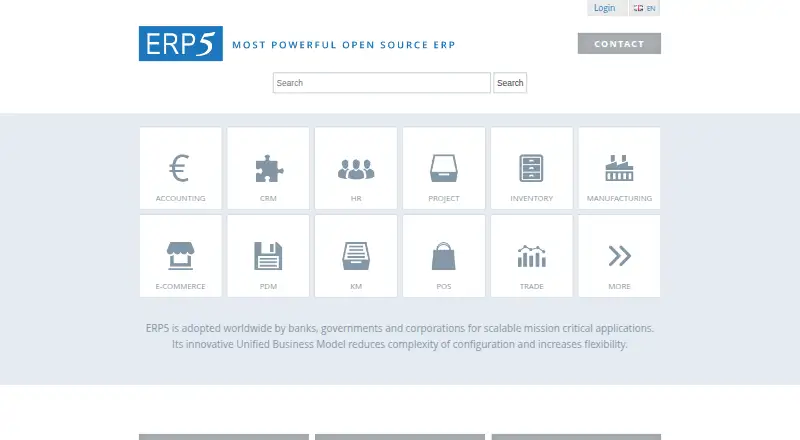
What ERP5 is
ERP5 is an enterprise resource planning system for organizations that want finance, inventory, order management, and manufacturing tools in one self-hosted package. Its finance module covers financial work, while inventory and order management address stock and order operations. Manufacturing tools extend its scope to production. ERP5 also supports multiple entities, which suits organizations that need to manage more than one entity in the same system.
The software is deployed on-premise and listed for self-hosted use, so it runs in an organization’s own environment. ERP5 is made by ERP5, founded in 2001 and headquartered in Lille, France. Its pricing model is free, and a free plan is available. Organizations evaluating ERP5 should consider both its operational coverage and its deployment model: it brings together several core business functions, but requires a self-hosted, on-premise setup. The listed modules make it relevant to organizations seeking finance, stock, orders, and manufacturing capabilities, with support for multiple entities.
Who it suits
ERP5 suits organizations that need finance, inventory, order management, and manufacturing tools, especially those managing multiple entities. It is for teams prepared to run ERP software on-premise in a self-hosted environment.
What it does well
- Includes finance, inventory, order, and manufacturing modules.
- Supports multiple entities.
- Offers a free plan.
- Runs on-premise in a self-hosted setup.
What to know first
- Requires an on-premise deployment.
- Its listed platform is self-hosted.
Plans
| Plan | Billed and limits | Price |
|---|---|---|
| ERP5 | GPL v2 open-source software · free to download and use | Free |
As erp5.com lists them, read 9 Oct 2026. The maker's own page has the final word.
Getting started
- Open the ERP5 website.
- Plan to run the software in a self-hosted environment.
- Set up an on-premise deployment.
Overview
ERP5 is an open-source ERP and business platform that brings operational functions such as accounting, production and supply chain into one system. It is best suited to organizations willing to take responsibility for deployment and learn a flexible platform in depth. Its free license and broad scope are attractive, but production use calls for more than simply starting the supplied virtual machine.
Key features
ERP5 combines CRM, production management, supply chain, product design, accounting, human resources and e-commerce, with finance, inventory, order management, manufacturing tools and multi-entity support. Its Unified Business Model describes how the system's components relate, and it has been implemented in sectors including banking, government, trade, manufacturing and aerospace. This breadth can suit organizations coordinating diverse operations; buyers who want a narrowly focused product or a deployment they need not supervise should look elsewhere.
Users can access and configure ERP5 in a browser, and the maker says all browsers are supported. A HATEOAS JSON API and MCP implementation provide integration options; MCP services can be read-only or read-write. MCP calls use the connected ERP5 user's permissions, and personal data can be stripped from results. ERP5's 5A security model uses Author, Auditor, Assignor, Assignee and Associate roles, with permissions configured by module and document. These controls offer a structured basis for access management, but organizations need to configure them around their own requirements.
The maker offers a preconfigured virtual machine for running ERP5 on a server, but does not recommend that package for large production environments with many users or for development. SlapOS is the recommended route for production and complex integrations with other packages. That distinction matters: the VM is a practical starting point, not a substitute for planning a larger deployment. ERP5 is written mostly in Python and uses both the NEO transactional NoSQL database and a relational SQL database, with MariaDB preferred.
ERP5 is not a reporting tool, although it can interface with PALO and other tools. Organizations whose core requirement is reporting should plan for a complementary tool. User, consultant, developer and internationalisation/localisation documentation supports different roles, but ERP5 is still aimed at teams prepared to supervise deployment or build deeper expertise.
Pricing
The ERP5 plan costs nothing. GPL v2 open-source software is free to download and use, making it a low-cost option for organizations able to handle deployment themselves. The free license does not remove the operational distinction between the supplied VM and a production setup: larger environments and complex integrations point toward SlapOS.
Platforms
ERP5 supports API, Linux, macOS, self-hosted, web and Windows. Browser access is central to using and configuring the system, while self-hosting gives organizations control over where it runs. The platform options do not change the recommendation to use SlapOS for production environments and complex integrations.
Who it's for
ERP5 is a stronger fit for organizations that need several core business functions, multi-entity support and the flexibility of a business platform, and have the capacity to oversee deployment or learn the system in depth. Its manufacturing tools and production management also make it relevant to manufacturing operations; see Manufacturing ERP Software and ERP Software. It is a weaker fit for teams seeking a reporting-first product, a ready-made large-scale VM deployment or a deployment model other than on-premise.
Pros and cons
- Pro: The free GPL v2 license and broad operational coverage let organizations start without licensing fees while bringing finance, manufacturing and other functions together.
- Pro: Multi-entity support, API access and configurable role permissions suit organizations with varied structures and integration needs.
- Con: The VM is not recommended for large production environments or development, so substantial deployments require more planning and the recommended SlapOS route.
- Con: ERP5 is not a reporting tool, which can mean adding another product for reporting needs.
- Con: Its intended audience is prepared to supervise deployment or learn ERP5 in depth, making it a poor match for buyers seeking a hands-off setup.
Alternatives
Apache OFBiz is another free, open-source, self-hosted option for buyers seeking an alternative ERP platform. Consider Cetec ERP if a paid product with a free trial is a better fit. Odoo Manufacturing offers a free plan with unlimited users and may suit readers seeking a manufacturing-oriented option with a mobile platform. Global Shop Solutions ERP is an alternative for buyers open to tailored pricing and an upfront plus ongoing quarterly cost. abas ERP is another paid ERP option, with implementation costs varying by users, process complexity, migration, functions and adjustments. Epicor Kinetic may suit buyers looking for a platform core, cloud package, concurrent user licenses and industry bundles. Acumatica Product Configurator is an alternative for buyers seeking product configurator software with pricing tailored to applications, usage, resources and deployment preferences. ECI M1 offers customized pricing tailored to business needs.
Verdict
Choose ERP5 if your organization needs a broad, multi-entity ERP and can take charge of deployment: its free GPL v2 license is a compelling starting point. Look elsewhere if you need a reporting tool, a hands-off production setup or anything other than on-premise deployment.
Verdict
Choose ERP5 if you need several core operational modules, multi-entity support, and a free plan in a self-hosted ERP. Look elsewhere if you need a deployment model other than on-premise.
Questions
Is ERP5 free?
ERP5 has a free pricing model and a free plan.
What platforms does ERP5 support?
ERP5 is listed as self-hosted.
Can ERP5 manage more than one entity?
Yes. Multi-entity support is listed.
What business functions does ERP5 cover?
Its listed modules include finance, inventory management, order management, and manufacturing tools.
Where is ERP5 made?
The maker is ERP5, founded in 2001 and headquartered in Lille, France.
Facts from ERP5's own pages
- API and MCP
- ERP5 provides a HATEOAS JSON API, and its MCP implementation can expose read-only or read-write services to MCP clients. · erp5.com, 9 Oct 2026
- Business model
- ERP5 uses a Unified Business Model to describe its components and has been implemented across industries including banking, government, trade, manufacturing and aerospace. · erp5.com, 9 Oct 2026
- Deployment
- on-premise · nexedi.com, 20 Sept 2026
- Deployment limit
- The ERP5 VM package is not recommended for large production environments with many users or for development. · erp5.com, 9 Oct 2026
- Finance module
- Yes · nexedi.com, 20 Sept 2026
- Founded
- 2001 · erp5.com, 28 Sept 2026
- Free plan
- Yes · nexedi.com, 20 Sept 2026
- Headquarters
- Lille, France · erp5.com, 28 Sept 2026
- Intended audience
- The maker describes ERP5 as suitable for organizations needing a flexible, scalable business platform or framework and prepared to supervise deployment or learn ERP5 in depth. · erp5.com, 9 Oct 2026
- Inventory management
- Yes · nexedi.com, 20 Sept 2026
- Manufacturing tools
- Yes · nexedi.com, 20 Sept 2026
- MCP safeguards
- ERP5's MCP service runs tool calls under the connected ERP5 user's permissions and can strip personal data from tool results. · erp5.com, 9 Oct 2026
- Multi-entity support
- Yes · nexedi.com, 20 Sept 2026
- Order management
- Yes · nexedi.com, 20 Sept 2026
- Production deployment
- The maker recommends SlapOS for production environments and complex integrations with other packages. · erp5.com, 9 Oct 2026
- Product scope
- ERP5 covers CRM, production management, supply chain, product design, accounting, human resources and e-commerce. · erp5.com, 9 Oct 2026
- Reporting limit
- The maker says ERP5 is not a reporting tool, though it can interface with PALO and other tools. · erp5.com, 9 Oct 2026
- Security
- ERP5 uses a 5A security model with Author, Auditor, Assignor, Assignee and Associate roles, with permissions configured by module and document. · erp5.com, 9 Oct 2026
- Self-hosting
- The maker offers a preconfigured ERP5 virtual machine for end users who want an instance running on their server. · erp5.com, 9 Oct 2026
- Support and documentation
- The maker site provides user, consultant, developer, and internationalisation/localisation documentation. · erp5.com, 9 Oct 2026
- Technology
- ERP5 is written mostly in Python and uses the NEO transactional NoSQL database and a relational SQL database, with MariaDB preferred. · erp5.com, 9 Oct 2026
- Web access
- ERP5 can be used and configured through a web browser, and the maker says all browsers are supported. · erp5.com, 9 Oct 2026
Where ERP5 stands on Freedom251
- ERP Software#15 of 128
- Manufacturing ERP Software#4 of 32
- Enterprise Resource Planning Software#5 of 23