Freedom251 › LLM Gateway Software
Envoy AI Gateway
What Envoy AI Gateway is
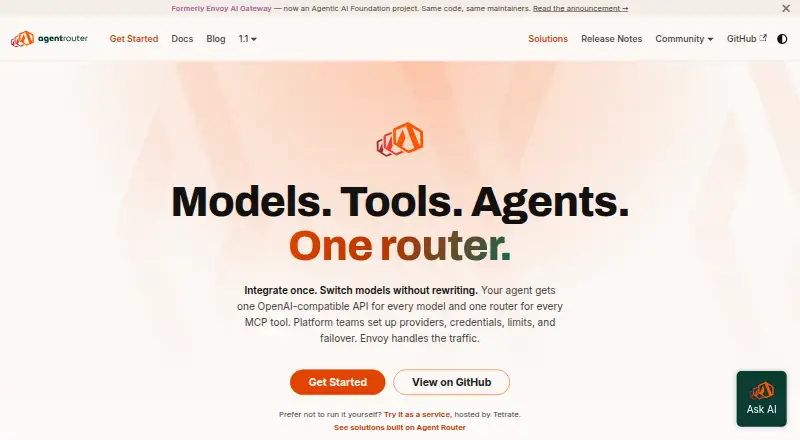
Envoy AI Gateway, now named Agent Router, is an open-source control plane for managing AI and agent traffic with Envoy. It provides an OpenAI-compatible API for hosted and self-hosted models and MCP servers, with integrations for providers including OpenAI, Azure OpenAI, Google Gemini, AWS Bedrock, Mistral, and Anthropic. Traffic controls include model virtualization, provider failover, token quotas, and usage-based rate limits. The MCP gateway supports server multiplexing, tool routing, OAuth authentication, and observability; InferencePool support adds routing and load balancing for inference endpoints. Credentials can be managed centrally, including short-lived credential flows for some supported providers, and the project describes metrics collection and monitoring. The CLI runs locally on Linux and macOS; production Kubernetes deployments require compatible dependencies. The compatibility matrix lists Agent Router v1.2.x with Kubernetes v1.32 or later, Envoy Gateway v1.9.2 or later, and Gateway API v1.6.1. The project uses the Apache 2.0 license and directs users to Discord and GitHub issues for help. The site says the rename did not change the code, maintainers, or APIs.
Who it suits
Agent Router suits teams sharing models or tools that need centralized credentials, quotas, usage attribution, or provider failover. It offers local CLI use on Linux and macOS and Kubernetes deployment with compatible dependencies.
What it does well
- OpenAI-compatible API for models and MCP servers
- Includes provider failover and token quotas
- MCP gateway supports OAuth authentication
- Apache 2.0 licensed
- Supports local and Kubernetes deployment
What to know first
- Local CLI currently supports only Linux and macOS
- Kubernetes deployment requires compatible dependencies
Limits
The project is free. Kubernetes deployments require Agent Router v1.2.x, Kubernetes v1.32 or later, Envoy Gateway v1.9.2 or later, and Gateway API v1.6.1.
Plans
| Plan | Billed and limits | Price |
|---|---|---|
| Open-source project | Self-managed; local CLI supports Linux and macOS · Kubernetes deployments require compatible dependencies | Free |
As aigateway.envoyproxy.io lists them, read 9 Oct 2026. The maker's own page has the final word.
Getting started
- Visit the Agent Router website.
- Choose a local standalone proxy or a Kubernetes deployment.
- For local use, run the CLI on Linux or macOS.
- For Kubernetes, use Agent Router v1.2.x with Kubernetes v1.32 or later, Envoy Gateway v1.9.2 or later, and Gateway API v1.6.1.
- Configure the model, provider, or MCP server integrations your team needs.
Envoy AI Gateway, now called Agent Router, is an open-source control plane for routing AI and agent traffic through Envoy. It suits teams that share models or tools and need centralized credentials, quotas, usage attribution or failover. Its strongest case is self-managed control across many providers; running locally is narrower than production deployment, which depends on Kubernetes.
Overview
Agent Router presents an OpenAI-compatible API for hosted and self-hosted models as well as MCP servers. Its provider integrations span OpenAI, Azure OpenAI, Google Gemini, Vertex AI, AWS Bedrock, Mistral, Cohere, Groq, Together AI, DeepInfra, DeepSeek, Hunyuan, SambaNova, Grok and Anthropic. That breadth makes it a plausible shared entry point for teams working across providers, rather than a model or inference engine of its own.
The project was founded in 2024 and is now an Agentic AI Foundation project. Its site says the code, maintainers and APIs remain the same after the rename. It uses the Apache 2.0 license, with help directed to community Discord and GitHub issues.
Key features
Traffic management
Model virtualization, provider failover, token quotas and usage-based rate limits give teams ways to route requests and govern shared consumption. Usage analytics and budget controls are also supported. These controls suit organizations that need centralized policy; teams seeking only a basic proxy may find the control-plane and deployment requirements more than they need.
MCP and inference routing
The MCP gateway can multiplex servers, route tools, handle OAuth authentication and provide observability. InferencePool support adds intelligent routing and load balancing for inference endpoints. Together, those capabilities make the product relevant to teams managing tools alongside models, not only model API traffic.
Credentials and monitoring
Upstream authentication secures connections to AI services while allowing provider credentials to stay out of application workloads. Credentials can be centrally managed, with short-lived credential flows supported for AWS Bedrock, Azure OpenAI and GCP Vertex AI. Metrics collection and monitoring cover AI workloads, though the project does not replace the need to operate the gateway itself.
Pricing
Open-source project — free. The plan is self-managed, with a local CLI for Linux and macOS and Kubernetes deployment subject to compatible dependencies. The Apache 2.0 project is the fit for teams able to run their own infrastructure and manage its upgrades; there is no paid managed tier described for Agent Router. The project also links to hosted services offered by other providers, which are separate options.
Platforms
The aigw run CLI supports Linux and macOS for local standalone use. Production deployment uses Kubernetes with Envoy Gateway. Agent Router v1.2.x requires Kubernetes v1.32 or later, Envoy Gateway v1.9.2 or later, and Gateway API v1.6.1. Teams on incompatible versions should account for that prerequisite before choosing it for production.
Who it's for
Choose Agent Router if multiple applications or teams share models and tools and need central credentials, usage attribution, quotas or provider failover. It is also suited to self-hosting teams that want one OpenAI-compatible interface across a broad provider set. It is a weaker fit for users who need a managed gateway, broad local operating-system support, or production deployment without Kubernetes.
Pros and cons
Pros
- Broad provider coverage: One compatible API spans hosted and self-hosted models and MCP servers across numerous named providers.
- Useful governance controls: Quotas, usage-based limits, budget controls and failover address shared traffic and provider resilience.
- Credential isolation: Central management and supported short-lived flows can keep upstream credentials out of application workloads.
- Open-source self-management: Apache 2.0 licensing and a free plan suit teams that want to operate the gateway themselves.
Cons
- Production has infrastructure prerequisites: Kubernetes and compatible Envoy Gateway and Gateway API versions are required.
- Local support is limited to Linux and macOS: Teams seeking a local Windows CLI will need another option.
- Self-managed operation: The free project leaves deployment and ongoing operation to the team, with community Discord and GitHub issues as support routes.
Alternatives
LLM Gateway Software is the broader category directory for comparing gateway options.
- Bifrost is worth comparing for teams wanting an OSS gateway with self-hosting through npx, Docker, Kubernetes or a Go binary; its free plan is billed free forever.
- Routerly offers a free self-hosted plan with no markup on API calls, a useful alternative for teams prioritizing that pricing model.
- YoloRouter offers a self-hosted single binary with SQLite out of the box and optional PostgreSQL, for readers preferring that deployment format.
- Kong Gateway may suit teams seeking a time-limited trial: its free trial lasts 30 days, requires no credit card and has no Gateway limits.
- SGLang is an open-source inference framework installable with pip or Docker, rather than a direct gateway choice.
- TensorZero is an alternative for teams looking for a 100% self-hosted, open-source LLMOps platform.
- Eden AI charges per API call at provider prices plus a 5.5% platform fee when purchasing credits, making it a different option for readers evaluating that usage model.
- Helicone describes itself as open source and offers a free Hobby plan with 10,000 free requests.
Verdict
Agent Router is a strong choice for infrastructure-capable teams that need a self-managed, OpenAI-compatible control point for models and MCP tools, especially when centralized credentials, quotas and failover matter. Its breadth and governance controls are the reasons to choose it; look elsewhere if Kubernetes production prerequisites or Linux/macOS-only local use do not fit your environment.
Verdict
Agent Router provides a unified interface and traffic controls for teams managing AI models and tools. Local use and Kubernetes production deployment have different requirements, so check the listed compatibility versions before deployment.
Questions
Is Agent Router free?
Yes. The listed Open-source project plan costs nothing.
Is Agent Router open source?
Yes. It uses the Apache 2.0 license.
What platforms does it support?
The CLI supports Linux and macOS. The project also supports self-hosted deployment and Kubernetes.
Which providers does it integrate with?
Listed integrations include OpenAI, Azure OpenAI, Google Gemini, Vertex AI, AWS Bedrock, Mistral, Cohere, Groq, Together AI, DeepInfra, DeepSeek, Hunyuan, SambaNova, Grok, and Anthropic.
What does the Kubernetes deployment require?
The compatibility matrix lists Agent Router v1.2.x, Kubernetes v1.32 or later, Envoy Gateway v1.9.2 or later, and Gateway API v1.6.1.
Where can users get help?
The project points users to its community Discord and GitHub issues.
Facts from Envoy AI Gateway's own pages
- Credential security
- Upstream credentials can be centrally managed; supported providers include short-lived credential flows for AWS Bedrock, Azure OpenAI, and GCP Vertex AI. · theagentrouter.ai, 9 Oct 2026
- Deployment
- The CLI can run locally on Linux and macOS, and production deployment uses Kubernetes with Envoy Gateway. · theagentrouter.ai, 9 Oct 2026
- Deployment options
- The project can run locally as a standalone proxy or deploy to Kubernetes; the site also links to hosted services offered by other providers. · theagentrouter.ai, 9 Oct 2026
- Founded
- 2024 · aigateway.envoyproxy.io, 28 Sept 2026
- Inference routing
- InferencePool support provides intelligent routing and load balancing for inference endpoints. · theagentrouter.ai, 9 Oct 2026
- Intended users
- The documentation identifies teams sharing models or tools, seeking centralized credentials, quotas, usage attribution, or failover as likely users. · theagentrouter.ai, 9 Oct 2026
- Kubernetes compatibility
- The compatibility matrix lists Agent Router v1.2.x with Kubernetes v1.32 or later, Envoy Gateway v1.9.2 or later, and Gateway API v1.6.1. · theagentrouter.ai, 9 Oct 2026
- License
- The project uses the Apache 2.0 license. · theagentrouter.ai, 9 Oct 2026
- Local platform support
- The `aigw run` CLI currently supports Linux and macOS. · theagentrouter.ai, 9 Oct 2026
- MCP gateway
- The MCP gateway aggregates tools from multiple servers and supports tool routing, security policies, and observability. · theagentrouter.ai, 9 Oct 2026
- Observability
- The CLI supports OpenTelemetry tracing and can record request and response details; the documentation describes configuration to hide input and output content. · theagentrouter.ai, 9 Oct 2026
- Provider integrations
- The project lists integrations including OpenAI, Azure OpenAI, Google Gemini, Vertex AI, AWS Bedrock, Mistral, Cohere, Groq, Together AI, DeepInfra, DeepSeek, Hunyuan, SambaNova, Grok, and Anthropic. · github.com, 9 Oct 2026
- Purpose
- The open-source project routes and manages generative AI traffic between applications and AI services, with rate limiting and policy control. · theagentrouter.ai, 9 Oct 2026
- Renamed project
- Envoy AI Gateway is now Agent Router, an Agentic AI Foundation project; the site says the code, maintainers, and APIs remain the same. · theagentrouter.ai, 9 Oct 2026
- Security
- The project describes upstream authentication for securing connections to AI services and says provider credentials can be kept out of application workloads. · theagentrouter.ai, 9 Oct 2026
- Support
- The project directs users to its community Discord and GitHub issues for help. · theagentrouter.ai, 9 Oct 2026
- Traffic controls
- Capabilities include model virtualization, provider failover, token quotas, and usage-based rate limiting. · theagentrouter.ai, 9 Oct 2026
- Unified API
- It provides an OpenAI-compatible API for routing requests across model providers and lets applications switch models by changing the model name. · theagentrouter.ai, 9 Oct 2026
Where Envoy AI Gateway stands on Freedom251
- LLM Gateway Software#5 of 34
- Byok System#4 of 24
- LLM gateways#7 of 33