SGLang
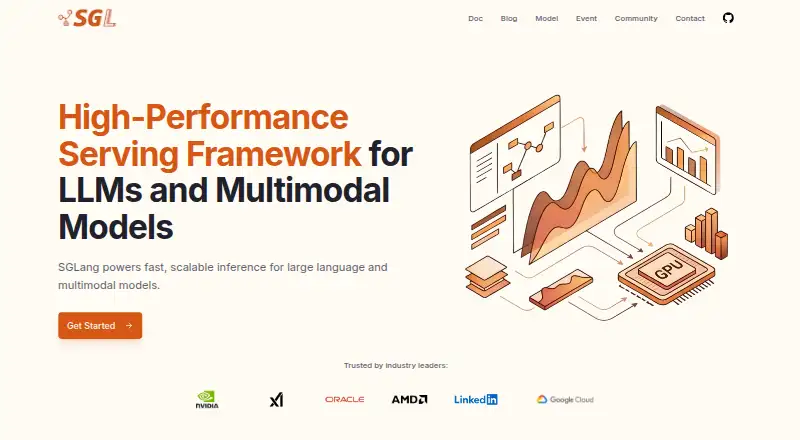
What SGLang is
SGLang is an open-source inference framework for serving large language, vision-language, and diffusion models. It is built for agentic workloads, reinforcement-learning rollouts, and large-scale serving, with a design for low-latency, high-throughput inference from one GPU to distributed clusters. Its runtime includes RadixAttention, prefix caching, and multi-GPU parallelism, alongside techniques such as speculative decoding and disaggregated prefill and decode. The framework supports DeepSeek, Qwen, GPT-OSS, Llama, Mistral, and GLM models, and works with Hugging Face and OpenAI APIs. A launched model server can expose OpenAI-compatible endpoints. SGLang runs on a range of hardware, including NVIDIA and AMD GPUs, Google TPUs, Intel GPUs and CPUs, Apple Silicon, Huawei Ascend NPUs, and Moore Threads GPUs. It can be installed with Python tooling or Docker and supports self-hosting. SGLang Diffusion, for image and video generation, is included in the repository and Python package. The project is free under the Apache-2.0 license.
Who it suits
SGLang suits developers and teams serving language, vision-language, or diffusion models, including agentic and reinforcement-learning workloads. It is relevant to teams using supported hardware and self-hosted deployment.
What it does well
- Free, open-source software under Apache-2.0.
- Supports multiple model families and hardware platforms.
- Includes OpenAI-compatible endpoints and Hugging Face API compatibility.
- Includes image and video generation through SGLang Diffusion.
What to know first
- Prefill context parallelism is unavailable on HIP, NPU, and MUSA.
- Fallback routing is not supported.
- Virtual API keys are not supported.
Limits
The free plan is the open-source inference framework. The October 2, 2026 release notes say prefill context parallelism is unavailable on HIP, NPU, and MUSA until those platforms are ported.
Plans
| Plan | Billed and limits | Price |
|---|---|---|
| SGLang | Open-source inference framework · install with pip or Docker | Free |
As sglang.io lists them, read 8 Oct 2026. The maker's own page has the final word.
Getting started
- Visit the SGLang website.
- Install the framework with pip or run it from a Docker image.
- Deploy it on supported hardware and launch a model server.
- Query the launched server through its OpenAI-compatible endpoints.
SGLang is an open-source framework for serving language, vision-language, and diffusion models, with a runtime aimed at demanding inference workloads. It suits engineering teams running their own model infrastructure, from a single accelerator to distributed clusters. The zero-cost license and broad deployment options are compelling, but platform-specific gaps matter when you depend on advanced parallelism.
Overview
SGLang targets low-latency, high-throughput inference for agentic applications, reinforcement-learning rollouts, and large-scale serving. Its dedicated deployment mode supports GPU accelerators, batch inference, and self-hosting, while model inputs can use safetensors, PyTorch .bin, GGUF, or Mistral-native formats. Apache-2.0 licensing allows organizations to operate and adapt the framework without a software subscription.
The project can serve models through standard OpenAI-compatible endpoints and works with Hugging Face APIs, which reduces integration work for clients already built around those interfaces. Installation is available through Python tooling or Docker, so teams can choose a package-based workflow or a containerized deployment.
Key features
Inference runtime and optimization
RadixAttention, prefix caching, and multi-GPU parallelism are built into the runtime. In practice, these capabilities target repeated prompt prefixes, larger model footprints, and higher concurrent throughput. The optimization set also includes disaggregated prefill and decode, speculative decoding, a zero-overhead scheduler, and optimized GPU kernels. Together they make SGLang better suited to production serving and rollout generation than a minimal model wrapper, although getting the benefit requires infrastructure expertise.
Models, diffusion, and integrations
Named support covers DeepSeek, Qwen, GPT-OSS, Llama, Mistral, and GLM models. SGLang Diffusion is included in the repository and Python package for image and video generation, extending the framework beyond text serving. Reinforcement-learning integrations include Miles, slime, AReaL, Tunix, and verl, while deployment integrations include Ray Serve, NVIDIA Dynamo, and llm-d.
Hierarchical KV caching can span GPU memory, host memory, and external storage through projects such as HiCache, Mooncake, and LMCache. That architecture is useful when working sets exceed accelerator memory, but it also introduces additional components to operate.
Pricing
SGLang costs free under its single SGLang plan. The plan is an open-source inference framework installed with pip or Docker, with no paid tier, seat charge, trial period, or usage quota stated. It fits teams prepared to fund their own compute and operations rather than buy a managed serving service. The trade-off is that infrastructure, scaling, monitoring, and support remain your responsibility.
Platforms
SGLang supports API access, Linux, macOS, and self-hosted deployment. The hardware list spans NVIDIA and AMD GPUs, Google TPUs, Intel GPUs and CPUs, Apple Silicon, Huawei Ascend NPUs, and Moore Threads GPUs. The October 2, 2026 release notes identify one concrete constraint: prefill context parallelism is not available on HIP, NPU, or MUSA until those ports are completed. Teams relying on that feature should verify their accelerator choice before standardizing.
Who it's for
SGLang is a strong fit for platform engineers and research teams serving open models, running reinforcement-learning rollouts, or building agentic systems that need high throughput and OpenAI-style access. It also suits organizations wanting one stack for language, vision-language, and diffusion workloads across varied hardware. It is less suitable for buyers seeking a hosted service, built-in fallback routing, virtual API keys, or a turnkey operational layer; those functions are not part of this plan.
Pros and cons
- Pro: No software charge and Apache-2.0 licensing make self-hosted deployment economically flexible.
- Pro: Caching, speculative decoding, parallelism, and kernel optimizations address both latency and throughput bottlenecks.
- Pro: OpenAI-compatible endpoints and Hugging Face compatibility simplify adoption by existing clients.
- Pro: Broad accelerator coverage and included diffusion support reduce the need for separate serving stacks.
- Con: Prefill context parallelism is unavailable on HIP, NPU, and MUSA.
- Con: There is no fallback routing or virtual API-key capability, limiting built-in gateway controls.
- Con: Self-hosting leaves compute, reliability, and day-to-day operations to your team.
Alternatives
Choose Bifrost instead when you want a freemium gateway with self-hosted OSS deployment through npx, Docker, Kubernetes, or a Go binary, plus a separate enterprise tier. Routerly is a simpler free self-hosted option with no markup on API calls and AGPL-3.0 licensing.
YoloRouter fits teams preferring a single binary with SQLite out of the box and optional PostgreSQL. Envoy AI Gateway is another free, self-managed project for Linux and macOS, with Kubernetes deployments requiring compatible dependencies.
Kong Gateway is worth considering if a 30-day, no-credit-card trial with no Gateway limits and 30 days of analytics retention is more important than an entirely free framework. TensorZero offers a 100% self-hosted, open-source LLMOps platform. Eden AI is a paid API gateway that charges providers' API prices plus a 5.5% platform fee when purchasing credits. Helicone is a freemium, proudly open-source option with a Hobby plan including 10,000 free requests and 1 GB of storage.
For a broader gateway comparison, see LLM Gateway Software.
Verdict
Choose SGLang if you need a free, self-hosted serving foundation for open models, reinforcement-learning rollouts, or agentic workloads and have the engineering capacity to run it. Its runtime optimizations, API compatibility, model breadth, and hardware reach are substantial advantages. Look elsewhere if you require managed operations, fallback routing, virtual API keys, or prefill context parallelism on HIP, NPU, or MUSA.
Verdict
SGLang combines model serving, multiple inference optimizations, and broad hardware support in a free framework. One listed limitation is that prefill context parallelism is not available on HIP, NPU, or MUSA.
Questions
How much does SGLang cost?
The listed plan is free.
Is SGLang open source?
Yes. The repository identifies its license as Apache-2.0.
What platforms and hardware does it support?
Listed platforms are API, Linux, macOS, and self-hosted. Hardware includes NVIDIA and AMD GPUs, Google TPUs, Intel GPUs and CPUs, Apple Silicon, Huawei Ascend NPUs, and Moore Threads GPUs.
How can I install it?
The project lists installation with pip or use of a Docker image.
Which models and APIs are supported?
Listed models include DeepSeek, Qwen, GPT-OSS, Llama, Mistral, and GLM. SGLang is compatible with Hugging Face and OpenAI APIs and provides OpenAI-compatible endpoints.
What support and integrations are listed?
Support channels include GitHub issues, Slack, Discord, and community discussions. Listed integrations include Ray Serve, NVIDIA Dynamo, llm-d, and rollout frameworks Miles, slime, AReaL, Tunix, and verl.
Facts from SGLang's own pages
- API
- SGLang provides standard OpenAI-compatible endpoints for querying a launched model server. · sglang.io, 8 Oct 2026
- API compatibility
- SGLang is compatible with Hugging Face and OpenAI APIs, and its site describes OpenAI-compatible endpoints. · docs.sglang.io, 8 Oct 2026
- Caching
- The project describes hierarchical KV caching across GPU memory, host memory, and external storage through ecosystem projects including HiCache, Mooncake, and LMCache. · github.com, 8 Oct 2026
- Community support
- The documentation directs technical questions and development discussions to the SGLang Slack community. · docs.sglang.io, 8 Oct 2026
- Diffusion
- SGLang Diffusion is a built-in image and video generation engine included in the repository and Python package. · github.com, 8 Oct 2026
- Ecosystem integrations
- The project lists integrations with the RL frameworks Miles, slime, AReaL, Tunix, and verl for rollout generation. · github.com, 8 Oct 2026
- Hardware
- The project lists support for NVIDIA and AMD GPUs, Google TPUs, Intel GPUs and CPUs, Apple Silicon, Huawei Ascend NPUs, and Moore Threads GPUs. · github.com, 8 Oct 2026
- Hardware support
- The project README lists NVIDIA and AMD GPUs, Google TPUs, Intel GPUs and CPUs, Apple Silicon, Huawei Ascend NPUs, and Moore Threads GPUs. · github.com, 8 Oct 2026
- Install
- Users can install SGLang with pip or run it from a Docker image. · github.com, 8 Oct 2026
- Installation
- The project can be installed with Python tooling or run from a Docker image. · github.com, 8 Oct 2026
- Integrations
- The README lists deployment and orchestration integrations including Ray Serve, NVIDIA Dynamo, and llm-d. · github.com, 8 Oct 2026
- License
- The GitHub repository identifies the project license as Apache-2.0. · github.com, 8 Oct 2026
- Model support
- The product site lists support for DeepSeek, Qwen, GPT-OSS, Llama, Mistral, and GLM models. · sglang.io, 8 Oct 2026
- Notable limitation
- The October 2, 2026 release notes state that prefill context parallelism is unavailable on HIP, NPU, and MUSA until those platforms are ported. · sglang.io, 8 Oct 2026
- Optimizations
- The product site lists disaggregated prefill and decode, speculative decoding, parallelism, a zero-overhead scheduler, and optimized GPU kernels. · sglang.io, 8 Oct 2026
- Performance
- SGLang is designed for low-latency, high-throughput inference from a single GPU to distributed clusters. · docs.sglang.io, 8 Oct 2026
- Purpose
- SGLang is an open-source inference framework for serving large language, vision-language, and diffusion models. · github.com, 8 Oct 2026
- Runtime features
- Its runtime includes RadixAttention, prefix caching, and multi-GPU parallelism. · docs.sglang.io, 8 Oct 2026
- Security
- The repository identifies its license as Apache-2.0. · github.com, 8 Oct 2026
- Support
- The project points users to GitHub issues, Slack, Discord, and community discussions for questions and help. · sglang.io, 8 Oct 2026
- Use cases
- The framework is optimized for agentic workloads, reinforcement-learning rollouts, and large-scale serving. · github.com, 8 Oct 2026
Where SGLang stands on Freedom251
- LLM gateways#14 of 33
- LLM Gateway Software#15 of 34