Freedom251 › Search Analytics Software

Elastic Cloud Enterprise
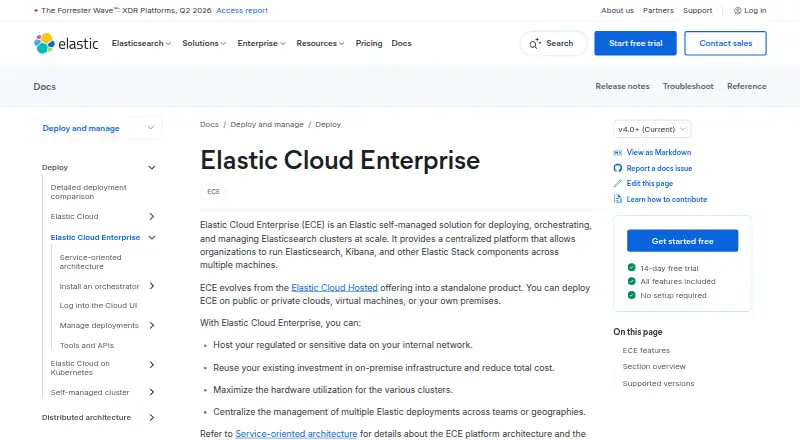
What Elastic Cloud Enterprise is
Elastic Cloud Enterprise (ECE) is a self-managed solution for deploying and operating Elasticsearch clusters at scale. It automates provisioning, scaling and upgrades, with management through a web interface or API. ECE can run on public or private clouds, virtual machines or on-premises infrastructure; listed public cloud providers are Amazon Web Services, Google Cloud Platform and Microsoft Azure. It supports high availability through multiple Availability Zones, data replication and automated restore and snapshots. Deployments can include Elasticsearch and Kibana, with optional APM and Fleet services. On version 8.0 and later, users can add a combined APM Server and Fleet Server. Access controls include platform roles and external authentication providers such as Active Directory, LDAP and SAML. Network traffic is encrypted by default, but encryption at rest requires configuration on hosts and snapshot targets. ECE does not support isolating a specific cluster on entirely dedicated hardware. Elastic describes it for internal hosting of sensitive data, reuse of on-premises infrastructure and centralized management across teams or geographies. Licensing is based on node count and used RAM; pricing is on request.
Who it suits
ECE is aimed at teams that want to manage Elasticsearch deployments on cloud or on-premises infrastructure. It may suit organisations centralizing deployments across teams or geographies, or hosting sensitive data on an internal network.
What it does well
- Automates cluster provisioning, scaling and upgrades
- Supports multiple Availability Zones and data replication
- Offers web and API management
- Supports role-based access and external authentication
- Network traffic is encrypted by default
What to know first
- Encryption at rest needs configuration
- Clusters cannot use entirely dedicated hardware
- FIPS support is not officially validated
Limits
Pricing is on request, and licensing is based on the number of nodes and used RAM. Encryption at rest is not provided out of the box and requires configuration on hosts and snapshot targets.
Plans
| Plan | Billed and limits | Price |
|---|---|---|
| License-based pricing | Licensing based on number of nodes and used RAM · Number of nodes · used RAM | On request |
As elastic.co lists them, read 3 Oct 2026. The maker's own page has the final word.
Getting started
- Review the Elastic Cloud Enterprise deployment documentation.
- Choose a deployment location: public or private cloud, virtual machines, or on-premises.
- For public cloud, select from Amazon Web Services, Google Cloud Platform, or Microsoft Azure.
- Prepare a supported installation operating system.
- Request pricing; licensing is based on node count and used RAM.
Verdict
ECE provides centralized management and high-availability features for self-managed Elasticsearch clusters across several deployment environments. Review the configuration needed for encryption at rest and the dedicated-hardware limitation before choosing it.
Questions
What does Elastic Cloud Enterprise manage?
It deploys, orchestrates and manages Elasticsearch clusters, automating provisioning, scaling and upgrades.
Where can ECE be deployed?
It can run on public or private clouds, virtual machines, or on-premises. Listed public cloud providers are Amazon Web Services, Google Cloud Platform and Microsoft Azure.
How is ECE priced?
Pricing is on request. Licensing is based on the number of nodes and used RAM.
Which components can deployments include?
Deployments can include Elasticsearch and Kibana, with optional APM and Fleet services. On version 8.0 and later, users can add a combined APM Server and Fleet Server.
Does ECE encrypt data?
It encrypts network traffic by default. Encryption at rest requires configuration on hosts and snapshot targets.
Does ECE support FIPS compliance?
FIPS compliance is not officially supported or validated for ECE, and its use is not recommended for production environments.
Facts from Elastic Cloud Enterprise's own pages
- Authentication and access
- ECE supports platform role-based access control and external authentication providers including Active Directory, LDAP, and SAML. · elastic.co, 3 Oct 2026
- Availability
- ECE supports high availability through multiple Availability Zones, data replication, and automated restore and snapshot. · elastic.co, 3 Oct 2026
- Cloud providers
- For public cloud deployments, Elastic lists Amazon Web Services, Google Cloud Platform, and Microsoft Azure. · elastic.co, 3 Oct 2026
- Cluster management
- ECE automates cluster provisioning, scaling, and upgrades. · elastic.co, 3 Oct 2026
- Deployment locations
- ECE can be deployed on public or private clouds, virtual machines, or on-premises. · elastic.co, 3 Oct 2026
- Elastic Stack components
- ECE deployments can include Elasticsearch and Kibana, with optional services such as APM and Fleet. · elastic.co, 3 Oct 2026
- Encryption
- ECE encrypts network traffic by default, but does not provide encryption at rest out of the box; hosts and snapshot targets must be configured for it. · elastic.co, 3 Oct 2026
- FIPS support
- FIPS compliance is not officially supported or validated for ECE and is not recommended for production environments. · elastic.co, 3 Oct 2026
- Founded
- 2012 · elastic.co, 28 Sept 2026
- Integrations
- For deployments on version 8.0 and later, users can add a combined APM Server and Fleet Server. · elastic.co, 3 Oct 2026
- Intended use
- Elastic describes ECE as useful for hosting sensitive data on an internal network, reusing on-premises infrastructure, and centrally managing deployments across teams or geographies. · elastic.co, 3 Oct 2026
- Management interface
- ECE provides a web interface and API for creating and managing clusters. · elastic.co, 3 Oct 2026
- Notable limitation
- ECE does not support running a specific cluster on entirely dedicated hardware separate from other clusters. · elastic.co, 3 Oct 2026
- Operating systems
- ECE installation guidance names Ubuntu 20.04 and 22.04, RHEL 8, 9, and 10, Rocky Linux 8 and 9, and SUSE Linux Enterprise Server 12 SP5 and 15. · elastic.co, 3 Oct 2026
- Purpose
- Elastic Cloud Enterprise is a self-managed solution for deploying, orchestrating, and managing Elasticsearch clusters at scale. · elastic.co, 3 Oct 2026
Where Elastic Cloud Enterprise stands on Freedom251
- Search Analytics Software#14 of 37
- Database Administration Tools#19 of 34
- AI Search and Discovery Platforms Software#17 of 28
- Enterprise Search Software#13 of 20