Freedom251 › Retail Media Advertising Platforms

Constructor
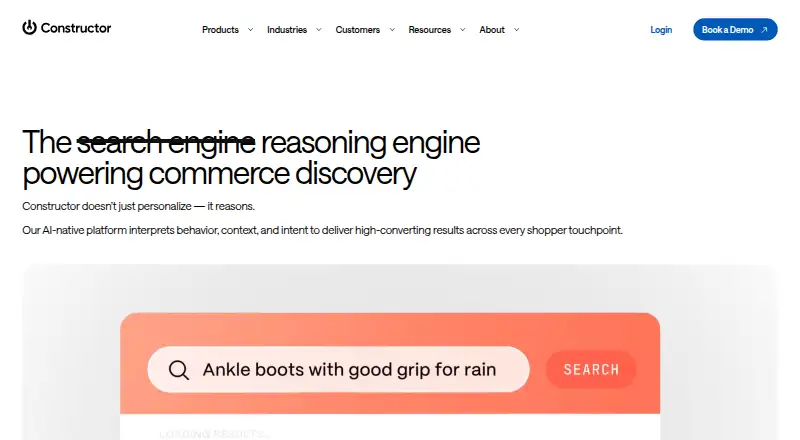
What Constructor is
Constructor is an AI-native commerce discovery platform for retailers, founded in 2015. Its suite covers ecommerce search, autosuggest, browse, recommendations, collections, quizzes, and retail media, using shopper behavior, context, and intent to personalize product discovery. The AI Shopping Agent guides shoppers through natural-language product requests, while the Product Insights Agent answers personalized product questions. Merchant Intelligence Agent and Merchandiser Controls provide insights, dashboards, reports, and experiments for merchandising teams. B2B capabilities include account-segmented pricing and availability, personalization, and discovery across large catalogs. The platform supports hybrid and vector search, faceted search, zero-result reporting, search conversion tracking, and result click analytics. Catalogs can be supplied through platform connectors, scheduled JSON, JSONL, or CSV feeds, or REST API updates. REST APIs and client libraries support retrieving results, sending behavioral events, and updating catalog data or settings; documented libraries include JavaScript, Swift, and Kotlin. Constructor says it minimizes personal data through anonymous IDs, IP address truncation, and hashed identifiers. Pricing is on request.
Who it suits
Constructor suits retailers looking to add search and discovery tools to ecommerce, including businesses with B2B catalogs. Its AI Shopping Agent is described as purpose-built for enterprise ecommerce.
What it does well
- Search, browse, recommendations, and retail media in one suite
- Natural-language product discovery agent
- Supports hybrid, vector, and faceted search
- REST API and browser, Swift, and Kotlin libraries
What to know first
- Pricing is available on request
- Security audit reports require an NDA
Limits
The custom enterprise plan has no published price; prospective customers are directed to book a demo to discuss the platform.
Plans
| Plan | Billed and limits | Price |
|---|---|---|
| Custom enterprise pricing | Pricing is not published; book a demo to discuss the platform. | On request |
As constructor.com lists them, read 7 Oct 2026. The maker's own page has the final word.
Getting started
- Visit constructor.com and book a demo to discuss the platform.
- Discuss account and index configuration with Constructor’s integration team.
- Provide catalog data through a platform connector, scheduled JSON, JSONL or CSV feed, or REST API updates.
- Map data and review the integration with the integration team.
- Use the REST API or client libraries to retrieve results and send behavioral events.
Overview
Constructor is a commerce discovery platform for retailers, including B2B teams with large catalogs. It is strongest for organizations that want search, personalization, and merchant controls in one system; the enterprise orientation and demo-led buying process make it a poor fit for teams seeking a quick, self-serve purchase.
Key features
The suite covers ecommerce search, autosuggest, browse, recommendations, collections, quizzes, and retail media. Hybrid and vector search, faceted navigation, and zero-result reporting give teams ways to improve how shoppers find products. Search-conversion tracking and result-click analytics help assess engagement. This breadth makes sense when discovery is part of a wider merchandising program, but may be excessive for a retailer that only needs a focused search tool.
Constructor's Commerce Reasoning Engine uses clickstream and other shopper and market data to personalize discovery across touchpoints in real time. Its AI Shopping Agent guides shoppers with natural-language queries and product recommendations, while the Product Insights Agent handles personalized product questions. These tools are aimed at enterprise ecommerce, so they are better suited to retailers with substantial discovery operations than to smaller stores looking for a lightweight add-on.
Merchant Intelligence Agent and Merchandiser Controls bring analytics, dashboards, reports, controls, and experiments into the same product suite. That can help merchandising teams act on discovery performance without treating search as a standalone technical function. B2B tools support account-segmented pricing and availability, personalization, and discovery across large catalogs, a relevant distinction for business sellers with varied customer accounts.
Catalogs can be supplied through platform connectors, scheduled JSON, JSONL, or CSV feeds, or item-by-item REST API updates. The REST API supports product data, result retrieval, and settings such as synonyms, redirects, and searchandising; browser and server-side client libraries support multiple languages, with JavaScript, Swift, and Kotlin among the documented options. Constructor's integration team helps configure accounts and indexes, map data, review integrations, and test results with business and merchandising teams. That support is useful for a complex rollout, though it does not turn the product into a self-service deployment.
Constructor says its service is independently audited under SOC 2 Type 2 and ISO 27001, with reports available under NDA. It describes controls including multi-factor authentication, device trust, role-based access, and regular external penetration tests. Its privacy measures include anonymous IDs, IP address truncation, and hashed identifiers to reduce links to personally identifiable information.
Pricing
Constructor uses paid, custom enterprise pricing. It does not publish a plan price; prospective customers are directed to book a demo to discuss the platform. That approach is more appropriate for retailers evaluating a broad enterprise deployment than for smaller teams that need to compare costs and start without a sales conversation.
Platforms
Constructor supports web, iOS, Android, and API access. Its cloud deployment and REST query interface suit teams integrating discovery into ecommerce experiences across web and mobile, while client libraries provide additional implementation paths.
Who it's for
Constructor is best suited to retailers with large or complex catalogs, dedicated merchandising teams, and a need to connect search, personalization, and analytics. Its account-segmented B2B capabilities make it relevant to business ecommerce as well. Smaller shops or buyers who want a narrow, low-cost recommendation tool may find the enterprise scope and custom sales process disproportionate.
Pros and cons
- Pro: Search, recommendations, retail media, collections, and AI shopping agents sit alongside merchant controls, reducing the need to treat discovery and merchandising as separate initiatives.
- Pro: B2B account-level pricing and availability address catalog and personalization needs that general retail search may not cover.
- Pro: Multiple catalog ingestion methods and integration-team support provide options for organizations with established data and commerce systems.
- Con: Custom pricing and a demo-led process make cost comparison and self-serve adoption difficult.
- Con: The enterprise focus and broad toolset may be more than smaller retailers need when they are looking for one specific discovery capability.
Alternatives
Recombee is worth considering when a recommendation-focused option with a free tier is a better fit: its free plan caps usage at fewer than 100,000 interactions and recommendation requests per month, fewer than 20,000 active users per month, and fewer than 20,000 catalog items.
Personyze offers a free plan with 5,000 pageviews, one domain, three active campaigns, eight AI tasks a month, and email support. It is a more accessible starting point for teams that can work within those limits.
Alterable has a free Engage plan with limits including 10,000 impressions per month and local maps for up to 10 locations, making it an option to examine when those constraints fit the use case.
Wiser AI has a free plan for up to 50 orders and a $9 a month tier for 51–100 orders. It may suit buyers whose needs align with those order-based tiers.
Dynamic Yield is another paid platform to compare for teams considering an enterprise alternative.
Athos Commerce Personalization offers a standalone annual Onsite Discovery plan with search, merchandising, and personalization, plus optional AI modules; consider it when that narrower scope matches the requirement.
DYMATRIX Web Analytics is another paid option to compare.
SocialHub.AI Recommendation Engine is another paid option to compare.
For adjacent categories, see Email Personalization Software, Search Analytics Software, and Search Databases.
Verdict
Choose Constructor if you are a retailer or B2B ecommerce operator that needs broad product discovery, personalization, and merchandising controls in one cloud platform. Its combination of search, analytics, agent features, and integration support is the central reason to consider it. Look elsewhere if you need transparent pricing, a fast self-serve start, or only a small, focused tool.
Verdict
Constructor brings product discovery, shopper personalization, and merchandising tools together for retail ecommerce. Its broad search and agent features are relevant to retailers, while pricing requires a demo discussion.
Questions
How much does Constructor cost?
Pricing is custom and is discussed through a demo; plan prices are not published.
Which platforms does Constructor support?
Its listed platforms are Android, API, iOS, and web.
What search features does it include?
It supports hybrid, vector, and faceted search, plus zero-result reporting, search conversion tracking, and result-click analytics.
Can Constructor connect with commerce platforms?
Its partner list includes Akeneo, Alokai, BigCommerce, commercetools, Contentful, Contentstack, Salesforce Commerce Cloud, Shopify, and VTEX.
What API and client libraries are available?
Constructor documents REST API access and client libraries for JavaScript in browsers, Swift on iOS, and Kotlin on Android.
What security and privacy controls does Constructor describe?
It says its service is independently audited under SOC 2 Type 2 and ISO 27001, and describes access controls, external penetration tests, and practices to minimize and anonymize personal data.
Facts from Constructor's own pages
- AI shopping agent
- The AI Shopping Agent uses natural-language queries to guide shoppers and recommend products. · constructor.com, 7 Oct 2026
- API and mobile
- Constructor documents REST API access and client libraries for JavaScript in browsers, Swift on iOS, and Kotlin on Android. · docs.constructor.com, 7 Oct 2026
- API and SDKs
- Its REST API supports sending product data, retrieving results, and controlling settings such as synonyms, redirects, and searchandising. · docs.constructor.com, 7 Oct 2026
- Audience
- Constructor says its product search and discovery solution is built for retailers, with dedicated solutions for B2B ecommerce and several retail sectors. · constructor.com, 7 Oct 2026
- B2B
- Constructor says its B2B solutions support account-segmented pricing and availability, personalization, and discovery across large catalogs. · constructor.com, 7 Oct 2026
- Company history
- Constructor says it was founded in 2015 by Eli Finkelshteyn and Dan McCormick. · constructor.com, 7 Oct 2026
- Data privacy
- Constructor says it minimizes personal data and uses anonymous IDs, removes the last octet of IP addresses, and hashes identifiers to reduce the risk of linking IDs to personally identifiable information. · constructor.com, 7 Oct 2026
- Discovery features
- The suite includes search and browse, recommendations, retail media, collections, and AI shopping agents. · constructor.com, 7 Oct 2026
- Founded
- 2015 · constructor.com, 28 Sept 2026
- Implementation support
- Constructor's integration team helps configure accounts and indexes, map data, review integrations, and test results with business and merchandising teams. · docs.constructor.com, 7 Oct 2026
- Integration methods
- Catalogs can be supplied through platform connectors, scheduled JSON, JSONL or CSV feeds, or item-by-item REST API updates. · docs.constructor.com, 7 Oct 2026
- Integrations
- Constructor's partner page lists technology partners including Akeneo, Alokai, BigCommerce, commercetools, Contentful, Contentstack, Salesforce Commerce Cloud, Shopify, and VTEX. · constructor.com, 7 Oct 2026
- Intended customers
- The AI Shopping Agent is described as purpose-built for enterprise ecommerce. · constructor.com, 7 Oct 2026
- Merchandising
- Merchant Intelligence Agent and Merchandiser Controls provide insights, controls, dashboards, reports, and experiments for product discovery. · constructor.com, 7 Oct 2026
- Merchant tools
- The product suite includes merchant controls and intelligence for analytics, merchandising, and experiments. · constructor.com, 7 Oct 2026
- Personalization
- Its Commerce Reasoning Engine uses website clickstream and other shopper and market data to personalize discovery across touchpoints in real time. · constructor.com, 7 Oct 2026
- Pricing availability
- The official site directs prospective customers to book a demo and does not show plan prices on the pages reviewed. · constructor.com, 7 Oct 2026
- Privacy
- Constructor says it minimizes personal data and anonymizes identifiers using anonymous IDs, IP address truncation, and hashing. · constructor.com, 7 Oct 2026
- Product
- Constructor describes itself as an AI-native commerce discovery platform that interprets shopper behavior, context, and intent. · constructor.com, 7 Oct 2026
- Search and discovery
- Its suite includes ecommerce search, autosuggest, browse, recommendations, collections, quizzes, and retail media. · constructor.com, 7 Oct 2026
- Security audits
- Constructor says its service is independently audited under SOC 2 Type 2 and ISO 27001; reports are available through an account executive or customer success manager under NDA. · constructor.com, 7 Oct 2026
- Security controls
- The company describes access controls including multi-factor authentication, device trust, and role-based access management, along with regular external penetration tests. · constructor.com, 7 Oct 2026
- Shopping agents
- The platform offers an AI Shopping Agent for natural-language product discovery and a Product Insights Agent for personalized product questions. · constructor.com, 7 Oct 2026
- Supported client libraries
- Constructor offers browser and server-side client libraries in multiple programming languages for retrieving results, sending behavioral events, and updating catalog data or configurations. · docs.constructor.com, 7 Oct 2026
Where Constructor stands on Freedom251
- Retail Media Advertising Platforms#1 of 9
- Email Personalization Software#8 of 23
- Search Analytics Software#13 of 37
- Recommender Systems#12 of 25
- Product Search and Discovery Software#13 of 27
- AI Search and Discovery Platforms Software#16 of 28
- Site Search Software#17 of 25
- Search Databases#24 of 30