Freedom251 › API Marketplace Software
Datovu
What Datovu is
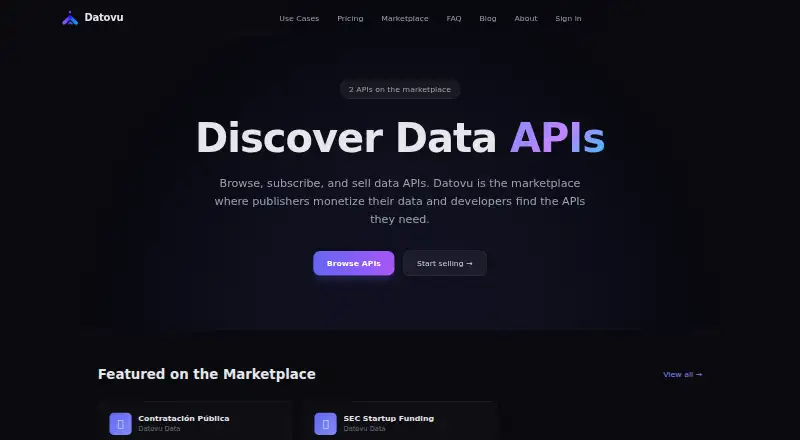
Datovu helps users collect and index information, then publish datasets as data APIs without writing backend infrastructure. Its AI agent can plan research from natural-language instructions, search across sources, and return structured data. Inputs include CSV, JSON, and PDF files, pasted text, connected data feeds, and web results, which can be combined in one searchable index. The API builder creates REST APIs with generated endpoints, pagination, filtering, and documentation. Publishers can set up checkout, usage metering, and payouts through Stripe Connect, and list APIs in a marketplace where visitors can discover and subscribe without an account. Datovu is available on the web and by API, with cloud deployment. A free plan is available; paid plans start at $29 a month. Operations stop at plan limits without overage charges, with alerts at 80%, 90%, and 100% usage. Datovu says data is isolated by user and team and offers zero-retention options. It says it respects robots.txt and website terms and does not support unauthorized scraping of login-gated or legally protected content.
Who it suits
It suits developers building data APIs, data teams monetizing datasets, and companies creating internal knowledge APIs. Publisher plans also support multi-user workspaces with assigned roles.
What it does well
- Combines file, text, feed, and web inputs in one index
- Builds REST APIs with pagination and filtering
- Marketplace discovery and subscriptions do not require an account
- No overage charges when operations reach plan limits
- Offers zero-retention options
What to know first
- Free plan allows 150 actions per month
- Free plan includes one published API
- Operations stop at plan limits
- No free trial
Limits
The Free plan includes 150 actions per month, one published API, one dataset, 100 documents, 10 API-hours, and 1,000 API requests per month. Operations stop at plan limits without overage charges.
Plans
| Plan | Billed and limits | Price |
|---|---|---|
| Free | $0/mo · 150 actions/mo · 1 API published · 1 dataset · 100 docs · 10 API-hours/mo · 1K API requests/mo · Community support | Free |
| Business | $199/mo · 5,000 actions/mo · Up to 25 APIs · Unlimited datasets and docs · 1M API requests/mo · Dedicated support | $199 a month |
| Starter | $29/mo · 200 actions/mo · 1 API · 24/7 · 1 dataset · 1K docs · 10K API requests/mo · Basic support | $29 a month |
| Publisher Business | $299/mo · 5,000 actions/mo · 25 APIs · 24/7 · Custom plans for clients · 8% commission · API analytics dashboard · 1M API requests/mo · Priority support | $299 a month |
| Maker | $49/mo · 500 actions/mo · 3 APIs · 24/7 · 3 datasets · 5K docs each · 50K API requests/mo · Basic support | $49 a month |
| Publisher Scale | $699/mo · 20,000 actions/mo · 100 APIs · 24/7 · White-label option · 5% commission · 5M API requests/mo · Priority support | $699 a month |
| Publisher Pro | $99/mo · 1,000 actions/mo · 5 APIs · 24/7 · 15% commission · Automatic payouts · 100K API requests/mo · Priority support | $99 a month |
| Pro | $99/mo · 1,000 actions/mo · 5 APIs · 24/7 · 5 datasets · 10K docs each · 100K API requests/mo · Priority support | $99 a month |
The first 8 of 9 plans, as datovu.com lists them, read 30 Sept 2026. The maker's own page has the final word. Every plan
Getting started
- Visit Datovu on the web or use its API.
- Choose the Free plan or a paid plan starting at $29 a month.
- Upload CSV, JSON, or PDF files, paste text, connect data feeds, or use web results.
- Build a REST API from a dataset using generated endpoints and available API options.
- If publishing an API, configure checkout, usage metering, and payouts through Stripe Connect.
Datovu is a cloud service for assembling data, creating REST APIs, and selling access to those APIs. It is best suited to developers, data teams, and companies building internal knowledge services or commercial datasets. The deciding question is whether its quotas and cloud-only deployment fit your workload.
Overview
Datovu combines research, ingestion, indexing, API deployment, and publisher payments in one workflow. Its AI agent turns natural-language instructions into research plans, searches across sources, and returns structured data. You can add CSV, JSON, and PDF files, paste text, or connect feeds, then search those inputs alongside web results. That combination is useful when information arrives in several formats rather than one maintained database.
The service generates REST endpoints from datasets, including pagination, filtering, and documentation. Publishers also get checkout, usage metering, and payouts handled through Stripe Connect. Its marketplace allows discovery and subscription to data APIs without an account, reducing a common sign-up barrier for buyers. Datovu says each user and team has isolated data, injected data is not shared between accounts, and zero-retention options are available. It respects robots.txt and website terms and does not support unauthorized scraping of login-gated or legally protected material.
Key features
Research and indexing
The AI-led research flow is a practical starting point for teams that need to turn broad questions into structured records. Combining uploads, pasted material, feeds, and web results in one index avoids stitching together separate collection tools, although action and document quotas can constrain intensive research.
API creation
Generated REST APIs with pagination, filtering, and documentation remove much of the backend work normally required to expose a dataset. This is a strong fit for developers who want a publishable interface quickly, while teams requiring infrastructure outside the cloud should look elsewhere.
Billing and integrations
Checkout, metering, and payouts make Datovu more than an API builder for publishers planning subscription revenue. Webhooks can send notifications into other workflows, and API connections can provide injected data. Payments through Stripe Connect give the billing path a defined provider rather than an in-house mechanism.
Controls and limits
Operations stop at the plan limit without overage charges, and alerts arrive at 80%, 90%, and 100% usage. That protects against surprise bills but can interrupt a production workflow when a quota is exhausted. Business and Publisher plans add multi-user workspaces with administrator, member, and viewer roles.
Pricing
Datovu has a free tier and no free trial. The Free plan costs nothing and includes 150 actions, one published API, one dataset, 100 documents, 10 API-hours, 1K API requests, and community support. It is suitable for a small proof of concept, not a busy service.
Starter costs $29 a month for 200 actions, one API, 24/7 availability, one dataset, 1K documents, 10K requests, and basic support. Maker is $49 a month, raising capacity to 500 actions, three APIs, three datasets, 5K documents each, and 50K requests. These plans suit individual builders and small projects, but the modest action allowances remain a constraint.
Pro costs $99 a month for 1,000 actions, five APIs, five datasets, 10K documents each, 100K requests, and priority support. Publisher Pro costs the same and adds a 15% commission and automatic payouts. Choose Pro for internal or direct API use; choose Publisher Pro when Datovu handles customer billing and revenue distribution.
Business costs $199 a month with 5,000 actions, up to 25 APIs, unlimited datasets and documents, 1M requests, and dedicated support. Publisher Business costs $299 a month for 5,000 actions, 25 APIs, custom client plans, an 8% commission, analytics, 1M requests, and priority support. Publisher Scale costs $699 a month for 20,000 actions, 100 APIs, white-labeling, a 5% commission, 5M requests, and priority support. Enterprise uses custom pricing and adds negotiated terms, SLA guarantees, dedicated infrastructure, custom actions and requests, dedicated support, and a 2% commission. Higher publisher tiers make more sense when commission and API volume outweigh the subscription cost.
Platforms
Datovu runs as a cloud service through web and API access. It does not provide a self-hosted deployment option, so organizations requiring local infrastructure should account for that limitation.
Who it's for
Developers can use Datovu to expose datasets without building backend infrastructure. Data teams gain a route to index mixed inputs and monetize reusable collections. Companies building internal knowledge APIs benefit from combining research and private data under team isolation. It is less suitable for workloads that need self-hosting, unrestricted scraping, or guaranteed continuation after fixed monthly quotas are reached.
Pros and cons
- Pros: One workflow spans AI research, mixed-source indexing, REST API generation, and publisher billing.
- Pros: Free entry tier and clear stop-at-limit behavior avoid surprise overage charges.
- Pros: Team roles, data isolation, zero-retention options, and webhook support address operational and privacy needs.
- Cons: Every plan caps actions, documents, datasets, or requests, which can interrupt growing workloads.
- Cons: Cloud deployment and stated scraping restrictions rule out some infrastructure and collection strategies.
- Cons: Publisher plans take commissions, from 15% on Publisher Pro to 2% on Enterprise.
Alternatives
API Marketplace Software is a useful category comparison when you want to review marketplace-focused products broadly. Choose Postman instead for a freemium API client with collection tools, mock servers, native Git, and extension, desktop, and web platforms. Gravitee API Gateway is the better direction for an Apache 2.0 community edition and self-hosted gateway. Kong Gateway suits teams wanting a 30-day free trial with no gateway limits. API.market is another freemium marketplace option. api0.app fits a small deployment needing up to two live endpoints and 10,000 requests monthly on its free plan. APILayer Marketplace offers a 100-request monthly free plan and a $19.99 a month starter tier. FabriXAPI is worth considering for its free public and unlisted plan allowances. Fusio is the alternative when an open-source, Apache 2.0 API management platform is the priority.
Verdict
Choose Datovu if you need one cloud workflow that turns varied inputs into documented APIs and can also charge subscribers. Its strongest advantage is the span from research to monetization. Look elsewhere if self-hosting, unrestricted collection, or capacity beyond fixed monthly quotas is central to your operation.
Verdict
Datovu brings data collection, API creation, and publisher billing into one cloud platform, with a free entry tier and paid plans from $29 a month. Consider its plan limits and its stated restrictions on scraping when evaluating a workflow.
Questions
How much does Datovu cost?
The Free plan costs nothing. Paid plans start at $29 a month; Enterprise uses custom pricing.
What is included in Datovu’s free plan?
It includes 150 actions per month, one published API, one dataset, 100 documents, 10 API-hours, 1,000 API requests per month, and community support.
Which platforms does Datovu support?
Datovu is available on the web and through an API. Its deployment option is cloud.
Can Datovu connect to other data sources?
Users can connect data feeds and API connections. Webhooks can connect notifications to workflows.
How does Datovu handle publisher payments?
It provides checkout, usage metering, and payouts for API publishers, and says payments are handled through Stripe Connect.
What happens when a plan reaches its usage limit?
Operations stop at plan limits without overage charges. Datovu sends usage alerts at 80%, 90%, and 100%.
Facts from Datovu's own pages
- API builder
- Datovu deploys REST APIs from datasets with generated endpoints, pagination, filtering, and documentation. · datovu.com, 30 Sept 2026
- Data inputs
- Users can upload CSV, JSON, and PDF files, paste text, or connect data feeds, combining these inputs with web results in one searchable index. · datovu.com, 30 Sept 2026
- Integrations
- The FAQ says injected data can come from API connections and that webhooks can connect notifications to any workflow. · datovu.com, 30 Sept 2026
- Marketplace
- The marketplace lets people discover and subscribe to publishers’ data APIs without an account. · datovu.com, 30 Sept 2026
- Privacy
- Datovu says data is isolated per user and team, injected data is not shared across accounts, and zero-retention options are available. · datovu.com, 30 Sept 2026
- Product
- Datovu is a platform to collect, index, and monetize data by building data APIs without writing backend infrastructure. · datovu.com, 30 Sept 2026
- Publisher billing
- For API publishers, Datovu provides checkout, usage metering, and payouts, and says payments are handled through Stripe Connect. · datovu.com, 30 Sept 2026
- Scraping limits
- Datovu says it respects robots.txt and website terms and does not support scraping login-gated or legally protected content without authorization. · datovu.com, 30 Sept 2026
- Search and research
- Its AI agent can plan research from natural-language instructions, search across sources, and deliver structured data. · datovu.com, 30 Sept 2026
- Support
- The Free plan includes community support, paid plans list basic, priority, or dedicated support according to tier, and the Enterprise plan offers dedicated support. · datovu.com, 30 Sept 2026
- Target users
- Datovu describes its intended users as developers needing data APIs, data teams monetizing datasets, and companies building internal knowledge APIs. · datovu.com, 30 Sept 2026
- Team access
- Business and Publisher plans support multi-user workspaces with admin, member, and viewer roles. · datovu.com, 30 Sept 2026
- Usage limits
- Operations stop at plan limits without overage charges, and the service sends usage alerts at 80%, 90%, and 100%. · datovu.com, 30 Sept 2026
Where Datovu stands on Freedom251
- API Marketplace Software#7 of 36
- Data as a Service (DaaS) Software#4 of 12