Freedom251 › Schema Registry Software

Dataphos Schema Registry
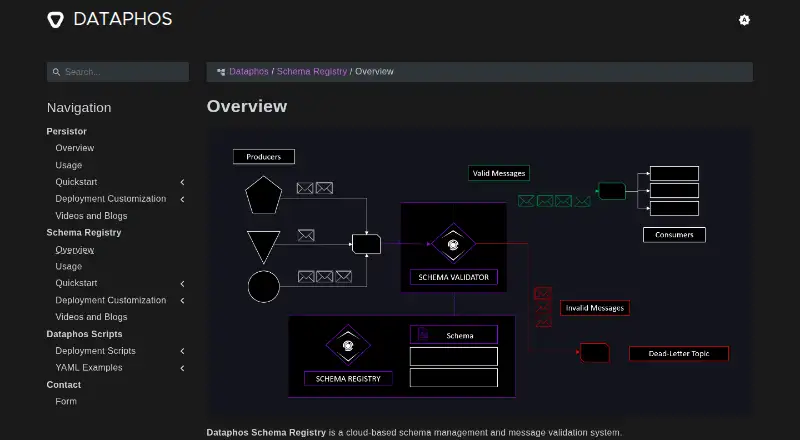
What Dataphos Schema Registry is
Dataphos Schema Registry manages schemas for serialized data in streaming systems and checks events as they move through the infrastructure. Its REST API supports registering schemas, updating versions, retrieving or deleting them, and checking schema validity and compatibility. The registry retains version history, with BACKWARD as the default compatibility mode. Other documented modes include forward and full compatibility, their transitive variants, and none; validity defaults to FULL, with NONE and SYNTAX_ONLY also available.
Validators handle JSON, Avro, Protocol Buffers, XML, and CSV. They support GCP Pub/Sub, Azure Service Bus, Azure Event Hubs, Apache Kafka, Apache Pulsar, and NATS JetStream. Validation results determine whether a message is routed to a valid topic or a dead-letter topic. The product can also support producers and consumers using different protocols, such as Kafka and Pub/Sub.
The registry and validators run as deployments in Kubernetes. Deployment guidance covers Shell, Helm, and Pulumi. The Shell quickstart calls for cluster nodes with at least 8 GB of available RAM. The documentation identifies Dataphos Schema Registry as open source, available through an API or for self-hosting, and a Syntio product.
Who it suits
Dataphos Schema Registry suits teams building distributed data architectures that need shared schemas and validation of streaming events. It is relevant to operators using the supported brokers and formats who can deploy services in Kubernetes.
What it does well
- Stores versioned schema history and exposes a REST API.
- Supports five message formats, including Avro and Protocol Buffers.
- Works with six listed message brokers and services.
- Routes validation failures to a dead-letter topic.
- Offers Shell, Helm, and Pulumi deployment guidance.
What to know first
- The Shell quickstart calls for at least 8 GB of available RAM on Kubernetes nodes.
- The registry and validators run as Kubernetes deployments.
Getting started
- Open the Dataphos Schema Registry documentation.
- Prepare a Kubernetes cluster with nodes meeting the Shell quickstart's 8 GB available RAM requirement.
- Choose Shell, Helm, or Pulumi deployment guidance.
- Deploy the registry and validators in the cluster.
- Register schemas and configure validation and compatibility checks.
Verdict
Choose Dataphos Schema Registry when a streaming architecture needs managed schema versions, compatibility checks, and validation-based routing across its supported formats and brokers. It is less suited to teams without a Kubernetes deployment environment or the cluster capacity specified by the Shell quickstart.
Questions
Is Dataphos Schema Registry free?
It is listed as free and open source.
Can it be self-hosted?
Yes. The registry and validators run as deployments in a Kubernetes cluster.
Which message formats are supported?
Validators support JSON, Avro, Protocol Buffers, XML, and CSV.
Which brokers and messaging services does it support?
The validator supports GCP Pub/Sub, Azure Service Bus, Azure Event Hubs, Apache Kafka, Apache Pulsar, and NATS JetStream.
What is the default compatibility mode?
The default schema compatibility type is BACKWARD.
Who makes the product?
The documentation identifies Dataphos Schema Registry as a Syntio product.
Facts from Dataphos Schema Registry's own pages
- Compatibility
- The documented compatibility modes include backward, forward and full compatibility, with transitive variants; the default is BACKWARD. · docs.dataphos.com, 4 Oct 2026
- Compatibility default
- The default schema compatibility type is BACKWARD. · docs.dataphos.com, 8 Oct 2026
- Deployment
- The Registry and Validator run as deployments in a Kubernetes environment. · docs.dataphos.com, 8 Oct 2026
- Deployment prerequisites
- The shell quickstart specifies a Kubernetes cluster node or nodes with at least 8 GB of available RAM. · docs.dataphos.com, 8 Oct 2026
- Infrastructure requirement
- The Shell quickstart says the Kubernetes cluster nodes should have at least 8 GB of available RAM. · docs.dataphos.com, 4 Oct 2026
- Intended use
- The documentation describes the product for distributed data architectures that need shared schemas and validated streaming messages. · docs.dataphos.com, 8 Oct 2026
- Maker
- The documentation identifies Dataphos as a Syntio product. · docs.dataphos.com, 4 Oct 2026
- Message brokers
- The Validator supports GCP Pub/Sub, Azure ServiceBus, Azure Event Hubs, Apache Kafka, Apache Pulsar, and NATS JetStream. · docs.dataphos.com, 8 Oct 2026
- Message formats
- Validators support JSON, Avro, Protocol Buffers, XML and CSV. · docs.dataphos.com, 4 Oct 2026
- Message routing
- Validators route messages that pass validation to a valid topic and messages that fail to a dead-letter topic. · docs.dataphos.com, 8 Oct 2026
- Monitoring
- The Helm quickstart lists Prometheus as an optional resource for gathering metrics and monitoring logs. · docs.dataphos.com, 8 Oct 2026
- Protocol conversion
- The product can support producers and consumers using different protocols, such as Kafka and Pub/Sub. · docs.dataphos.com, 8 Oct 2026
- Purpose
- Dataphos Schema Registry manages schemas and validates messages against them. · docs.dataphos.com, 8 Oct 2026
- Schema formats
- Validators support JSON, Avro, Protocol Buffers, XML, and CSV. · docs.dataphos.com, 8 Oct 2026
- Schema history
- The registry stores versioned schema history and provides a REST API for managing schemas. · docs.dataphos.com, 4 Oct 2026
- Schema management
- The Registry supports schema registration, versioning, retrieval, deletion, validity checks, and compatibility checks. · docs.dataphos.com, 8 Oct 2026
- Schema operations
- The registry supports schema registration, version updates, retrieval, deletion, validity checks and compatibility checks. · docs.dataphos.com, 4 Oct 2026
- Validation routing
- The validator routes messages based on validation results, sending valid messages to a valid topic and invalid messages to a dead-letter topic. · docs.dataphos.com, 4 Oct 2026
- Validity default
- The default schema validity type is FULL; the documented modes are FULL, NONE, and SYNTAX_ONLY. · docs.dataphos.com, 8 Oct 2026
Where Dataphos Schema Registry stands on Freedom251
- Schema Registry Software#21 of 26