Freedom251 › Schema Registry Software
Cloudera Schema Registry
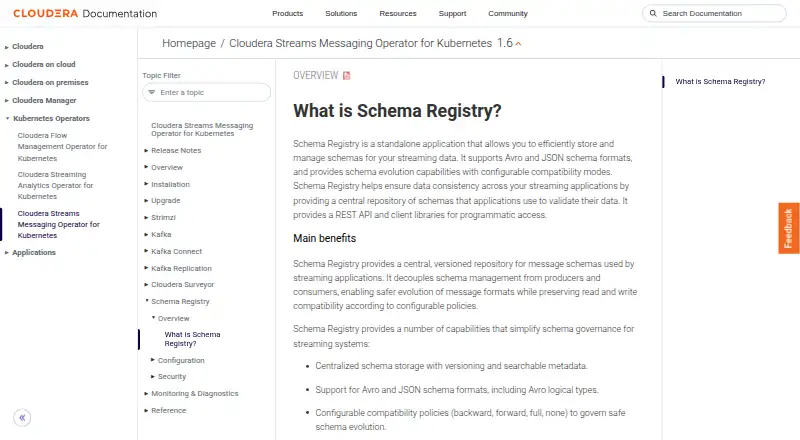
What Cloudera Schema Registry is
Cloudera Schema Registry provides a shared repository for schemas used by streaming applications. It stores and manages schemas centrally so applications can validate event data, while schema identifiers and versioning help teams manage changes to producer and consumer message formats. It supports Avro and JSON schemas, including Avro logical types, and offers backward, forward, full, or no compatibility checks. Searchable metadata helps users find schemas.
Its REST API supports schema and version management, file import and export, search, aggregation, and Confluent-compatible endpoints. Documented integration points include custom NiFi processors and Kafka serializers and deserializers. Schema metadata can be stored in MySQL, PostgreSQL, or Oracle; serializer and deserializer JARs can be stored on local filesystems or HDFS, with local storage as the default. The Kubernetes Operator edition packages Cloudera Runtime Schema Registry as a Helm chart for Kubernetes deployment. TLS can secure application, client, OAuth, and database traffic. The documented secure Kubernetes installation configures authentication, authorization, and channel encryption using OAuth with an external server. The UI does not support OAuth login, so its use in this release is limited to unauthenticated technical previews or development environments; secured production use should rely on the REST API.
Who it suits
Cloudera Schema Registry suits streaming application teams that need a shared place to manage schemas and validate event data as message formats evolve. Its documented Kafka and NiFi integration points and Kubernetes Operator edition may fit teams using those tools and deployment environments.
What it does well
- Supports Avro and JSON schemas, including Avro logical types.
- Offers four configurable compatibility modes.
- REST API includes search and file import and export.
- Schema metadata supports MySQL, PostgreSQL, and Oracle.
- Kubernetes Operator edition is packaged as a Helm chart.
What to know first
- The Schema Registry UI does not support OAuth login.
- Kubernetes installation prerequisites include a valid Cloudera license and repository credentials.
- Pricing is available by contacting sales.
Plans
| Plan | Billed and limits | Price |
|---|---|---|
| Streams Messaging | Contact Sales for Pricing · Pricing listed for the Streams Messaging offering; Schema Registry is not separately priced on this page | On request |
As docs.cloudera.com lists them, read 2 Oct 2026. The maker's own page has the final word.
Getting started
- Review the Cloudera Schema Registry documentation.
- For Kubernetes deployment, use the Operator edition’s Helm chart.
- For the documented Kubernetes installation, obtain a valid Cloudera license and artifact repository credentials.
- Configure schema metadata storage with MySQL, PostgreSQL, or Oracle.
- Configure TLS and the documented OAuth authentication, authorization, and channel encryption for a secure Kubernetes installation.
- Use the REST API for secured production environments.
Verdict
Consider Cloudera Schema Registry if your streaming applications need centrally managed, versioned schemas and configurable compatibility checks. Teams requiring a secured production interface should plan to use the REST API, since the UI is limited to unauthenticated previews or development environments.
Questions
How is Cloudera Schema Registry priced?
Pricing is on request. The listed Streams Messaging offering says to contact sales for pricing; Schema Registry is not separately priced on that page.
Which schema formats does it support?
It supports Avro and JSON schemas, including Avro logical types.
What compatibility modes are available?
Backward, forward, full, and no compatibility checks are available.
Does the UI support OAuth login?
No. In this release, the UI is limited to unauthenticated technical previews or development environments. Secured production environments should use the REST API.
Where can schema metadata and serializer JARs be stored?
Schema metadata supports MySQL, PostgreSQL, and Oracle. Serializer and deserializer JARs support local filesystems or HDFS; local filesystem storage is the default.
What does the Kubernetes installation require?
The documented prerequisites include access to a valid Cloudera license and credentials for Cloudera’s artifact repositories.
Facts from Cloudera Schema Registry's own pages
- API
- Its REST API supports schema and version management, file import and export, search, aggregation, and Confluent-compatible endpoints. · docs.cloudera.com, 2 Oct 2026
- Authentication and authorization
- The documented secure Kubernetes installation configures authentication, authorization, and channel encryption, and uses OAuth authentication with an external OAuth server. · docs.cloudera.com, 2 Oct 2026
- Deployment
- The Kubernetes Operator edition packages Cloudera Runtime Schema Registry as a Helm chart for deployment on Kubernetes. · docs.cloudera.com, 2 Oct 2026
- Formats
- It supports Avro and JSON schemas, including Avro logical types. · docs.cloudera.com, 2 Oct 2026
- Integrations
- Documented integration points include custom NiFi processors and Kafka serializers and deserializers. · docs.cloudera.com, 2 Oct 2026
- Intended users
- The documentation describes the product for streaming applications that need a shared schema repository and safer evolution of producer and consumer message formats. · docs.cloudera.com, 2 Oct 2026
- License requirement
- The documented Kubernetes installation prerequisites include access to a valid Cloudera license and credentials for Cloudera’s artifact repositories. · docs.cloudera.com, 2 Oct 2026
- Purpose
- Schema Registry centrally stores and manages schemas for streaming data so applications can validate their data. · docs.cloudera.com, 2 Oct 2026
- Security
- TLS can secure application, client, OAuth, and database traffic, and Cloudera recommends enabling it for all these categories. · docs.cloudera.com, 2 Oct 2026
- Storage
- Schema metadata storage supports MySQL, PostgreSQL, and Oracle; serializer and deserializer JAR storage supports local filesystems and HDFS, with the local filesystem as default. · docs.cloudera.com, 2 Oct 2026
- Support
- Cloudera states that its cloud and on-premises offerings include enterprise-grade technical support and version, maintenance, and security updates. · cloudera.com, 2 Oct 2026
- UI limitation
- In this release the Schema Registry UI is limited to unauthenticated technical previews or development environments because it does not support OAuth login; production environments requiring security should use the REST API. · docs.cloudera.com, 2 Oct 2026
- Versioning
- Schemas have identifiers and can be versioned, with searchable metadata and configurable backward, forward, full, or no compatibility checks. · docs.cloudera.com, 2 Oct 2026
Where Cloudera Schema Registry stands on Freedom251
- Schema Registry Software#17 of 26