Freedom251 › Academic Research Databases

CORE
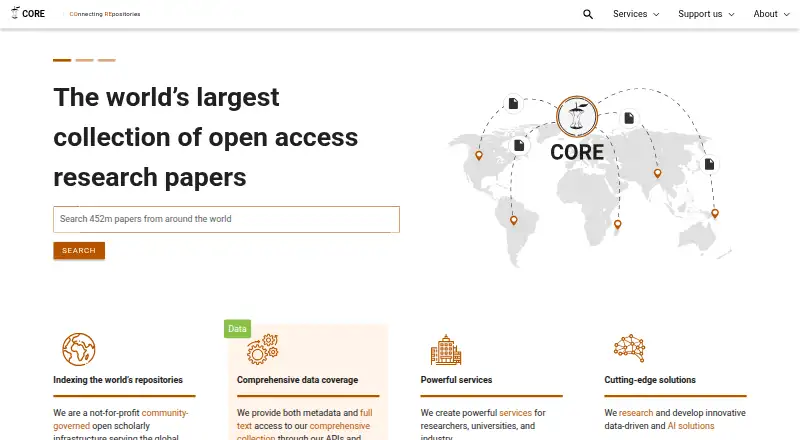
What CORE is
CORE is a multidisciplinary search service for open-access scholarly work collected from repositories, preprint servers, and journals. It covers research papers, journal articles, preprints, theses, dissertations, conference proceedings, reports, and books. CORE says its collection contains 449 million searchable research papers, including 57 million full texts. Researchers and the public can search for literature, while developers can retrieve metadata and full texts through a real-time API. Free API access without registration is limited to one batch request or five single requests per 10 seconds; registered users receive better performance, and higher rates require a quote. CORE Dataset provides downloadable data for prototyping, analysis, and text mining, but access is limited to users representing organisations in non-sanctioned countries; individuals may use the API. Discovery tools are available as a browser extension, repository plugin, and API. A recommender plugin can suggest similar articles in repositories, journal systems, and web interfaces. CORE describes itself as a not-for-profit, community-governed service. Commercial API use is permitted subject to its terms, and some uses require a licence.
Who it suits
CORE can serve researchers and members of the public looking for open-access scholarship, as well as developers and institutions integrating discovery tools. Organisations seeking dataset downloads should check the stated eligibility limit.
What it does well
- Searches across multidisciplinary scholarly literature.
- Provides API access to metadata and full texts.
- Discovery tools include a browser extension and repository plugin.
- Free API access is available without registration.
What to know first
- Unregistered API requests are rate-limited.
- Dataset access is limited to eligible organisations.
- Some commercial API uses require a licence.
Limits
Free API access allows one batch request or five single requests per 10 seconds. Dataset downloads are limited to users representing organisations registered in non-sanctioned countries; individuals may access data through the API.
Plans
| Plan | Billed and limits | Price |
|---|---|---|
| Starting | CORE Repository Dashboard · CORE Search · CORE Discovery · CORE Recommender · General support | On request |
| Supporting | Versions and duplicates detection · CORE API access for the institution · Technical support · Board of Supporters seat | On request |
| Sustaining | Open-access compliance tools · FAIR-related tools · Unlimited technical support · CORE Dataset access for researchers | On request |
| Institution and Enterprise API trial | 30-day trial · eligibility assessed during registration | Free |
| CORE API — free access without registration | Free access subject to rate limits; one batch request or five single requests per 10 seconds | Free |
| Starting membership | Repository Dashboard · OAI identifier resolution · CORE Discovery · CORE Search · CORE Recommender · general support | Free |
| CORE API | No registration required · one batch or five single requests per 10 seconds · faster registered and VIP rates available | Free |
| CORE API — registered access | Registered users get better performance; higher rates require contacting CORE for a quote | On request |
The first 8 of 10 plans, as core.ac.uk lists them, read 20 Sept 2026. The maker's own page has the final word. Every plan
Getting started
- Open the CORE website to search scholarly literature.
- Use the free API without registration, subject to its rate limits.
- Register for API access if better performance is needed.
- Use the browser extension or contact CORE about repository discovery tools.
- Represent an eligible organisation to access CORE Dataset downloads.
CORE is a multidisciplinary scholarly search and data service for people who need open research at scale. It fits researchers, developers, repositories and institutions especially well; casual readers may find its programmatic focus more than they need. The combination of very broad coverage, full-text discovery and integration tools is its main advantage, while access limits matter for intensive or commercial work.
Overview
CORE indexes literature from repositories, preprint servers and journals, with a search service focused on open-access papers. Its collection contains 449 million searchable research papers, including 57 million full texts. Coverage includes journal articles, preprints, theses, dissertations, conference proceedings, reports and books, so it is useful when a project spans disciplines and publication types instead of relying on one specialist index.
Advanced search and full-text access support more substantive discovery than title-only catalogues. CORE describes itself as a not-for-profit, community-governed service and a signatory to the Principles of Open Scholarly Infrastructures. It serves researchers, the public, academic institutions, developers, funders and companies.
Key features
Discovery and integration
CORE Discovery comes as a browser extension, repository plugin and API. The extension suits individual researchers who want paper discovery within a browser; the plugin and API are aimed at repositories and third-party services embedding discovery into their own environments. CORE Recommender adds similar-article suggestions to repositories, journal systems and web interfaces, which is useful for surfacing related work beyond a single search result.
API and data
The CORE API provides real-time machine access to paper metadata and full texts. Documentation includes examples and wrappers for common programming languages, lowering the integration work for development teams. The CORE Dataset supports downloading data for prototyping, analysis and text mining on local infrastructure. Commercial API use is permitted under CORE’s terms, although some uses require a licence, so commercial deployments need a terms review before scaling.
Dataset access is not universal: downloadable data is limited to users representing organisations registered in non-sanctioned countries. Individuals who do not meet that condition can use the API instead, but that changes the architecture of offline or large-scale projects.
Pricing
CORE uses a freemium model and offers a free trial. The CORE API — free access without registration costs nothing, with one batch request or five single requests per 10 seconds. That is adequate for occasional lookup and prototyping, not sustained high-volume collection.
Starting membership costs nothing for data providers and includes the CORE Repository Dashboard. CORE API — registered access has custom pricing; registration brings better performance, while higher rates require contacting CORE for a quote. This is the relevant route for applications that outgrow anonymous limits.
Supporting membership has custom pricing and includes Starting benefits, technical support, and CORE API access for the institution and its researchers. Sustaining membership also has custom pricing and adds an OA Compliance dashboard, university dataset use, a repository health check, and unlimited, prioritised support. Supporting membership suits institutions needing assistance; Sustaining is the stronger fit for universities managing compliance, repository quality and heavier operational demands.
Platforms
CORE is offered through the web, an API and a browser extension. Its repository plugin and API options also support institutional and third-party integrations. This mix covers ordinary searching as well as embedded and automated workflows.
Who it's for
Researchers and students benefit from multidisciplinary open-paper discovery, advanced search and full texts. Developers can build services around real-time metadata and full-text access, while repositories and journal systems can add discovery and recommendations. Institutions and funders may value compliance and repository tooling through higher memberships. It is less suitable for individuals who specifically need downloadable bulk data but cannot represent an eligible organisation.
Pros and cons
- Pro: 449 million papers and 57 million full texts provide unusually wide multidisciplinary reach.
- Pro: API, extension, plugin and recommender options support both personal discovery and embedded services.
- Pro: Open-access focus and full-text search make it useful for finding accessible versions across repositories and preprint servers.
- Con: Anonymous API use is tightly rate-limited, restricting repeated or production-scale requests.
- Con: Dataset downloads are restricted to eligible organisations, excluding some individual users from bulk workflows.
- Con: Registered, Supporting and Sustaining prices are custom, making institutional budgeting less predictable.
Alternatives
Browse Academic Research Databases for a wider category comparison. Choose JSTOR instead when you want a curated platform with open content and limited free reading, plus a 19.50 USD monthly JPASS option. Academia.edu is a better fit for following academics, uploading research and basic analytics alongside reading and bookmarking.
Choose MAXQDA when the priority is desktop qualitative-analysis software rather than literature discovery. AGRICOLA offers a free public catalog focused on agricultural literature. arXiv is the simpler choice for a free open archive with no-fee submissions, while bioRxiv focuses on life-science preprints and free manuscript distribution. EconLit suits economics-focused bibliographic searching, and Europe PMC is preferable for free life-sciences literature and related tools.
Verdict
Choose CORE if you need broad open-access scholarly discovery plus an API, repository integrations or institutional data tooling. Its scale and range are the reason to pick it. Look elsewhere when strict bulk-data access for an individual, predictable API pricing or a narrowly specialised corpus matters more than multidisciplinary coverage.
Verdict
CORE offers broad scholarly discovery alongside API, dataset, and integration options. Its free unregistered API has a request limit, and dataset downloads are not available to every individual user.
Questions
Is CORE free?
CORE has a free plan. Its unregistered API access is free, and the Starting membership is free for data providers.
What is the free API limit?
Free API access without registration is limited to one batch request or five single requests per 10 seconds.
Can I download CORE Dataset data as an individual?
Dataset access is limited to users representing organisations registered in non-sanctioned countries. Individuals may access data through the API.
What platforms does CORE support?
CORE lists API, extension, and web platforms.
Can CORE be used commercially?
Commercial use of the API is allowed subject to CORE’s terms and conditions. Some uses require a licence.
What does a CORE membership include?
Supporting membership includes technical support and institutional API access. Sustaining membership adds an OA Compliance dashboard, university dataset use, a repository health check, and unlimited prioritised support.
Facts from CORE's own pages
- API access
- The REST API supplies real-time machine access to harmonised metadata and full texts and offers live examples plus language wrappers. · core.ac.uk, 15 Oct 2026
- API documentation
- The API service advertises detailed documentation with examples and wrappers for common programming languages. · core.ac.uk, 15 Oct 2026
- Bulk data
- CORE Dataset lets users download CORE data and run processes such as prototyping, data analysis, and text mining on their own infrastructure. · core.ac.uk, 29 Sept 2026
- Collection scale
- A 2023 study reported more than 291 million metadata records and 32.8 million records with full text. · microblogging.infodocs.eu, 15 Oct 2026
- Commercial licensing
- Commercial use of the API is allowed subject to terms, licensing and possible paid higher quotas. · core.ac.uk, 15 Oct 2026
- Company size
- LinkedIn lists CORE as a nonprofit education organisation with 11–50 employees and headquarters in Milton Keynes. · linkedin.com, 15 Oct 2026
- CORE Recommender
- The Recommender is a free plugin for repositories, journals and web interfaces that suggests related articles and validates that recommendations are free to read. · core.ac.uk, 15 Oct 2026
- CORE Search
- The public web service lets researchers discover open-access papers across repositories and journals. · core.ac.uk, 15 Oct 2026
- Corpus size
- CORE says its collection contains 449 million searchable research papers and 57 million full texts. · core.ac.uk, 29 Sept 2026
- Dataset
- The CORE Dataset can be downloaded for processing, analysis and text mining in an organisation's own infrastructure. · core.ac.uk, 15 Oct 2026
- Dataset licence
- CORE identifies some downloadable datasets as ODC-By licensed for commercial or non-commercial use with attribution. · core.ac.uk, 15 Oct 2026
- Discovery extension
- CORE Discovery finds free copies of papers when users encounter publisher paywalls and can also locate records without DOIs. · chromewebstore.google.com, 15 Oct 2026
- Discovery tools
- CORE Discovery is available as a browser extension, repository plugin, and API for developers and third-party services. · core.ac.uk, 29 Sept 2026
- Eligibility limits
- CORE says downloadable dataset access is currently limited to users representing organisations registered in non-sanctioned countries; individuals may access data through the API instead. · core.ac.uk, 29 Sept 2026
- FastSync
- CORE FastSync provides incremental enterprise synchronisation so third-party systems can maintain an up-to-date copy of CORE data. · microblogging.infodocs.eu, 15 Oct 2026
- Founded
- The Open University records the CORE project period as February–July 2011, and contemporary OU news says the service launched in 2011. · university.open.ac.uk, 15 Oct 2026
- Full-text search
- CORE searches approved open repositories and aggregates downloadable full-text files rather than metadata alone. · blog.stem.open.ac.uk, 15 Oct 2026
- Global coverage
- The 2023 study said CORE content came from more than 10,000 providers in 150 countries and covered 118 estimated languages. · microblogging.infodocs.eu, 15 Oct 2026
- Governance
- CORE is a community-governed, not-for-profit service hosted by The Open University, whose stakeholder group carries financial and legal responsibility. · core.ac.uk, 15 Oct 2026
- Headquarters
- Milton Keynes, United Kingdom · core.ac.uk, 23 Sept 2026
- Independent adoption
- The same study reported CORE Recommender embedded in 70 repository systems, including Cambridge and arXiv. · microblogging.infodocs.eu, 15 Oct 2026
- Independent scale
- A Nature Scientific Data paper reported more than 40 million monthly active users in February 2023. · microblogging.infodocs.eu, 15 Oct 2026
- Integrations
- CORE says its Discovery tool can integrate with repositories, and its API documentation includes examples and wrappers for common programming languages. · core.ac.uk, 29 Sept 2026
- Limit: duplicate versions
- The study notes that different repository versions of one paper make matching and deduplication a significant technical challenge. · microblogging.infodocs.eu, 15 Oct 2026
Where CORE stands on Freedom251
- Academic Research Databases#3 of 35