Freedom251 › Academic Research Databases

AGRICOLA
What AGRICOLA is
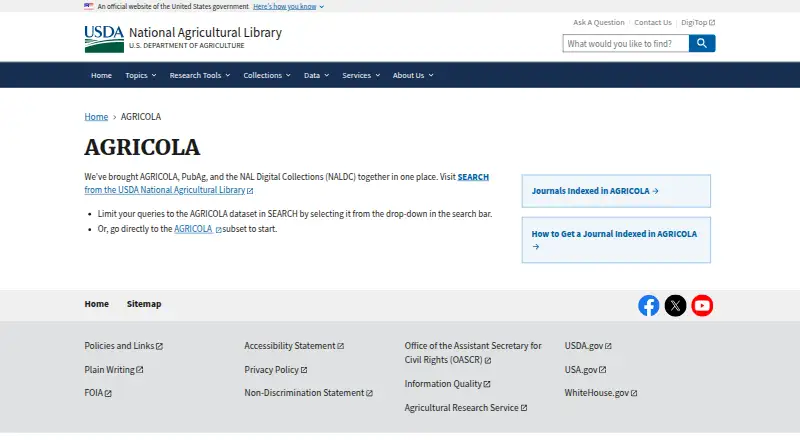
AGRICOLA is the National Agricultural Library catalog for agriculture and allied disciplines. Its more than 5 million records include current literature and printed works dating back to the 15th century. The collection includes journal articles, bibliographies, monographs, symposia, meeting abstracts, conference proceedings, and theses and dissertations. Selected peer-reviewed journal articles are indexed for discovery; indexed articles and conference proceedings have named personal authors and English titles and abstracts. Journals are reviewed under the library's collection policy and metadata requirements. Users can search the catalog through USDA NAL SEARCH by choosing AGRICOLA from the dataset menu or opening its subset directly. Advanced search is available across multidisciplinary subject coverage. The web catalog is free to access, but it does not provide full text, so access to an individual article may depend on linked sources. Publishers can submit metadata in MODS, JATS, or NLM DTD, with MODS preferred for faster processing. NAL also offers an online question form and weekday chat from 8:30 a.m. to 4:30 p.m. Eastern Time, excluding federal holidays.
Who it suits
AGRICOLA suits readers looking for agricultural and allied-discipline literature, including journal articles, proceedings, and older printed works. Publishers can also consult NAL's metadata requirements and submission guidance.
What it does well
- Free web access to a catalog with over 5 million records.
- Coverage includes works dating back to the 15th century.
- Advanced search across multidisciplinary subjects.
- Includes proceedings, theses, and dissertations.
What to know first
- The catalog does not provide full text.
- Article access may depend on linked sources.
- NAL chat excludes federal holidays and operates during weekday hours.
Limits
AGRICOLA provides catalog records, not full text; access to an individual article may depend on linked sources.
Plans
| Plan | Billed and limits | Price |
|---|---|---|
| AGRICOLA | Public access to the AGRICOLA catalog; individual article full text may depend on linked sources | Free |
As nal.usda.gov lists them, read 2 Oct 2026. The maker's own page has the final word.
Getting started
- Open USDA NAL SEARCH on the web.
- Select AGRICOLA from the dataset dropdown or open its subset directly.
- Search the catalog for agricultural and allied-discipline records.
- Use the online question form or weekday chat if you need search assistance.
AGRICOLA is a free web catalog from the National Agricultural Library for agricultural and allied literature. It is a strong fit for researchers, students and readers who need to find material across disciplines, formats and long periods of publication. Its reach is substantial, but finding a record does not mean getting the article itself.
Overview
More than five million records bring current literature together with printed works dating as far back as the 15th century. That historical depth is a real advantage for tracing how an agricultural subject has developed or locating older material that a journal-focused search may miss. The trade-off is that AGRICOLA is a catalog, not a full-text library: access to an individual article may depend on a linked source.
Search the AGRICOLA collection through USDA NAL SEARCH by selecting the dataset or opening its subset directly. This is a focused route into the catalog, though readers should expect discovery rather than a complete research workflow: records identify material, while article access is separate.
Key features
AGRICOLA’s subject scope covers agriculture and allied disciplines, with material that includes journal articles, bibliographies, monographs, symposia, meeting abstracts, conference proceedings, theses and dissertations. That range suits literature searches that cross publication types, rather than questions confined to recent journal papers.
The indexed journal literature consists of selected peer-reviewed articles and conference proceedings with named personal authors and English titles and abstracts. NAL reviews journals under its collection development policy and metadata requirements. This gives users identifiable records across a broad subject area, but the selection process means the catalog should not be treated as a guarantee that every relevant journal or paper is indexed.
AGRICOLA is also built around structured publisher metadata. Publishers can submit records in MODS, JATS or NLM DTD, with MODS preferred for faster processing. Required record fields include an English title and abstract, author details, journal title, publisher, publication date and identifiers when available. After sample metadata is accepted, publishers coordinate file exchange with NAL through options such as SFTP, FTP or HTTP; NAL also accepts transfers to its SFTP-only service. XML files and archives such as zip, gzip, tar and Bagit are accepted, while Word, PDF and RAR files are not. These requirements matter to publishers contributing records, not readers searching the catalog.
For search help, NAL provides an online question form and weekday chat from 8:30 a.m. to 4:30 p.m. Eastern Time, excluding federal holidays. That gives users a support route when a search needs clarification, though chat hours are limited to the stated schedule.
Pricing
AGRICOLA costs nothing, with public access to the catalog. There is no paid tier or trial to weigh against the free option. The important limitation is not a usage cap but scope: the plan does not include full-text access, so readers may need to follow linked sources for complete articles.
Platforms
AGRICOLA is available on the web. Its search access through USDA NAL SEARCH makes it suitable for browser-based discovery, but no other platform is part of the offering.
Who it's for
Choose AGRICOLA when you need a free way to identify agricultural and allied literature across scholarly and historical material, especially when books, proceedings, theses or older works belong in the search. It is less suitable as a standalone destination for readers who need complete article text directly from the service.
Pros and cons
- Pros: More than five million records and coverage back to the 15th century support broad historical searching.
- Pros: Multiple publication types, including theses, dissertations and conference proceedings, extend discovery beyond journal articles.
- Pros: Free public catalog access removes a subscription barrier to searching.
- Cons: No full-text access is included, so discovery may not lead directly to the article.
- Cons: Journal indexing is selective and governed by collection and metadata requirements, so it is not an exhaustive index.
- Cons: Search is web-based, with no other platform offered.
Alternatives
For a broader starting point across research databases, browse Academic Research Databases. Pick JSTOR instead if open content and public-domain articles, plus limited free reading of select items, better fit your need for reading material; its Read only plan is free, while JPASS Monthly is $19.50 a month.
arXiv is a free open-access archive with no fees or costs for article submission, making it a better fit for that model of access and publishing. CORE offers free API access, but its free tier is rate-limited to one batch request or five single requests per 10 seconds. Consider EconLit for economics literature; its free access is for AEA members and has no full-text links. Europe PMC is free to anyone and focuses on life sciences literature and related tools.
OpenAlex is an option for readers who want API access or a self-hosted route; its free plan is described as $1 per day with a budget that resets at midnight UTC. For biomedical and life sciences literature, PubMed is a free search and retrieval resource. MAXQDA is another option for readers considering a paid research product; its AI Assist Free add-on has limited capacity for occasional use.
Verdict
AGRICOLA is an easy recommendation for anyone who needs free, wide-ranging discovery across agricultural and allied literature, particularly when historical works and non-journal formats matter. Its main reason to choose is the combination of a large catalog, broad subject coverage and deep publication history. Look elsewhere if direct full-text access is essential, or if your search needs a guaranteed comprehensive index rather than selected records.
Verdict
AGRICOLA offers broad discovery across agricultural and allied literature, with advanced search and a substantial historical collection. It is a catalog rather than a full-text service, so readers may need linked sources to access articles.
Questions
Is AGRICOLA free?
Yes. Public access to the AGRICOLA catalog is free.
Does AGRICOLA include full-text articles?
No. Full text for an individual article may depend on linked sources.
How do I search AGRICOLA?
Use USDA NAL SEARCH and select AGRICOLA from the dataset dropdown, or open the AGRICOLA subset directly.
What subjects and materials does AGRICOLA cover?
It covers agriculture and allied disciplines. Its records include journal articles, bibliographies, monographs, symposia, meeting abstracts, conference proceedings, and theses and dissertations.
How can publishers submit metadata?
NAL accepts metadata in MODS, JATS, or NLM DTD, and says MODS is preferred for faster processing. After sample metadata is accepted, publishers coordinate file exchange with NAL.
When is search help available?
NAL offers an online question form and chat on weekdays from 8:30 a.m. to 4:30 p.m. Eastern Time, excluding federal holidays.
Facts from AGRICOLA's own pages
- Accepted file formats
- NAL accepts metadata as XML files or archives in formats including zip, gzip, tar, and Bagit, and does not accept Word, PDF, or RAR files. · nal.usda.gov, 2 Oct 2026
- Collection size
- The catalog contains over 5 million records, including current literature and printed works dating as far back as the 15th century. · nal.usda.gov, 2 Oct 2026
- Coverage
- Its subject coverage includes all aspects of agriculture and allied disciplines, while the catalog spans works dating back to the 15th century. · nal.usda.gov, 2 Oct 2026
- Discovery
- NAL indexes selected peer-reviewed journal articles and makes them available for discovery. · nal.usda.gov, 2 Oct 2026
- File transfer
- After sample metadata is accepted, publishers coordinate file exchange with NAL using a method such as SFTP, FTP, or HTTP; NAL also accepts publisher transfers to its SFTP-only service. · nal.usda.gov, 2 Oct 2026
- Headquarters
- Beltsville, Maryland, United States · nal.usda.gov, 28 Sept 2026
- Indexed content
- AGRICOLA covers peer-reviewed journal articles and conference proceedings with named personal authors and English titles and abstracts across agriculture and allied disciplines. · nal.usda.gov, 2 Oct 2026
- Journal selection
- Journals are reviewed under NAL's collection development policy and for compliance with its metadata requirements. · nal.usda.gov, 2 Oct 2026
- Publisher metadata
- Publishers may submit metadata in MODS, JATS, or NLM DTD, and NAL says MODS is preferred for faster processing. · nal.usda.gov, 2 Oct 2026
- Purpose
- AGRICOLA is the National Agricultural Library catalog for agricultural and allied disciplines. · nal.usda.gov, 2 Oct 2026
- Search access
- Users can search the AGRICOLA dataset through USDA NAL SEARCH by selecting AGRICOLA from the dataset dropdown or opening its subset directly. · nal.usda.gov, 2 Oct 2026
- Search support
- NAL offers an online question form and chat during weekday hours of 8:30 a.m. to 4:30 p.m. Eastern Time, excluding federal holidays. · nal.usda.gov, 2 Oct 2026
- Submission requirements
- Indexed records require metadata such as an English article title and abstract, author information, journal title, publisher, identifiers when available, and publication date. · nal.usda.gov, 2 Oct 2026
- Support
- Publishers can contact [email protected] with questions and to coordinate metadata file exchange. · nal.usda.gov, 2 Oct 2026
Where AGRICOLA stands on Freedom251
- Academic Research Databases#6 of 35