Freedom251 › Market Research Software

Conjoint Survey
What Conjoint Survey is
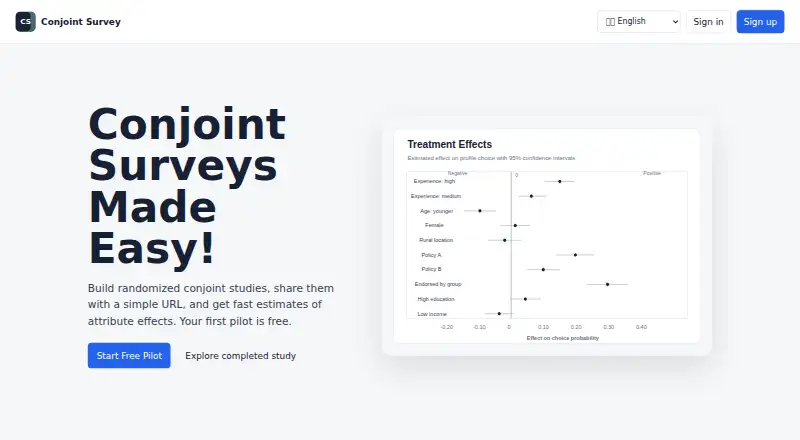
Conjoint Survey is a web app for designing randomized conjoint studies, sharing them with respondents and estimating attribute effects. Researchers set attributes and levels, can restrict impossible profiles or add a neither choice, and write the prompt for paired-profile choice tasks. The app provides ATE results for inspection. For publication workflows, researchers can use full-model AMCE/LPM tables and profile-level data with R or Stata replication scripts. A study can be shared by URL through email, Prolific, MTurk, an LMS or a panel vendor. The free plan allows one researcher account, one pilot survey and up to 20 completed responses, with preview results but no full exports, coauthor viewing, redirects or archive bundle. A one-time payment of 100.00 USD adds expanded survey and response limits, export options and Sona Systems-compatible fielding with survey-code capture and automatic credit granting. AI Help answers questions from product documentation and guides, not survey data. Researchers can delete studies and response data in the dashboard, though backups and provider logs may remain temporarily.
Who it suits
It suits researchers who need to design and field conjoint studies, inspect effects, or prepare publication materials with R or Stata. The license describes academic, instructional, nonprofit, government or internal research use through one researcher account.
What it does well
- Studies can be shared by URL across several fielding channels.
- Paid plan includes CSV, R/Stata and archive exports.
- Paid access supports Sona Systems-compatible fielding.
- Researchers can delete studies and response data.
What to know first
- Free plan is limited to 20 completed responses.
- Free plan has one researcher account and one pilot.
- AI Help does not analyze survey data.
- Support has no promised response or resolution time.
Limits
The free plan allows one researcher account, one conjoint survey pilot, and up to 20 completed responses. It does not include full exports, coauthor viewing, redirects, or an archive bundle. The one-time $100 plan permits up to 1,000 saved surveys, 10,000 completed responses per survey, and 50,000 completed responses lifetime.
Plans
| Plan | Billed and limits | Price |
|---|---|---|
| Free | 1 researcher account · 1 conjoint survey pilot · up to 20 completed responses · preview results · no full exports, coauthor viewing, redirects, or archive bundle | Free |
| One-Time Payment | One-time payment · 1 researcher account · up to 1,000 saved surveys · up to 10,000 completed responses per survey · up to 50,000 completed responses lifetime · AI Help up to 100 questions monthly, 1,200 annually, and 3,000 lifetime | $100, paid once |
As conjointsurvey.com lists them, read 2 Oct 2026. The maker's own page has the final word.
Getting started
- Visit https://conjointsurvey.com/.
- Create a researcher account and define study attributes and levels.
- Set optional profile restrictions or a neither choice, then write the respondent prompt.
- Share the study URL by email, Prolific, MTurk, an LMS, or a panel vendor.
- Choose the one-time $100 plan if you need paid exports or Sona-compatible fielding.
Conjoint Survey is a web app for designing randomized conjoint studies, sharing them by URL and estimating attribute effects. It is best suited to solo academic, instructional, nonprofit, government or internal researchers who need a focused conjoint workflow. The free pilot is useful for a small test; the one-time paid plan is the practical choice for larger studies and export-based analysis.
Overview
Researchers define attributes and levels, with optional restrictions on impossible profiles, a neither-choice option and a prompt for paired-profile choice tasks. This gives conjoint studies relevant design controls without positioning the app as a general-purpose survey platform.
URL-based fielding can work through email, Prolific, MTurk, an LMS or a panel vendor. The app provides ATE results for inspection; publication workflows can use full-model AMCE/LPM tables, profile-level data and R or Stata replication scripts. That division suits researchers comfortable taking analysis beyond the app.
Key features
Design and analysis
Configurable choice tasks and profile restrictions are useful when a study needs more than basic attribute comparisons. ATE results offer an in-app view, while the fuller tables and replication materials support downstream analysis in R or Stata. Those publication-oriented outputs are not included in the free plan.
Fielding and exports
Sharing by URL leaves researchers free to recruit through several channels rather than requiring a particular panel. Paid access adds Sona Systems-compatible fielding, including survey-code capture and automatic credit granting, a specific advantage for studies using that system. Paid exports cover CSV, R/Stata, tables, plots, methods, an academic packet and an archive bundle.
AI Help and data handling
AI Help answers plain-English questions from product documentation and guides; it does not analyze or access survey data. Troubleshooting questions and selected excerpts from public guides are sent to OpenAI, and the service says it does not retain AI conversations as chat history. Researchers should weigh that handling against their own data policies.
Researchers can delete studies and associated response data from the dashboard, though backups and provider logs may remain for a limited operational period. The privacy policy advises against collecting directly identifying respondent information unless the research protocol permits it. Support is best effort, with no promised response or resolution time unless agreed in writing.
Pricing
The Free plan costs nothing. It includes one researcher account, one conjoint survey pilot, up to 20 completed responses and preview results. It excludes full exports, coauthor viewing, redirects and the archive bundle. This is a meaningful test allowance, not a plan for a completed study that needs reproducible exports.
The One-Time Payment plan costs $100, paid once, billed as a one-time payment. It includes one researcher account, up to 1,000 saved surveys, up to 10,000 completed responses per survey and 50,000 completed responses over the account lifetime. AI Help is capped at 100 questions monthly, 1,200 annually and 3,000 lifetime. The jump in response capacity and the included exports make it the fit for researchers running substantial studies, though the single account does not provide a multi-seat workflow.
Platforms
Conjoint Survey runs on the web. Panel access and conjoint analysis are supported, with one researcher seat per plan.
Who it's for
It is a strong fit for a solo researcher who needs conjoint-specific design controls, URL-based recruitment and analysis outputs that can feed R or Stata. Academic and instructional users can test a pilot at no cost, while internal, nonprofit and government researchers can use the paid plan for larger response volumes. It is a weaker fit for teams needing multiple researcher accounts, dependable support turnaround or a free study beyond 20 completed responses.
Pros and cons
- Pro: Paired-profile tasks, optional impossible-profile restrictions and a neither-choice option support tailored conjoint designs.
- Pro: AMCE/LPM tables, profile-level data and replication scripts serve publication workflows beyond the in-app ATE view.
- Pro: A single one-time payment raises capacity to 10,000 responses per survey and includes a broad set of export formats.
- Con: The free plan stops at 20 completed responses and omits full exports, limiting its usefulness for finished research.
- Con: Both plans provide only one researcher account, and support carries no response-time commitment.
- Con: AI Help questions and selected guide excerpts go to OpenAI, while deleted study data may persist temporarily in backups or provider logs.
Alternatives
For a broader market research shortlist, browse Market Research Software.
- Conjointly is worth comparing for researchers who want unlimited surveys and questions on its Basic plan, which allows 20 responses for advanced methods, or can budget $2,895 a year for Professional. It also offers a free plan and free trial.
- DataLion suits users who want a free one-user project with 100 cases, survey tools, templates and Excel, CSV and SPSS import; it is not presented as a conjoint-focused alternative here.
- GlobalWebIndex may suit users whose need is Agent Spark prompts and chart saving or export: its free plan has 10 prompts monthly, while Plus is $150 a month with unlimited prompts. That is a different stated emphasis from conjoint study design.
- LimeSurvey is an option for someone seeking a free plan with 25 responses monthly and one admin user; its free tier is smaller in scope than Conjoint Survey’s conjoint-specific workflow.
- OpinionX offers a free plan with unlimited surveys, all survey methods and analysis features, capped at 25 participants per survey. Pick it to explore multiple survey methods rather than prioritize Conjoint Survey’s stated conjoint workflow.
- Qualitati is another freemium option, with a free plan of 30 monthly credits and paid tiers beginning at €9 a month.
- Qualtrics offers a free individual plan with one user, three active surveys, 30 questions per survey and 500 total responses. Consider it if those survey limits suit the task; Conjoint Survey instead provides explicit conjoint design and analysis outputs.
- SoSci Survey is another freemium survey option, including a free research plan for 5,000 respondents.
Verdict
Choose Conjoint Survey if you are a solo researcher who needs configurable conjoint choice tasks, URL-based fielding and publication-ready analysis materials without a recurring fee. Its chief advantage is the focused workflow paired with a substantial one-time paid response allowance; look elsewhere if you need multiple seats, a free quota above 20 responses or committed support turnaround.
Verdict
Conjoint Survey covers study design, URL-based fielding and analysis outputs, with a free pilot option and a one-time paid plan. Researchers should note the free plan’s response limit and the stated handling of AI Help questions and operational data.
Questions
Is there a free plan?
Yes. It includes one researcher account, one pilot survey, and up to 20 completed responses.
How much does the paid plan cost?
The One-Time Payment plan costs $100 USD once.
What does the paid plan add?
It includes CSV, R/Stata, table, plot, methods, academic packet, and archive exports. It also includes Sona Systems-compatible fielding and expanded survey, response, and AI Help allowances.
Can I use Conjoint Survey with R or Stata?
Yes. Publication workflows can use profile-level data and full-model AMCE/LPM tables with R or Stata replication scripts. Paid access includes R/Stata exports.
How can I distribute a study?
Studies can be shared by URL through email, Prolific, MTurk, an LMS, or a panel vendor.
Does AI Help analyze survey responses?
No. AI Help answers questions using product documentation and guides, and does not access or analyze survey data.
Facts from Conjoint Survey's own pages
- AI data handling
- Troubleshooting questions and selected public-guide excerpts are sent to OpenAI; the service says it does not save AI conversations as chat history. · conjointsurvey.com, 2 Oct 2026
- AI Help
- AI Help answers plain-English questions using product documentation and guides; it does not analyze or access survey data. · conjointsurvey.com, 2 Oct 2026
- Analysis
- The app provides ATE results for inspection, while publication workflows can use full-model AMCE/LPM tables and profile-level data with R or Stata replication scripts. · conjointsurvey.com, 2 Oct 2026
- Exports
- The paid plan includes CSV, R/Stata, table, plot, methods, academic packet, and archive exports. · conjointsurvey.com, 2 Oct 2026
- Fielding
- Studies can be shared through a URL by email, Prolific, MTurk, an LMS, or a panel vendor. · conjointsurvey.com, 2 Oct 2026
- Integration
- Paid access includes Sona Systems-compatible fielding with survey-code capture and automatic credit granting. · conjointsurvey.com, 2 Oct 2026
- Intended users
- The license describes ordinary academic, instructional, nonprofit, government, or internal research use through one researcher account. · conjointsurvey.com, 2 Oct 2026
- Privacy
- Researchers can delete studies and associated response data from the app dashboard, though backups and provider logs may remain for a limited operational period. · conjointsurvey.com, 2 Oct 2026
- Security guidance
- The privacy policy advises researchers to avoid collecting directly identifying respondent information unless their research protocol permits it. · conjointsurvey.com, 2 Oct 2026
- Study design
- Researchers define attributes, levels, optional impossible-profile restrictions, an optional neither choice, and a respondent-facing prompt for paired-profile choice tasks. · conjointsurvey.com, 2 Oct 2026
- Support
- Support is best effort, with no promised response or resolution time unless separately agreed in writing. · conjointsurvey.com, 2 Oct 2026
- What it does
- Build randomized conjoint studies, share them through a URL, and estimate attribute effects. · conjointsurvey.com, 2 Oct 2026
Where Conjoint Survey stands on Freedom251
- Market Research Software#6 of 59