Freedom251 › Science Learning Software

Concord Consortium STEM Learning Tools
Visit Concord Consortium STEM Learning Tools Alternatives Pricing
What Concord Consortium STEM Learning Tools is
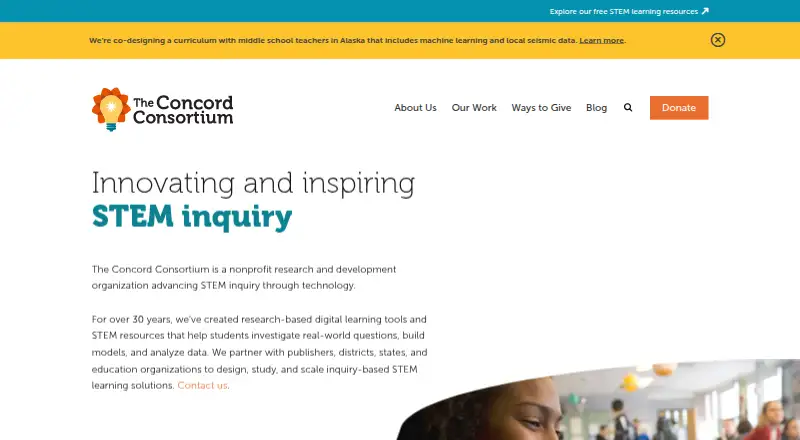
Concord Consortium is a nonprofit research and development organization that builds technology for STEM inquiry. Its digital learning resources include computational models that let learners explore scientific processes such as chemical reactions, genetics, evolution, and plate tectonics. CODAP is its free, web-based data science app for students in grades 5–14, curriculum developers, and education researchers. Students can analyze and visualize data across subjects using drag-and-drop graphs and maps, with dynamically linked graphs, maps, and tables. Data can come from spreadsheets, URLs, files, or plugins. CODAP plugins can draw on census, weather, and sensor databases, and the site features a PhET projectile simulation plugin. Developers can add plugins or contribute to the open-source codebase. Concord says it keeps student and teacher data confidential, does not sell it or use it for targeted advertising, and uses it for authorized educational and research purposes under school agreements and applicable laws including FERPA and COPPA. Educational resources are generally licensed CC BY-NC 4.0, while software code uses the MIT license. Teachers and students can use resources free for noncommercial purposes unless noted otherwise.
Who it suits
CODAP suits students in grades 5–14 exploring data across subjects, as well as curriculum developers and education researchers. Its free educational resources are for teachers and students using them noncommercially unless otherwise noted.
What it does well
- Free web-based data science app for students.
- Supports linked graphs, maps, and tables.
- Imports data from spreadsheets, URLs, files, or plugins.
- Developers can build plugins or contribute code.
What to know first
- The listed free use is noncommercial unless noted otherwise.
- Resources and software code use different licenses.
Limits
The listed free plan costs nothing. Teachers and students may use resources for free for noncommercial purposes unless otherwise noted.
Plans
| Plan | Billed and limits | Price |
|---|---|---|
| STEM learning resources | Teachers and students can use resources for free; noncommercial use unless otherwise noted | Free |
As concord.org lists them, read 4 Oct 2026. The maker's own page has the final word.
Getting started
- Visit the Concord Consortium website.
- Open the web-based resources or CODAP in a browser.
- Choose a resource or use CODAP for data analysis.
- In CODAP, import data from a spreadsheet, URL, file, or plugin.
Verdict
Concord Consortium offers a broad set of STEM learning resources, including CODAP’s data analysis tools and virtual labs. Teachers and students can access resources free for noncommercial use, subject to stated exceptions.
Questions
How much does Concord Consortium STEM Learning Tools cost?
The listed STEM learning resources plan is free. Teachers and students can use resources free for noncommercial purposes unless otherwise noted.
Is there a free plan or trial?
Yes, there is a free plan. No free trial is listed.
What platforms are supported?
The listed platforms are web and API. CODAP is web-based, and the resources list web browser support.
Is CODAP open source?
Developers can contribute to CODAP’s open-source codebase or extend it with plugins. Software code is released under the MIT license unless otherwise noted.
Who makes these tools?
The Concord Consortium is a U.S. 501(c)(3) nonprofit research and development organization founded in 1994 and headquartered in Concord, Massachusetts.
What support is available?
The organization provides CODAP how-to guides, FAQs, and a forum, and lists [email protected] for support inquiries.
Facts from Concord Consortium STEM Learning Tools's own pages
- Additional services
- Concord offers research and grant collaboration, consulting, speaking engagements, custom model and simulation development, assessments, and professional development. · concord.org, 4 Oct 2026
- Analysis features
- CODAP supports drag-and-drop graphs and maps, dynamically linked graphs, maps, and tables, and data import from spreadsheets, URLs, files, or plugins. · codap.concord.org, 4 Oct 2026
- Audience
- CODAP is designed for students in grades 5–14 to analyze and visualize data in any subject. · codap.concord.org, 4 Oct 2026
- CODAP
- CODAP is a free, web-based data science app for students, curriculum developers, and education researchers. · codap.concord.org, 4 Oct 2026
- Extensibility
- Developers can extend CODAP by building plugins or contributing to its open-source codebase. · codap.concord.org, 4 Oct 2026
- Founded
- 1994 · concord.org, 28 Sept 2026
- Headquarters
- Concord, Massachusetts, USA · concord.org, 28 Sept 2026
- Integrations
- CODAP plugins can extract data from national census, weather, and sensor databases, and the site features a PhET projectile simulation plugin. · codap.concord.org, 4 Oct 2026
- Licensing
- Unless otherwise noted, educational activities and resources use CC BY-NC 4.0, while software code is released under the MIT license. · concord.org, 4 Oct 2026
- Organization status
- The Concord Consortium is a U.S. 501(c)(3) nonprofit charity. · concord.org, 4 Oct 2026
- Privacy
- Concord says it treats student and teacher data as strictly confidential and does not sell it or use it for targeted advertising. · concord.org, 4 Oct 2026
- Research use
- CODAP is designed to support education research into how students interact with data and understand statistical concepts. · codap.concord.org, 4 Oct 2026
- Student data handling
- Concord says it uses student data for authorized educational and research purposes and handles it under school agreements and applicable laws including FERPA and COPPA. · concord.org, 4 Oct 2026
- Support
- The organization lists [email protected] for support inquiries and provides CODAP how-to guides, FAQs, and a forum. · concord.org, 4 Oct 2026
- Virtual labs
- Its computational models use scientific first principles to make otherwise invisible phenomena explorable, including chemical reactions, genetics, evolution, and plate tectonics. · concord.org, 4 Oct 2026
- What it is
- The Concord Consortium is a nonprofit research and development organization that advances STEM inquiry through technology and creates research-based digital learning tools and resources. · concord.org, 4 Oct 2026
Where Concord Consortium STEM Learning Tools stands on Freedom251
- Science Learning Software#4 of 25