Freedom251 › Hypervisor Software

Cloud Hypervisor
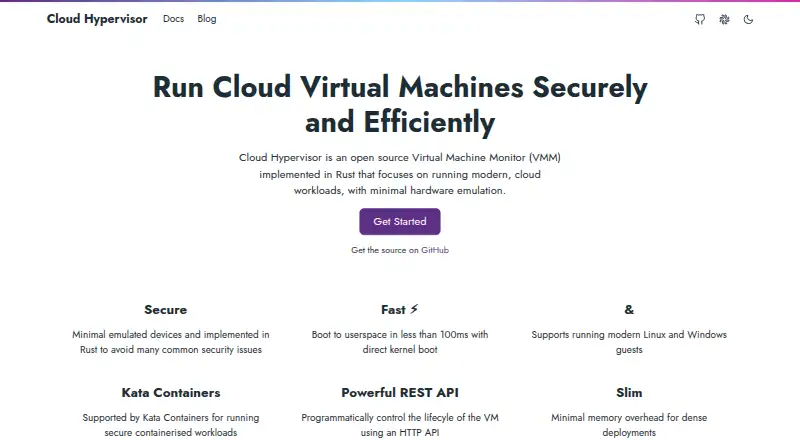
What Cloud Hypervisor is
Cloud Hypervisor is a free, open-source virtual machine monitor written in Rust for modern cloud workloads. It runs modern Linux and Windows guests on Linux hosts with x86-64 or AArch64 architectures, using minimal hardware emulation. Operators can manage VM lifecycles through a REST API or command-line interface, with an optional D-Bus API. It supports snapshots, nested virtualization, paravirtualized devices, and physical device passthrough. Live migration moves VMs between hosts without interruption, and migration data can be encrypted using mutual TLS. The maker says direct kernel boot reaches userspace in less than 100 ms. Kata Containers supports Cloud Hypervisor for running secure containerized workloads. The project cites its Rust implementation and minimal emulated devices as ways to avoid common security issues. Linux hosts need kernel 4.11 or later for required KVM functionality, while kernel 5.6 is recommended for adequate performance. Packages for some popular Linux distributions are available through the Open Build Service. The project is governed openly as part of the Linux Foundation and directs users to GitHub discussions or Slack for help, GitHub issues for bugs, and a mailing list for broader discussions.
Who it suits
Cloud Hypervisor suits operators building VM-based cloud workloads on Linux hosts with x86-64 or AArch64 processors. It is also relevant to Kata Containers users and teams that need VM snapshots or live migration.
What it does well
- Supports modern Linux and Windows guests.
- Offers REST API and command-line VM control.
- Supports snapshots, nested virtualization, and live migration.
- Migration data can be encrypted using mutual TLS.
- Free and open source.
What to know first
- Requires Linux hosts with kernel 4.11 or later.
- Kernel 5.6 is recommended for adequate performance.
- Host support is limited to x86-64 and AArch64.
Plans
| Plan | Billed and limits | Price |
|---|---|---|
| Cloud Hypervisor | Open-source VMM; no commercial plan or usage limits stated on the pages reviewed | Free |
As cloudhypervisor.org lists them, read 7 Oct 2026. The maker's own page has the final word.
Getting started
- Visit the Cloud Hypervisor website.
- Use a Linux host with kernel 4.11 or later; kernel 5.6 is recommended.
- Obtain a package for a supported Linux distribution through the Open Build Service, if available.
- Choose the REST API, command-line interface, or optional D-Bus API to control VM lifecycles.
- Use GitHub discussions or Slack for help, or GitHub issues to report bugs.
Verdict
Cloud Hypervisor provides VM lifecycle controls, device options, snapshots, and migration for Linux hosts. Check host kernel and architecture requirements against the deployment environment.
Questions
How much does Cloud Hypervisor cost?
The listed plan is free. It is open source, and no commercial plan or usage limits are stated.
Which host and guest systems does it support?
It runs on Linux hosts with x86-64 or AArch64 architectures and supports modern Linux and Windows guests.
How can operators manage virtual machines?
VM lifecycles can be controlled through a REST API or command-line interface. An optional D-Bus API is also available.
Does it support snapshots and live migration?
Yes. It supports VM snapshots and live migration between hosts without interruption. Migration data can be encrypted using mutual TLS.
What Linux kernel does the host need?
Kernel 4.11 is the documented minimum for required KVM functionality. Kernel 5.6 is recommended for adequate performance.
Where can users get help?
The project directs users to GitHub discussions or Slack for help, GitHub issues for bug reports, and a mailing list for broader discussions.
Facts from Cloud Hypervisor's own pages
- Boot performance
- The maker says direct kernel boot reaches userspace in less than 100 ms. · cloudhypervisor.org, 7 Oct 2026
- Devices
- It supports paravirtualized devices and physical device passthrough. · cloudhypervisor.org, 7 Oct 2026
- Distribution packages
- Packages for some popular Linux distributions are available through the Open Build Service. · cloudhypervisor.org, 7 Oct 2026
- Free plan
- Yes · cloudhypervisor.org, 20 Sept 2026
- Governance
- The project says it is governed openly as part of the Linux Foundation and supported by multiple organizations. · cloudhypervisor.org, 7 Oct 2026
- Guest architecture
- both · cloudhypervisor.org, 20 Sept 2026
- Guest operating systems
- It supports modern Linux and Windows guests. · cloudhypervisor.org, 7 Oct 2026
- Host architectures
- It runs on x86-64 and AArch64 hosts. · cloudhypervisor.org, 7 Oct 2026
- Host platforms
- Linux · cloudhypervisor.org, 20 Sept 2026
- Integration
- Kata Containers supports Cloud Hypervisor for running secure containerized workloads. · cloudhypervisor.org, 7 Oct 2026
- Linux host requirement
- The documented minimum host kernel is 4.11 for required KVM functionality, with 5.6 recommended for adequate performance. · cloudhypervisor.org, 7 Oct 2026
- Management interface
- both · cloudhypervisor.org, 20 Sept 2026
- Migration
- It supports live migration of VMs between hosts without interruption. · cloudhypervisor.org, 7 Oct 2026
- Migration encryption
- The v53.0 release notes say live migration data can be encrypted using mutual TLS. · cloudhypervisor.org, 7 Oct 2026
- Nested virtualization
- Yes · cloudhypervisor.org, 20 Sept 2026
- Security
- The project cites Rust implementation and minimal emulated devices as ways to avoid common security issues. · cloudhypervisor.org, 7 Oct 2026
- VM snapshots
- Yes · cloudhypervisor.org, 20 Sept 2026
- Support
- The project directs users to GitHub discussions or Slack for help, GitHub issues for bug reports, and a mailing list for broader discussions. · cloudhypervisor.org, 7 Oct 2026
- VM control
- Operators can control VM lifecycles through a REST API, command-line interface, or optional D-Bus API. · github.com, 7 Oct 2026
- What it does
- Cloud Hypervisor is an open-source Virtual Machine Monitor written in Rust for modern cloud workloads, with minimal hardware emulation. · cloudhypervisor.org, 7 Oct 2026
Where Cloud Hypervisor stands on Freedom251
- Hypervisor Software#5 of 26
- Virtual machine software#11 of 24