Freedom251 › Server Virtualization Software
Firecracker
What Firecracker is
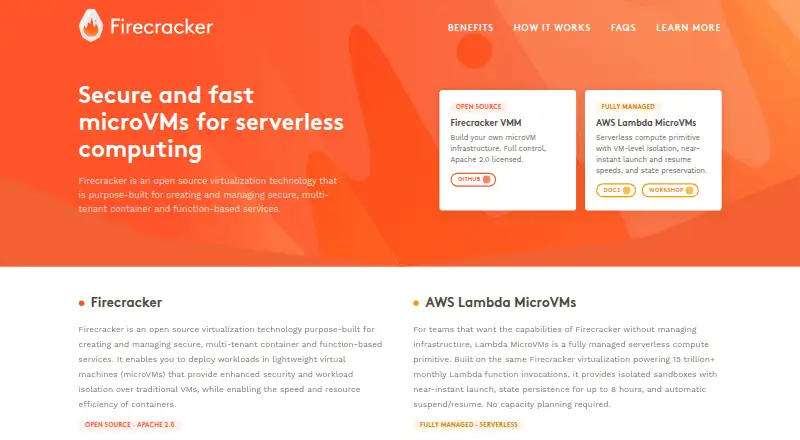
Firecracker is free, open-source virtualization technology for running container and function workloads in lightweight microVMs. It uses Linux KVM hardware virtualization to isolate workloads and exposes five emulated devices, which the project says reduces each microVM’s attack surface. Firecracker’s site states that microVMs start in under 125 ms and add under 5 MiB of memory overhead per VM. A host can create up to 150 microVMs per second and run thousands on one server, according to the project. A RESTful API configures and starts microVMs, while built-in rate limiters control network and storage resources. The companion jailer adds Linux user-space security barriers. Firecracker supports Linux hosts and guests with kernel versions 4.14 and above, plus OSv guests, on 64-bit Intel, AMD, and Arm CPUs with hardware virtualization support. VM snapshots are supported, but GPU acceleration is not. The project is licensed under Apache 2.0. One listed limitation is that the pl031 RTC device on aarch64 does not support interrupts, so guest programs using an RTC alarm will not work.
Who it suits
Firecracker may suit developers and operators running container or function workloads in isolated microVMs on supported Linux hosts. It is also relevant to teams seeking an open-source virtualization project with a RESTful control API.
What it does well
- Free and licensed under Apache 2.0.
- Uses Linux KVM hardware virtualization for isolation.
- Supports VM snapshots.
- Built-in rate limiters control network and storage use.
What to know first
- No GPU acceleration.
- aarch64 RTC alarms do not work in guest programs.
- Requires hardware virtualization support on listed CPUs.
Limits
The free Firecracker VMM plan is open source under Apache 2.0. On aarch64, the pl031 RTC device does not support interrupts, so guest programs using an RTC alarm will not work.
Plans
| Plan | Billed and limits | Price |
|---|---|---|
| Firecracker VMM | Open source · Apache 2.0 license | Free |
As firecracker-microvm.github.io lists them, read 7 Oct 2026. The maker's own page has the final word.
Getting started
- Visit the Firecracker website.
- Use a Linux host with supported hardware virtualization.
- Choose a supported Linux guest or OSv guest.
- Configure and start microVMs through the RESTful API.
Verdict
Firecracker combines microVM isolation with an API, resource controls, and a companion jailer. Check the supported host requirements and the aarch64 RTC limitation for your workload.
Questions
How much does Firecracker cost?
The Firecracker VMM plan is free.
Is Firecracker open source?
Yes. It is open source and licensed under Apache 2.0.
Which platforms and operating systems does it support?
Its listed platforms are API, Linux, and self-hosted. It supports Linux hosts and Linux guests with kernel versions 4.14 and above, plus OSv guests.
What hardware does Firecracker support?
The project lists 64-bit Intel, AMD, and Arm CPUs with hardware virtualization support for production workloads.
Does Firecracker support snapshots or GPU acceleration?
VM snapshots are supported. GPU acceleration is not.
Where can users get community support?
The project directs community questions to its Slack workspace and GitHub repository issues.
Facts from Firecracker's own pages
- Control API
- A RESTful API controls the Firecracker process, including microVM configuration and startup. · firecracker-microvm.github.io, 7 Oct 2026
- Density
- Firecracker says a host can create up to 150 microVMs per second and pack thousands onto one server. · firecracker-microvm.github.io, 7 Oct 2026
- Free plan
- Yes · firecracker-microvm.github.io, 20 Sept 2026
- GPU acceleration
- No · firecracker-microvm.github.io, 20 Sept 2026
- Guest architecture
- both · firecracker-microvm.github.io, 20 Sept 2026
- Host platforms
- Linux · firecracker-microvm.github.io, 20 Sept 2026
- Integrations
- The site lists integrations including containerd, Kata Containers, E2B, Fly.io, Koyeb, Northflank, OpenNebula, Qovery, and microvm.nix. · firecracker-microvm.github.io, 7 Oct 2026
- Isolation
- Firecracker uses Linux KVM hardware virtualization to isolate microVM workloads. · firecracker-microvm.github.io, 7 Oct 2026
- Jailer
- The companion jailer applies Linux user-space security barriers as a second line of defense if the virtualization barrier is compromised. · firecracker-microvm.github.io, 7 Oct 2026
- Minimal design
- Firecracker exposes five emulated devices and says this reduces the attack surface of each microVM. · firecracker-microvm.github.io, 7 Oct 2026
- Notable limitation
- On aarch64, the pl031 RTC device does not support interrupts, so guest programs using an RTC alarm will not work. · github.com, 7 Oct 2026
- Open source and license
- Firecracker is open source and licensed under Apache 2.0. · firecracker-microvm.github.io, 7 Oct 2026
- Operating systems
- Firecracker supports Linux host and guest operating systems with kernel versions 4.14 and above, as well as OSv guests. · firecracker-microvm.github.io, 7 Oct 2026
- Purpose
- Firecracker is open source virtualization technology for running secure, multi-tenant container and function workloads in lightweight microVMs. · firecracker-microvm.github.io, 7 Oct 2026
- Resource controls
- Built-in rate limiters control network and storage resource use, including bandwidth and operations. · firecracker-microvm.github.io, 7 Oct 2026
- VM snapshots
- Yes · firecracker-microvm.github.io, 20 Sept 2026
- Startup and memory
- The site states that microVMs start in under 125 ms and have under 5 MiB of memory overhead per VM. · firecracker-microvm.github.io, 7 Oct 2026
- Support
- The project directs community questions to its Slack workspace and GitHub repository issues. · github.com, 7 Oct 2026
- Supported hardware
- The site lists 64-bit Intel, AMD, and Arm CPUs with hardware virtualization support as generally available for production workloads. · firecracker-microvm.github.io, 7 Oct 2026
Where Firecracker stands on Freedom251
- Server Virtualization Software#5 of 22
- Hypervisor Software#6 of 26
- Virtual machine software#12 of 24