Freedom251 › Electronic Data Interchange Software

Cleo Integration Cloud
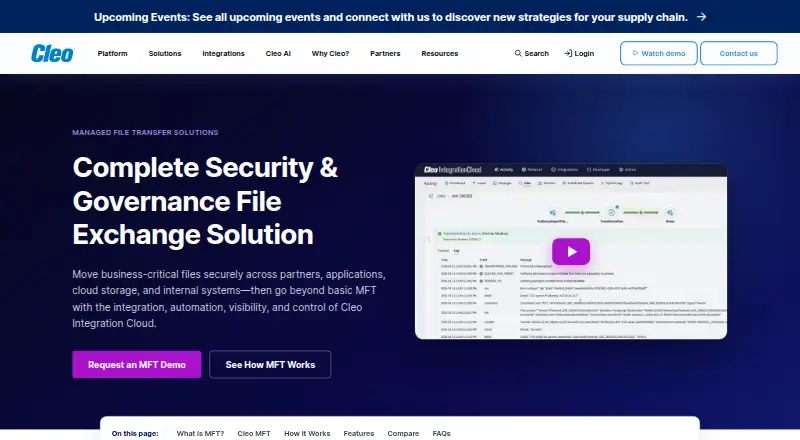
What Cleo Integration Cloud is
Cleo Integration Cloud combines API, EDI, managed file transfer, and application connectivity to exchange data with trading partners and business applications. Its MFT tools centralize file movement and connect transfers with APIs, EDI workflows, applications, cloud services, databases, and partner processes. Teams can automate recurring transfers, routing, schedules, notifications, downstream processing, and event-triggered transfers. Supported patterns include SFTP, FTPS, AS2, HTTPS, FTP, OFTP/OFTPS, partner mailboxes, file systems, cloud storage, and APIs. Security measures described for MFT include encrypted SFTP channels, X.509 certificates for TLS-based protocols, OpenPGP keys for applicable endpoints, centralized access controls, and audit logging. Cleo lists ISO/IEC 27001 and SOC reports, including SOC 1 Type 2, SOC 2 Type 2, and SOC 3. The platform connects to on-premises systems through the CIC Agent and offers cloud or private on-premise deployment. Smaller partners can use the web-based Partner Portal for document exchange. Pricing is custom and depends on ecosystem scale, transaction and data volume, integration complexity, and service model; no numeric subscription price is listed.
Who it suits
Cleo describes use cases in supply chain and manufacturing, retail and consumer goods, logistics and transportation, financial and back-office operations, and data and application integration. It suits organizations managing partner file exchange and connected workflows, including those with smaller partners using a web portal.
What it does well
- Automates scheduled and event-driven file workflows.
- Supports a broad range of transfer patterns.
- Centralized access controls and audit logging.
- Cloud and private on-premise deployment options.
- Customers can manage integrations or use Cleo services.
What to know first
- No numeric subscription price is listed.
- Final cost depends on scale, complexity, volume, and service model.
Limits
The custom subscription has no numeric price listed. Its cost depends on ecosystem scale, yearly transaction and data volume, integration complexity, and service model.
Plans
| Plan | Billed and limits | Price |
|---|---|---|
| Cleo Integration Cloud | Custom subscription; contact Cleo for pricing · Cost depends on ecosystem scale, transaction and data volume, integration complexity, and service model | On request |
As cleo.com lists them, read 4 Oct 2026. The maker's own page has the final word.
Getting started
- Visit the Cleo managed file transfer page.
- Contact Cleo to discuss custom pricing and your integration requirements.
- Choose cloud or private on-premise deployment.
- Connect on-premises systems through the CIC Agent where needed.
- Set up transfer workflows and decide whether to manage integrations yourself or use Cleo services.
Cleo Integration Cloud is an integration platform for moving data among trading partners and business applications. It best suits organizations coordinating file transfers alongside EDI, APIs, and application workflows; its breadth is a strength, but custom pricing makes it harder to assess against a defined budget.
Overview
Rather than treating file exchange as a standalone task, Cleo connects transfers with partner processes and business systems. Teams can automate recurring movement, routing, schedules, notifications, downstream processing, and event-triggered transfers. That joined-up approach is useful for complex operating networks, but may be more platform than organizations with a narrow file-transfer requirement need.
Cleo, headquartered in Rockford, Illinois, was founded in 1976. Cloud and private on-premise deployment options, plus a CIC Agent that connects to local ERP, CRM, TMS, WMS, and financial systems, give organizations a way to bridge hosted and on-premises environments.
Key features
Transfer protocols and security
Supported exchange methods include SFTP, FTPS, AS2, HTTPS, FTP, OFTP/OFTPS, partner mailboxes, file systems, cloud storage, and APIs. That breadth can accommodate varied partner requirements without limiting workflows to one transfer protocol. Security controls include encrypted SFTP channels, X.509 certificates for TLS-based protocols, OpenPGP keys for applicable endpoints, centralized access controls, and audit logging. Cleo's Trust Center lists ISO/IEC 27001 and SOC 1 Type 2, SOC 2 Type 2, and SOC 3 reports.
Connectors and partner access
Connectors include Salesforce, SAP, NetSuite, Shopify, Acumatica, Amazon S3 Storage, Microsoft Dynamics 365, and Oracle Fusion. The Partner Portal offers web-based document exchange for smaller trading partners that lack the resources for direct integration, which can extend access across a partner network without requiring every participant to build a direct connection.
Operating model
Customers can manage integrations themselves, engage Cleo Managed Services to build and operate them, or use Professional Services for scoped implementation and onboarding. This flexibility helps organizations choose how much integration work to retain in-house, though the service model also affects cost.
Pricing
Cleo Integration Cloud uses custom pricing; contact Cleo for a quote. Cost depends on ecosystem scale, annual transaction and data volume, integration complexity, and service model. There are no published subscription tiers or numeric prices to compare, so buyers should bring expected volumes, partner counts, integration scope, and support needs into pricing discussions. The model may suit organizations whose requirements call for a tailored arrangement, but it offers little upfront cost certainty for teams comparing fixed-price options.
Platforms
Cleo supports API access, web use, and self-hosted deployment. Its cloud and private on-premise options, together with the CIC Agent, support hybrid environments that need to connect local business systems to cloud services and trading partners.
Who it's for
The platform is aimed at supply chain and manufacturing, retail and consumer goods, logistics and transportation, financial and back-office operations, and data and application integration. It is a stronger fit for organizations with multiple partner and application connections, varied transfer protocols, or a need to coordinate transfer activity with downstream workflows. Buyers seeking only basic file exchange may find its combined integration scope unnecessary.
Pros and cons
- Pro: Broad protocol coverage spans established transfer standards, partner mailboxes, cloud storage, file systems, and APIs, helping accommodate diverse counterparties.
- Pro: Workflow automation links transfers to routing, schedules, notifications, downstream processing, and events rather than leaving those steps disconnected.
- Pro: Cloud and private on-premise deployment, plus the CIC Agent, support connections to local enterprise systems.
- Pro: Customers can operate integrations themselves or use managed and professional services, giving them a choice of operating responsibility.
- Con: Custom pricing depends on scale, volume, complexity, and service model, so buyers cannot readily compare a standard subscription cost.
- Con: The broad integration scope may be excessive for teams that need only a straightforward file-transfer tool.
Alternatives
For a narrower comparison, browse Managed File Transfer Software, Electronic Data Interchange Software, Secure File Transfer Software, or Integration Platform as a Service Software.
- CompleteFTP is worth considering when a free FTP/FTPS plan with unlimited users is the priority; it also offers a free trial and paid plans.
- JSCAPE Managed File Transfer is another paid option, with Linux, macOS, web, and Windows platforms.
- OpenText Managed File Transfer offers a contact-priced cloud managed service that states support for transfers of 50GB or more.
- Waarp R66 is a free option with web, Windows, and Linux platforms.
- Files.com may suit buyers comparing a published entry price: its Starter plan is $199 a month, billed monthly, and includes 10 Full Users, 50 System Users, two outbound connections, and 1 TB of monthly storage.
- Serv-U FTP Server is a paid alternative with a stated price of $55 a month, billed annually.
- Serv-U Managed File Transfer Server is another paid option, priced at $335 a month per server, billed monthly.
- Kiteworks Managed File Transfer is another paid option, with Windows listed as a platform.
Verdict
Cleo Integration Cloud is best for organizations that need managed file transfer to work in concert with EDI, APIs, applications, and trading-partner workflows. Its broad connectivity, hybrid deployment choices, and flexible service model are the main reasons to consider it. Look elsewhere if a simple transfer utility or a readily comparable subscription price is more important than an integrated platform.
Verdict
Cleo Integration Cloud combines managed file transfer with API, EDI, and application connectivity, with deployment choices and partner access options. Organizations should request pricing based on their ecosystem, volume, complexity, and service model.
Questions
How much does Cleo Integration Cloud cost?
Pricing is available on request. The final cost depends on ecosystem scale, yearly transaction and data volume, integration complexity, and service model.
Which platforms does it support?
Listed platforms are API, self-hosted, and web. Deployment options include cloud and private on-premise.
Which file-transfer protocols does it support?
Supported patterns include SFTP, FTPS, AS2, HTTPS, FTP, OFTP/OFTPS, partner mailboxes, file systems, cloud storage, and APIs.
Can it connect to on-premises systems?
Yes. The CIC Agent connects to on-premises ERP, CRM, TMS, WMS, and financial systems.
Can customers get help building integrations?
Customers can manage integrations themselves or use Cleo Managed Services to build and operate them. Professional Services are available for scoped implementation and onboarding.
Who makes Cleo Integration Cloud?
The maker is Cleo Integration Cloud, headquartered in Rockford, Illinois, United States. The maker was founded in 1976.
Facts from Cleo Integration Cloud's own pages
- Automation
- MFT workflows can automate recurring transfers, routing, schedules, notifications, downstream processing, and event-driven transfers. · cleo.com, 4 Oct 2026
- Compliance
- Cleo's Trust Center lists ISO/IEC 27001 and SOC reports, including SOC 1 Type 2, SOC 2 Type 2, and SOC 3. · trustcenter.cleo.com, 4 Oct 2026
- Deployment
- CIC connects to on-premises ERP, CRM, TMS, WMS, and financial systems through the CIC Agent, and Cleo describes cloud and private on-premise deployment options. · support.cleo.com, 4 Oct 2026
- Founded
- 1976 · cleo.com, 28 Sept 2026
- Headquarters
- Rockford, Illinois, United States · cleo.com, 28 Sept 2026
- Integrations
- Listed application connectors include Salesforce, SAP, NetSuite, Shopify, Acumatica, Amazon S3 Storage, Microsoft Dynamics 365, and Oracle Fusion. · cleo.com, 4 Oct 2026
- MFT
- The platform centralizes managed file transfer and connects file movement to EDI, APIs, applications, cloud services, databases, and trading partner workflows. · cleo.com, 4 Oct 2026
- Partner access
- The Partner Portal provides web-based document exchange for smaller trading partners that lack resources for direct integration. · support.cleo.com, 4 Oct 2026
- Pricing limits
- The page gives no numeric subscription prices and says the final cost depends on ecosystem scale, yearly transaction and data volume, integration complexity, and service model. · cleo.com, 4 Oct 2026
- Protocols
- Supported file-transfer patterns include SFTP, FTPS, AS2, HTTPS, FTP, OFTP/OFTPS, partner mailboxes, file systems, cloud storage, and APIs. · cleo.com, 4 Oct 2026
- Purpose
- Cleo Integration Cloud combines API, EDI, file transfer, and application connectivity to exchange data with trading partners and business applications. · support.cleo.com, 4 Oct 2026
- Security
- The MFT page describes SFTP encrypted channels, X.509 certificates for TLS-based protocols, OpenPGP key support for applicable endpoints, and centralized access controls and audit logging. · cleo.com, 4 Oct 2026
- Support and services
- Customers can manage integrations themselves or use Cleo Managed Services to build and operate them, with Professional Services available for scoped implementation and onboarding. · support.cleo.com, 4 Oct 2026
- Who it serves
- Cleo describes MFT use cases for supply chain and manufacturing, retail and consumer goods, logistics and transportation, financial and back-office operations, and data and application integration. · cleo.com, 4 Oct 2026
Where Cleo Integration Cloud stands on Freedom251
- Electronic Data Interchange Software#11 of 30
- Managed File Transfer - Midmarket Software#9 of 24
- Data Mapping Software#7 of 16
- EDI Software#9 of 20
- Managed File Transfer Software#14 of 27
- Integration Platform as a Service Software#61 of 113
- Secure File Transfer Software#20 of 28