Freedom251 › Revenue Recognition Software

Clarevon Revenue Recognition
What Clarevon Revenue Recognition is
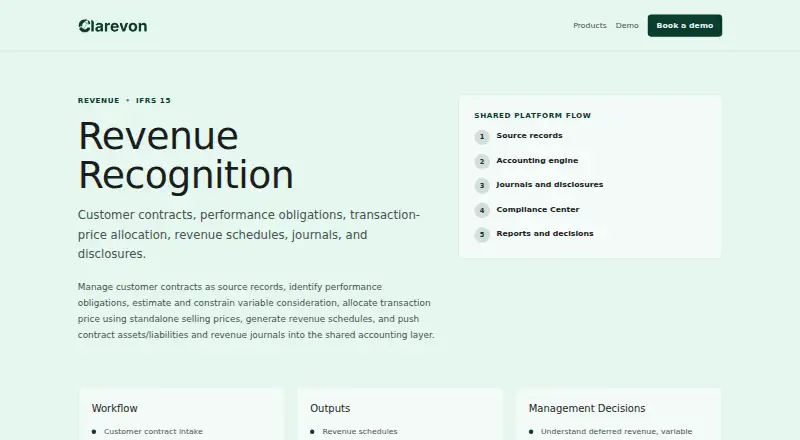
Clarevon Revenue Recognition manages customer contracts, performance obligations, transaction-price allocation, revenue schedules, journals, and disclosures. Its workflow takes contracts through intake and obligation identification, allocates transaction prices using standalone selling prices, and syncs revenue schedules and journals. The product estimates and constrains variable consideration. Outputs include revenue schedules, contract asset and liability movements, revenue journals, and support for IFRS 15 disclosures. Clarevon says the product helps users understand deferred revenue, variable-consideration exposure, and the impact of contract changes. It can be purchased and operated on its own; when used with other Clarevon products, its schedules, journals, disclosures, controls, audit evidence, and compliance signals can flow into shared platform tools. Listed journal-posting integrations include QuickBooks, SAP, Oracle, NetSuite, Dynamics 365, and Sage Intacct. The privacy policy describes encryption in transit and at rest for specified data, and says customer data is not sold or used to train AI models. Pricing is available on request, and the product page offers demo booking.
Who it suits
It is aimed at finance and compliance teams and CPA firms handling customer contracts and revenue accounting. It may suit teams seeking IFRS 15 disclosure support or journal posting to listed ERP systems.
What it does well
- Manages contracts, obligations, schedules, journals, and disclosures
- Estimates and constrains variable consideration
- Can operate as a standalone product
- Lists journal posting to several ERP systems
- Supports IFRS 15 disclosures
What to know first
- Pricing is available on request
- Some shared-platform flows require other Clarevon products
Getting started
- Visit the Revenue Recognition product page.
- Book a demo to discuss the product.
- Discuss pricing with Clarevon.
- Connect the workflow to a supported ERP for journal posting, if needed.
Clarevon Revenue Recognition turns customer contracts into allocation calculations, revenue schedules, journals, and IFRS 15 disclosure support. It suits finance and compliance teams and CPA firms handling multi-obligation agreements, variable consideration, or frequent contract changes. The product is strongest when accounting judgement and auditability matter more than self-service simplicity.
Overview
The workflow starts with contract intake and identification of performance obligations, then applies transaction-price and standalone-selling-price allocation before synchronising schedules and journals. That end-to-end sequence keeps the accounting decisions connected to their outputs instead of treating revenue recognition as a final ledger export.
Outputs include revenue schedules, contract-asset and contract-liability movements, revenue journals, and IFRS 15 disclosure support. The product also estimates and constrains variable consideration, helping teams assess deferred revenue, exposure to variable consideration, and the accounting effect of contract modifications.
Key features
Contract accounting workflow
Performance-obligation identification and SSP allocation give teams a defined method for arrangements with multiple deliverables. This is a practical fit for complex contracts; organisations with straightforward, fixed subscriptions may not need such a specialised process.
Schedules, journals, and disclosures
Revenue schedules, contract-balance movements, journal synchronisation, and IFRS 15 disclosure support connect operational calculations with reporting work. When combined with other Clarevon products, journals, schedules, disclosures, controls, audit evidence, and compliance signals flow into shared platform tools. Revenue Recognition can also be purchased and operated independently, which suits teams that want this capability without adopting the wider platform.
Controls and security
Access is recorded in a tamper-evident audit trail on the Regular plan and above. Data in transit uses TLS 1.2 or higher, while ERP credentials and OAuth tokens are encrypted at rest with AES-256-GCM and PBKDF2 key derivation. Clarevon says it does not sell customer data or use lease or ERP data to train AI models. Customers can select US, EU, UK, APAC, MEA, or India for data storage at registration. Account and lease data remains recoverable for 30 days after cancellation before permanent deletion.
Pricing
Clarevon uses paid, custom pricing: contact the team for a quote and book a demo to discuss fit. No public seat, usage, trial, or renewal terms are provided, so this is a procurement-led choice rather than a product a small team can price immediately. The Regular plan and above include the tamper-evident access trail, making plan selection relevant for organisations with stronger audit requirements.
Platforms
Clarevon says it can post journals to QuickBooks, SAP, Oracle, NetSuite, Dynamics 365, and Sage Intacct; its privacy policy also names QuickBooks Online, Xero, and Sage among systems used for journal posting. That range supports mixed ERP environments, although implementation fit should be confirmed during the demo. Data-region selection is available at registration.
Who it's for
Finance and compliance teams and CPA firms are the clearest audience. It is particularly well matched to organisations that must allocate transaction prices across obligations, constrain variable consideration, explain deferred revenue, or document modification impacts under IFRS 15. A business seeking a low-cost, instantly priced tool for uncomplicated contracts should look elsewhere.
Pros and cons
- Pro: The workflow spans contract intake, obligation identification, SSP allocation, schedules, and journals, reducing breaks between analysis and posting.
- Pro: Variable-consideration estimation and management views address judgement-heavy revenue decisions, not just recurring calculations.
- Pro: Standalone operation avoids requiring the full Clarevon platform, while shared tools add controls and audit evidence for broader deployments.
- Con: Custom pricing and demo-led sales make budget comparison and self-service adoption difficult.
- Con: The published audit-trail benefit starts at Regular and above, so lower plans may be less suitable for strict control environments.
Alternatives
Choose Zuora CPQ when you need an API and web product whose pricing can reflect products, transaction volume, business model, regions, and implementation scope.
Flowrev is the better starting point for teams wanting freemium access, a free trial, and published Bronze pricing of $50 a month per organisation for up to 300 active revenue or cost schedules per year.
Consider Loopfour Payment Reconciliation, SOFTRAX Revenue Management System, or RevRecog AI when their respective product focus better matches your process.
Trullion Leases is a web-based, paid option focused on lease portfolios, while Aptitude Revenue Recognition Engine targets API deployments with custom enterprise pricing and a demonstration. Ordway suits buyers seeking a fixed subscription proposal scaled to transaction value.
Verdict
Choose Clarevon Revenue Recognition if your finance or CPA practice needs a structured IFRS 15 contract-to-journal process, variable-consideration handling, and defensible reporting outputs across major ERPs. Look elsewhere if transparent pricing, a free entry tier, or a lightweight workflow matters more than contract-accounting depth and control features.
Verdict
Revenue Recognition covers a defined contract-to-journal workflow and can be used independently. Teams should request a demo to discuss fit, integrations, and pricing.
Questions
How much does Clarevon Revenue Recognition cost?
Pricing is on request. The product page offers a demo booking to discuss it.
Can it be used by itself?
Yes. Revenue Recognition can be purchased and operated on its own.
Which revenue standard does it support?
The product provides IFRS 15 disclosure support.
Which systems can receive journals?
Clarevon says it can post journals to QuickBooks, SAP, Oracle, NetSuite, Dynamics 365, and Sage Intacct. Its privacy policy also lists QuickBooks Online, Xero, and Sage for journal posting.
What does the product do with customer contracts?
It handles contract intake, identifies performance obligations, allocates transaction prices using standalone selling prices, and syncs revenue schedules and journals.
Who is Clarevon's platform built for?
Clarevon describes its platform as built for finance and compliance teams and CPA firms.
Facts from Clarevon Revenue Recognition's own pages
- Audience
- Clarevon describes its platform as serving finance and compliance teams and CPA firms. · clarevon.com, 7 Oct 2026
- Audit trail
- The privacy policy says access is logged in a tamper-evident audit trail on the Regular plan and above. · clarevon.com, 7 Oct 2026
- Contract workflow
- Its workflow covers customer contract intake, performance-obligation identification, transaction-price and standalone-selling-price allocation, and revenue-schedule and journal sync. · clarevon.com, 7 Oct 2026
- Data handling
- Clarevon says it does not sell customer data or use lease or ERP data to train AI models. · clarevon.com, 4 Oct 2026
- Data regions
- The privacy policy says customers can select a data-storage region from the US, EU, UK, APAC, MEA, or India at registration. · clarevon.com, 7 Oct 2026
- ERP integrations
- Clarevon's privacy policy lists QuickBooks Online, Dynamics 365, SAP, Oracle, Xero, NetSuite, and Sage for journal posting. · clarevon.com, 4 Oct 2026
- Integrations
- Clarevon says it can post journals to QuickBooks, SAP, Oracle, NetSuite, Dynamics 365, and Sage Intacct. · clarevon.com, 7 Oct 2026
- Management insights
- The product helps users understand deferred revenue, variable-consideration exposure, and contract-modification impact. · clarevon.com, 7 Oct 2026
- Management use
- The product is described as helping users understand deferred revenue, variable-consideration exposure, and contract-modification impact. · clarevon.com, 4 Oct 2026
- Outputs
- Outputs include revenue schedules, contract-asset and contract-liability movements, revenue journals, and IFRS 15 disclosure support. · clarevon.com, 7 Oct 2026
- Purpose
- The product manages customer contracts, performance obligations, transaction-price allocation, revenue schedules, journals, and disclosures under IFRS 15. · clarevon.com, 7 Oct 2026
- Retention
- The privacy policy says account and lease data is retained for 30 days after cancellation for recovery, then permanently deleted. · clarevon.com, 4 Oct 2026
- Security
- Clarevon says data is encrypted in transit using TLS 1.2 or higher and ERP credentials and OAuth tokens are encrypted at rest using AES-256-GCM with PBKDF2. · clarevon.com, 7 Oct 2026
- Shared platform
- When combined with other Clarevon products, its schedules, journals, disclosures, controls, and audit evidence connect to shared platform services including the Accounting Compliance Center, reporting engine, audit trail, ERP integration layer, and AI assistant. · clarevon.com, 7 Oct 2026
- Standalone availability
- Revenue Recognition can be purchased and operated on its own. · clarevon.com, 7 Oct 2026
- Support and sales
- The product page offers a demo booking to discuss the product. · clarevon.com, 7 Oct 2026
- Variable consideration
- The product estimates and constrains variable consideration. · clarevon.com, 7 Oct 2026
- Workflow
- Its workflow covers customer contract intake, performance-obligation identification, transaction-price and standalone-selling-price allocation, and revenue-schedule and journal sync. · clarevon.com, 4 Oct 2026
Where Clarevon Revenue Recognition stands on Freedom251
- Revenue Recognition Software#20 of 29