Freedom251 › IT Automation Software
Clad
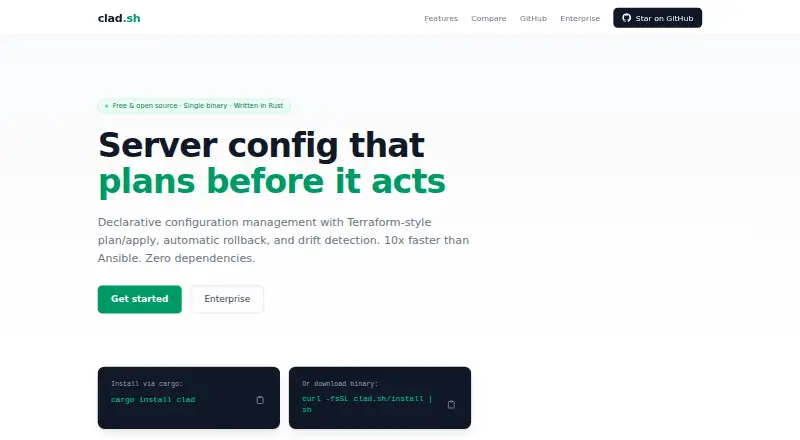
What Clad is
Clad is declarative configuration management software for servers, using a Terraform-style plan-and-apply workflow. Before commands run, it shows proposed changes for each host; if a task fails, it says it reverses changes in reverse order. It can compare declared configuration with live servers to find manual changes, while Clad Shapes let users define a service pattern and reuse it across deployments. Clad connects over SSH and says managed hosts need no agent. It can convert Ansible playbooks to Clad format with one command. Installation options include Cargo, shell-script commands, or downloading a binary; the maker describes it as a single 5MB binary without Python, pip, or virtualenvs. The free, open-source Clad plan is listed as free. Enterprise offerings include audit dashboards, scheduled drift scans, webhook notifications, team RBAC and SSO, compliance reports, and priority support; no Enterprise price is listed. The page identifies Grundlabs as the maker.
Who it suits
Clad may suit operators who want to manage server configuration over SSH and review planned changes before applying them. Enterprise features are listed for teams needing audit dashboards, access controls, or compliance reports.
What it does well
- Previews changes on every host before commands run.
- Reverses changes if a task fails.
- Finds drift between declared and live server state.
- Imports Ansible playbooks with one command.
What to know first
- Enterprise features are separate offerings.
- Managed hosts require SSH access.
Limits
The free Clad plan is the single-binary, open-source offering. Audit dashboards, scheduled drift scans, webhooks, team RBAC and SSO, compliance reports, and priority support are listed under Enterprise.
Plans
| Plan | Billed and limits | Price |
|---|---|---|
| Clad | Free and open source · Single binary | Free |
| Enterprise | Centralized audit dashboard · Scheduled drift scans · Webhook notifications · Team RBAC & SSO · Compliance reports · Priority support | On request |
As clad.sh lists them, read 11 Oct 2026. The maker's own page has the final word.
Getting started
- Open the Clad website
- Install with Cargo or the shell script, or download the binary
- Prepare SSH keys for managed hosts
- Define the desired server state
- Run the plan to review host changes
- Apply the configuration
Verdict
Clad offers a free, open-source route to declarative server configuration, with change previews, rollback, and drift checks. Teams needing centralized audit and access features can review its Enterprise offering, for which no price is listed.
Questions
Is Clad free?
Yes. The Clad plan is free and open source, with a listed price of $0.
Does Clad require an agent on servers?
No. Clad uses SSH and says managed hosts need no agent.
How can Clad be installed?
The page provides Cargo and shell-script commands, and it also offers a downloadable binary.
Can Clad import Ansible playbooks?
Yes. Clad can convert Ansible playbooks to Clad format with one command.
What does Enterprise include?
Enterprise lists audit dashboards, scheduled drift scans, webhook notifications, team RBAC and SSO, compliance reports, and priority support.
Who makes Clad?
The page footer identifies Grundlabs as the maker.
Facts from Clad's own pages
- Ansible import
- Clad can convert Ansible playbooks to Clad format with one command. · clad.sh, 11 Oct 2026
- Compliance
- The Enterprise offering lists compliance reports. · clad.sh, 11 Oct 2026
- Dependencies
- The maker describes Clad as a single 5MB binary that needs no Python, pip, or virtualenvs. · clad.sh, 11 Oct 2026
- Drift detection
- Clad compares declared state against live servers to identify manual changes. · clad.sh, 11 Oct 2026
- Enterprise features
- Enterprise offerings listed include audit dashboards, scheduled drift scans, team RBAC and SSO, and compliance reports. · clad.sh, 5 Oct 2026
- Enterprise integrations
- The Enterprise offering lists webhook notifications. · clad.sh, 11 Oct 2026
- Execution
- Clad uses SSH and says it needs no agent on managed hosts. · clad.sh, 5 Oct 2026
- Installation
- The page gives Cargo and shell-script commands to install Clad or download its binary. · clad.sh, 11 Oct 2026
- Integrations
- The page describes Ansible playbook import and webhook notifications for enterprise teams. · clad.sh, 5 Oct 2026
- Maker
- The page footer identifies Grundlabs as the maker; it does not state a headquarters or founding year. · clad.sh, 5 Oct 2026
- Managed hosts
- The maker says Clad uses SSH keys and requires no agent on managed hosts. · clad.sh, 11 Oct 2026
- Plan before apply
- Clad shows what will change on every host before a command runs. · clad.sh, 11 Oct 2026
- Reusable patterns
- Clad Shapes let users define a service pattern once and deploy it repeatedly. · clad.sh, 11 Oct 2026
- Rollback
- Clad says it rolls back changes in reverse order if a task fails. · clad.sh, 11 Oct 2026
- Speed
- Clad says batched checks use four SSH round-trips instead of 139 and are 10x faster than Ansible on real infrastructure. · clad.sh, 11 Oct 2026
- Support
- Priority support is listed as an Enterprise offering, and the page gives [email protected] as a contact. · clad.sh, 11 Oct 2026
- Team access
- The Enterprise offering lists team RBAC and SSO. · clad.sh, 11 Oct 2026
- What it does
- Clad is declarative server configuration management with Terraform-style plan and apply, automatic rollback, and drift detection. · clad.sh, 11 Oct 2026
Where Clad stands on Freedom251
- IT Automation Software#28 of 77