Freedom251 › Retrospective Software

Ceremonies
What Ceremonies is
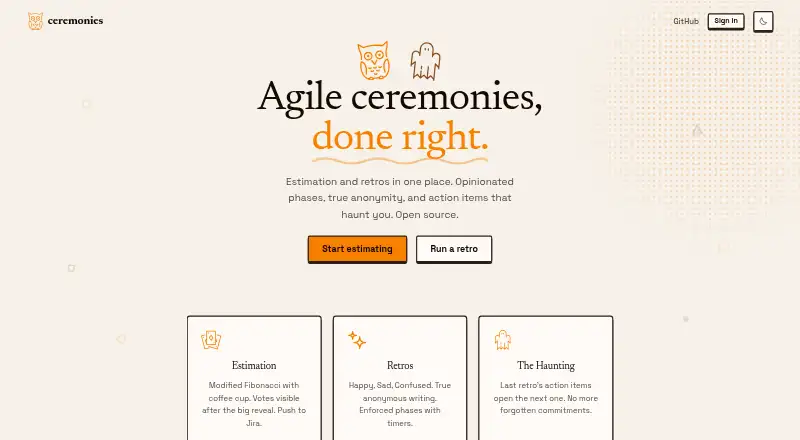
Ceremonies is an open-source toolkit for agile estimation and retrospective sessions, available as a hosted web service or for self-hosting. Estimation rooms use a Modified Fibonacci voting deck, including a coffee-cup option. Votes stay concealed until the group reveals them, and results can be pushed to Jira. Updates sync through WebSockets, so the room does not need a page refresh; finished estimation rounds can also be copied as a Slack summary.
For retrospectives, teams work with Happy, Sad, and Confused cards, anonymous writing, and enforced phases. Action items can be carried into the next retrospective. Participants enter a room through a link or code without making an account. The source is MIT-licensed, and Docker support is described as planned. The hosted Free plan costs nothing and covers one team, five members, and ten sessions per month. Pro removes those Free plan limits and is billed monthly via Stripe. The hosted service is operated by Shadman Rahman. Its privacy policy says it does not sell user data, run ads, or use user data to train AI models.
Who it suits
Ceremonies suits agile teams that want estimation and retrospective sessions in a browser or on a self-hosted setup. It also fits teams that need anonymous feedback, Jira results, or room access without participant accounts.
What it does well
- MIT-licensed source code can be self-hosted.
- Votes remain hidden until the group reveals them.
- Retrospective action items can carry into the next session.
- Participants can join with a link or room code without accounts.
- Estimation results can be pushed to Jira.
What to know first
- Free plan is limited to one team, five members, and ten sessions monthly.
- Docker support is described as planned.
Limits
The Free plan covers one team, five members, and ten sessions per month. Pro removes the Free plan limits, with monthly billing via Stripe.
Plans
| Plan | Billed and limits | Price |
|---|---|---|
| Free | 1 team · 5 members · 10 sessions per month | Free |
| Pro | Billed monthly via Stripe · Removes Free plan limits | On request |
As ceremonies.dev lists them, read 8 Oct 2026. The maker's own page has the final word.
Getting started
- Visit ceremonies.dev for the hosted service.
- Choose the Free plan, which costs nothing.
- Create a team and start an estimation or retrospective session.
- Invite participants with a room link or code; an account is not required to join.
- For self-hosting, use the MIT-licensed source code.
Overview
Ceremonies is an open-source toolkit for agile estimation and retrospective sessions, suited to teams that want anonymous input and shareable outcomes. Its strongest case is a focused set of live workflows with a free tier for small teams; the one-team, five-member and ten-session monthly caps may constrain regular use.
Key features
Estimation sessions use a Modified Fibonacci deck with a coffee-cup option, and keep votes hidden until reveal. Real-time updates sync through WebSockets without a page refresh, and results can be pushed to Jira. Past rounds can also be copied into a Slack summary. That combination makes Ceremonies useful for teams that want estimation outcomes to travel into their project and communication tools, though the workflows described are focused on estimation and retrospectives rather than a broader agile suite.
Retrospectives use Happy, Sad and Confused cards, anonymous writing, and enforced phases. Action items carry into the next retro, giving teams a thread between sessions rather than treating each meeting as a standalone board. Participants join by room link or code without creating accounts, which reduces friction for guests; the team still faces member and session caps on Free.
The project is MIT-licensed and can be self-hosted. Docker support is planned, not currently described as available, so teams relying on Docker deployment should not treat it as a present option. The privacy policy says Ceremonies does not sell user data, run ads or use user data to train AI models. Stripe processes payment details, and Ceremonies says it does not see or store card numbers. Team data remains while an account is active, is deleted with the team, and account-associated data is deleted within 30 days of account deletion.
Pricing
Free: free. It allows one team, five members and ten sessions per month. That is a clear starting point for a small team with occasional ceremonies, but the monthly session ceiling and member cap make it a poor fit for larger groups or frequent use.
Pro: custom pricing, billed monthly via Stripe. It removes Free plan limits, making it the route for teams that outgrow the included capacity. No free trial terms are given.
Platforms
Ceremonies is available on the web and as self-hosted software. The hosted service is operated by Shadman Rahman. Docker support is planned. Users can contact [email protected] or open a GitHub issue for questions.
Who it's for
Ceremonies is a strong fit for teams that need estimation and retrospectives in one focused toolkit, value anonymous contributions, and want guests to join without accounts. Its free allowance suits a small team running up to ten sessions monthly. Teams needing more than five members or ten monthly sessions need Pro; organizations that require Docker-based self-hosting should wait until that support is available.
Pros and cons
- Pro: Hidden estimation votes, live updates, Jira output and Slack summaries connect the estimation workflow to decisions and communication.
- Pro: Anonymous retrospective writing, enforced phases and carried-over action items support structured sessions and continuity.
- Pro: Guests can join by link or code without creating an account, reducing barriers to participation.
- Pro: MIT licensing allows self-hosting, while the stated data practices rule out ad use, data sales and AI training with user data.
- Con: Free is capped at one team, five members and ten sessions per month, limiting headroom for growing or active teams.
- Con: Pro removes those caps but has custom pricing, so its ongoing cost cannot be assessed from a published rate.
- Con: Docker support is planned rather than currently supported, narrowing the immediate self-hosting options for teams that depend on it.
Alternatives
For a broader comparison, browse Retrospective Software. Consider Echometer if you want Linux, macOS, Windows and web support, or a free trial; its Starter plan has one team, 25 workspace members, unlimited retro guests, and one retro per month after the trial, with an archive of two retros per team. RetroStack may suit teams prioritizing device coverage and no sign-up: its free plan covers web, iOS, Android and Mac.
Clear Retro is worth considering if the priority is a free web Community Edition with unlimited boards, members and history. FocusRetro offers a free trial and a Starter plan with three personal boards per month, core templates, voting, reactions, phase timers and action items; choose it when those personal-board terms suit the workflow. FreeRetrospectives is a free web option with retro rooms, live chat, templates, action tracking, exports, AI recaps, health checks, bridge workflows and no per-user pricing.
MiniRetro is an alternative for teams seeking unlimited retros and real-time collaboration on a free plan, with up to ten participants and access to the last five retros. Neatro may fit teams looking for a free plan for up to ten members, unlimited retrospectives and radars, over 70 templates and basic facilitation tools; it also offers a free trial. Paraboll is another free web choice, with unlimited retrospectives and participants, no sign-up and no credit card requirement.
Verdict
Choose Ceremonies if your team wants estimation and retrospective workflows in one MIT-licensed tool, especially when anonymous input, account-free guest joining and Jira or Slack outputs matter. Its Free plan gives a small team a defined way to start, but the five-member and ten-session limits are tight for regular, larger-group use. Look elsewhere if you need published Pro pricing or Docker support now.
Verdict
Choose Ceremonies if your team needs estimation and retrospective workflows with anonymous input and shareable outcomes. Its Free plan has explicit team, member, and monthly session limits, so teams needing more capacity would need Pro; self-hosters should note that Docker support is only planned.
Questions
Is Ceremonies free?
Yes. The Free plan costs nothing and includes one team, five members, and ten sessions per month.
What does Pro cost?
Pro is billed monthly via Stripe and removes the Free plan limits.
Can Ceremonies be self-hosted?
Yes. The source code is MIT-licensed and can be self-hosted; Docker support is described as planned.
Do participants need accounts?
No. Participants can join a room using a link or room code without creating an account.
What integrations are available?
Estimation results can be pushed to Jira, and past rounds can be copied as a Slack summary.
Who operates the hosted service?
The hosted service is operated by Shadman Rahman.
Facts from Ceremonies's own pages
- Data handling
- The privacy policy says Ceremonies does not sell user data, run ads, or use user data to train AI models. · ceremonies.dev, 8 Oct 2026
- Estimation
- Estimation rooms use a Modified Fibonacci deck with a coffee-cup option, keep votes hidden until the reveal, and can push results to Jira. · ceremonies.dev, 8 Oct 2026
- Joining
- Participants can join a room with a link or room code without creating an account. · ceremonies.dev, 8 Oct 2026
- License and hosting
- The source code is MIT-licensed and can be self-hosted; Docker support is described as planned. · github.com, 8 Oct 2026
- Maker
- The hosted service is operated by Shadman Rahman. · ceremonies.dev, 8 Oct 2026
- Product
- Ceremonies is an open-source agile ceremony toolkit for estimation and retrospective sessions. · ceremonies.dev, 8 Oct 2026
- Real-time
- Estimation sessions sync updates through WebSockets without requiring a page refresh. · github.com, 8 Oct 2026
- Retention
- Team data is retained while an account is active, deleted with the team, and account-associated data is deleted within 30 days of account deletion. · ceremonies.dev, 8 Oct 2026
- Retrospectives
- Retrospectives use Happy, Sad, and Confused cards, anonymous writing, enforced phases, and action items that carry into the next retro. · ceremonies.dev, 8 Oct 2026
- Security and payments
- Payment details are processed by Stripe, and the policy says Ceremonies does not see or store card numbers. · ceremonies.dev, 8 Oct 2026
- Slack
- Past estimation rounds can be copied as a summary for Slack. · github.com, 8 Oct 2026
- Support
- Users can contact [email protected] or open a GitHub issue with questions. · ceremonies.dev, 8 Oct 2026
Where Ceremonies stands on Freedom251
- Retrospective Software#3 of 31