Freedom251 › Disk Space Analyzers
ccdu
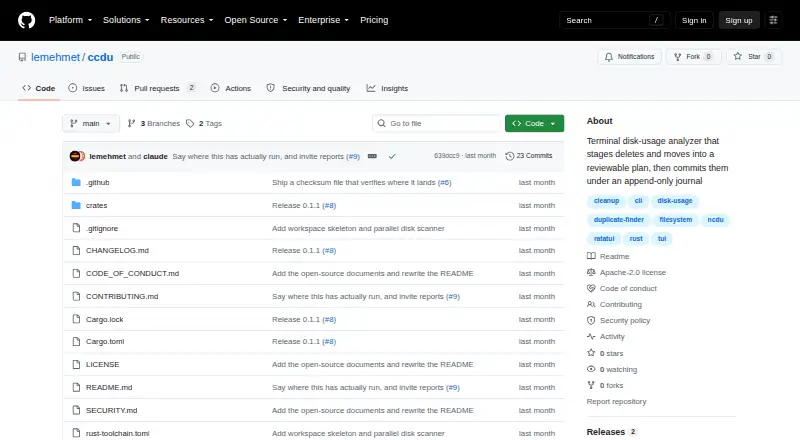
What ccdu is
ccdu is a free terminal disk-usage analyzer for Linux and macOS. It scans files and folders and helps you identify what is using space through size or name sorting, apparent-size and disk-usage views, a treemap, duplicate discovery, and partial scans. Deletions and moves are staged for review and require an explicit commit. Before acting, ccdu checks that each target still matches its staged identity and rejects protected system paths and invalid operations.
Commits are recorded in an append-only journal, allowing work to be paused, resumed, or recovered after a crash. Moves use rename, reflink, or copy-verify-unlink according to the filesystem; hash verification is also available. For another machine, ccdu can work through an SSH connection, with a read-only ncdu fallback if ccdu is unavailable remotely. It reads and writes its own compact scan format and ncdu JSON. The software makes no network connections itself beyond SSH or ncdu requested by the user. Plans and journals remain on the machine where they are stored, while scan exports contain paths and sizes. ccdu is Apache-2.0 licensed.
Who it suits
ccdu suits Linux and macOS users who want to inspect disk usage and stage file moves or deletions before committing them. It can also suit people managing remote files over SSH or using scan exports in ccdu or ncdu formats.
What it does well
- Stages file changes for review before an explicit commit.
- Offers sorting, treemap views, and duplicate discovery.
- Journals commits for pause, resume, and crash recovery.
- Supports SSH-based remote work and ncdu fallback.
- Reads and writes ccdu and ncdu JSON scan formats.
- Apache-2.0 licensed and free to use.
What to know first
- Committed deletions cannot be undone.
- Recursive deletion failures can leave a partly deleted tree.
- Several filesystem types have not been exercised.
- Intel Macs require building from Rust source.
Limits
There is no undo for committed deletions, and a recursive deletion failure can leave a tree partly deleted. The project says btrfs and XFS reflinks, ZFS, network filesystems, and case-insensitive APFS have not been exercised; Linux ext4 and tmpfs and macOS APFS are exercised in CI.
Plans
| Plan | Billed and limits | Price |
|---|---|---|
| ccdu | Single binary · Linux and macOS · Apache-2.0 | Free |
As github.com lists them, read 12 Oct 2026. The maker's own page has the final word.
Getting started
- Open the ccdu GitHub project page.
- Choose a prebuilt binary for Linux x86-64 or arm64, or macOS Apple Silicon.
- On an Intel Mac, build from source with Rust.
- Run a scan of files or folders, locally or through SSH.
- Review staged changes and explicitly commit when ready.
Verdict
Choose ccdu if you want a free terminal analyzer that stages file operations and records commit progress. Look elsewhere if you need undo after a committed deletion or require confidence with a filesystem the project has not exercised.
Questions
How much does ccdu cost?
ccdu is free, with a listed plan price of $0.
Which platforms does ccdu support?
It supports Linux and macOS. Prebuilt binaries are listed for Linux x86-64 and arm64 and macOS Apple Silicon; Intel Macs can build from source with Rust.
Can ccdu work with remote files?
Yes. It can scan and manage files on another machine over the user's SSH connection, with a read-only ncdu fallback if ccdu is unavailable remotely.
Does ccdu connect to the network?
It makes no network connections itself; remote operation uses SSH or ncdu that the user requests.
What happens to plans, journals, and scan exports?
Plans and journals stay on the machine where stored unless sent elsewhere. Scan exports contain scanned paths and sizes.
What license does ccdu use?
The repository identifies ccdu as Apache-2.0 licensed.
Facts from ccdu's own pages
- Data handling
- Plans and journals record paths and stay on the machine where they are stored unless the user sends them elsewhere; scan exports contain scanned paths and sizes. · github.com, 12 Oct 2026
- Exportable reports
- Yes · github.com, 22 Sept 2026
- Filesystem coverage
- The README says Linux ext4 and tmpfs and macOS APFS are exercised in CI; btrfs and XFS reflinks, ZFS, network filesystems, and case-insensitive APFS have not been tested in anger. · github.com, 12 Oct 2026
- Free plan
- Yes · github.com, 22 Sept 2026
- Install
- Prebuilt binaries are available for Linux x86-64 and arm64 and macOS Apple Silicon; Intel Macs can build from source with Rust. · github.com, 12 Oct 2026
- Interoperability
- ccdu can read and write its own compact scan format and ncdu JSON format. · github.com, 12 Oct 2026
- Known limits
- There is no undo, and a failure during recursive deletion can leave a tree partly deleted; the journal records progress. · github.com, 12 Oct 2026
- License
- The repository identifies the software as Apache-2.0 licensed. · github.com, 12 Oct 2026
- Limit: filesystem coverage
- The project says btrfs and XFS reflinks, ZFS, network filesystems, and case-insensitive APFS have not yet been exercised. · github.com, 12 Oct 2026
- Limit: undo
- There is no undo for committed deletions. · github.com, 12 Oct 2026
- Move behavior
- Moves use rename, reflink, or copy-verify-unlink depending on the filesystem; hash verification is available with `--verify=hash`. · github.com, 12 Oct 2026
- Network and data
- The security policy says ccdu makes no network connections except for SSH or ncdu that the user requests, and plans and journals are stored locally or on the remote machine doing the work. · github.com, 12 Oct 2026
- Network behavior
- ccdu makes no network connections itself; remote operation uses the SSH process the user requested. · github.com, 12 Oct 2026
- Plan and journal
- Commits use an append-only journal and can be paused, resumed, or recovered after a crash. · github.com, 12 Oct 2026
- Desktop platforms
- linux,macos · github.com, 22 Sept 2026
- Purpose
- ccdu is a terminal disk-usage analyzer that stages file deletions and moves for review before committing them. · github.com, 12 Oct 2026
- Remote access
- It can scan and manage files on another machine over the user's SSH connection, with a read-only ncdu fallback when ccdu is unavailable remotely. · github.com, 12 Oct 2026
- Resumable work
- Commits use an append-only journal and can be paused, resumed, and recovered after a crash. · github.com, 12 Oct 2026
- Safety
- The security policy says changes require an explicit commit, targets are rechecked against their staged identity, and system paths are refused. · github.com, 12 Oct 2026
- Scan features
- The interface supports sorting, apparent size and disk usage views, a treemap, and duplicate-file discovery. · github.com, 12 Oct 2026
- Scanning and browsing
- It supports parallel scans, size and name sorting, a treemap, duplicate detection, and partial scans. · github.com, 12 Oct 2026
- Scan scope
- files_folders · github.com, 22 Sept 2026
- Security checks
- Before operations, ccdu rechecks staged file identity and refuses protected system paths and other invalid operations. · github.com, 12 Oct 2026
- Support
- The maintainer asks vulnerability reporters to use GitHub's private vulnerability reporting or email and aims to acknowledge within a few days. · github.com, 12 Oct 2026
Where ccdu stands on Freedom251
- Disk Space Analyzers#26 of 105