Freedom251 › Bill of Materials Software

Carbon
What Carbon is
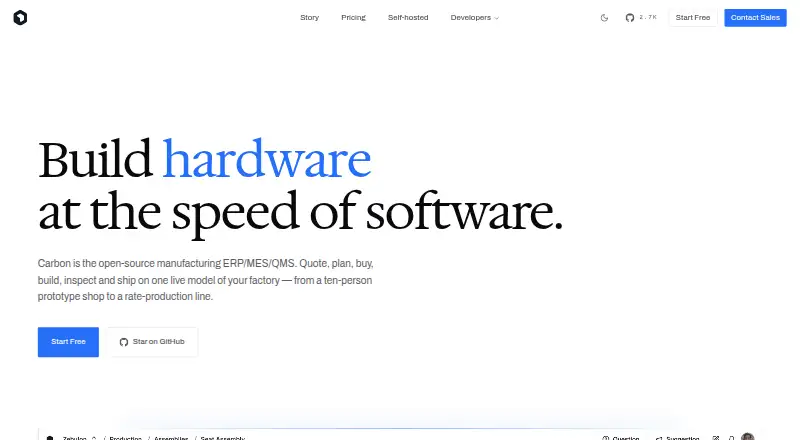
Carbon combines ERP, MRP, MES, and QMS functions for discrete manufacturers managing materials, production, quality, and actual costs. Product rules can generate bills of materials, routings, and quoted prices, with revision control and effectivity dates. Shop-floor tools include digital travelers, work instructions, QR and barcode tracking, and finite-capacity scheduling. Quality records such as first articles, nonconformances, CAPAs, and calibrations can connect to production records, serials, and lots. Deployment options include managed cloud, a customer cloud account, Docker, and on-premises; air-gapped use is an Enterprise feature. The Community edition includes core functions under AGPL-3.0. Starter costs $40 a month, billed per user monthly, and includes basic functionality, unlimited records, self-onboarding, and community support. A 30-day trial is listed. The Business plan costs $100 a month, billed per user monthly, with a five-user minimum. Enterprise pricing is not listed. Self-hosted API keys and MCP access require a commercial license.
Who it suits
Carbon is aimed at discrete manufacturers, including companies in aerospace, automotive, medical devices, electronics, robotics, energy, space, semiconductors, and industrial equipment. It may suit teams that need configurable manufacturing workflows and quality records linked to production.
What it does well
- Generates BOMs, routings, and quoted prices from rules.
- Includes revision control and effectivity dates.
- Shop-floor tools include QR and barcode tracking.
- Quality records can link to production records and genealogy.
- Community edition includes core functions under AGPL-3.0.
What to know first
- Starter has a five-user minimum only for Business?
- Air-gapped deployment is an Enterprise feature.
- Self-hosted API keys and MCP require a commercial license.
- Enterprise pricing is not listed.
Plans
| Plan | Billed and limits | Price |
|---|---|---|
| Starter | Billed per user, monthly · Automatic updates and backups · Basic ERP, MES, and QMS functionality · Unlimited records · Self-onboarding · Community support | $40 a month |
| Business | Billed per user, monthly; 5 user minimum · 5 users minimum | $100 a month |
| Enterprise | Self-hosted or managed · Forward deployed engineer · Customizations, training, and integrations · CMMC compliant · Full setup and migrations · SSO/SAML | On request |
As carbon.ms lists them, read 21 Sept 2026. The maker's own page has the final word.
Overview
Carbon brings ERP, MRP, MES and QMS into one system for discrete manufacturers, linking product rules and material planning with shop-floor work, quality records and actual costs. It suits teams that need controlled revisions and traceability across production; its breadth is compelling, but the per-user price and commercial licensing requirements matter for smaller or self-hosting teams.
Rules can generate bills of materials, routings and quoted prices, while revision control and effectivity dates help keep configured products aligned with their applicable specifications. Multi-level BOMs, BOM comparison, change workflows and inventory integration add useful structure for manufacturers managing product changes and production planning. See Manufacturing ERP Software and Bill of Materials Software for category options.
Key features
Production planning and execution
Digital travelers, work instructions, QR and barcode tracking, and finite-capacity scheduling connect production plans to shop-floor activity. This is a strong fit for operations that need work instructions and progress tied to manufacturing records, rather than a basic inventory-only system.
Configuration and cost control
Rule-based BOM and routing generation, revision control and effectivity dates support configurable products and changing specifications. Carbon can roll up costs and produce quoted prices from product rules, useful where product variants make manual costing and documentation difficult to maintain.
Quality and traceability
First articles, nonconformances, CAPAs and calibrations link to production records, with serial and lot genealogy. That connected record trail is valuable for manufacturers that need to follow product and quality history through production.
Integrations and access
Carbon connects with tools including Onshape, SolidWorks, Slack, Jira, Linear, QuickBooks, Xero, Sage Intacct, Stripe, Ramp, Okta and Microsoft Entra. Its REST API, webhooks and MCP server support custom workflows; typed client generation is documented for TypeScript, Python, Go, Ruby, C# and PHP. Self-hosted API keys and MCP access require a commercial license, a material constraint for teams expecting to use those interfaces with the Community edition.
Security and deployment
Carbon describes row-level security, granular permissions and complete record history. It can run in managed cloud, a customer cloud account, Docker, on-premises or an air-gapped network. The maker describes self-hosted deployment as supporting CMMC and ITAR requirements, and Enterprise BYOC deployments include inputs for an SSP, POA&M and SPRS score. Air-gapped deployment is an Enterprise feature; Enterprise engagements can also include architecture, installation, legacy migration, training and an SLA.
Pricing
Carbon has a paid model, a free plan and a 30-day trial that can be started without a sales call. Starter costs $40 a month per user, billed monthly. It includes automatic updates and backups, basic ERP, MES and QMS functionality, unlimited records, self-onboarding and community support. Unlimited records remove a common data cap, but the per-user monthly charge can add up as a production team grows.
Business costs $100 a month per user, billed monthly, with a 5 user minimum. That minimum makes it a larger commitment than Starter; the plan description does not identify additional inclusions. Enterprise has custom pricing and offers self-hosted or managed deployment, a forward deployed engineer, customizations, training and integrations, CMMC compliance, full setup and migrations, and SSO/SAML. It is the relevant tier for organizations needing that deployment and implementation support, rather than a small team seeking the lowest entry cost.
The Community edition includes core ERP, MRP, MES and QMS under AGPL-3.0. Enterprise features require a commercial agreement, and self-hosted API keys and MCP access require a commercial license, so open-source availability does not mean every deployment or integration capability is included without a paid arrangement.
Platforms
Carbon supports web, Linux, API access and self-hosting. Deployment choices span managed cloud, customer cloud accounts, Docker, on-premises and air-gapped networks; air-gapped operation is reserved for Enterprise.
Who it's for
Carbon targets discrete manufacturers in defense, aerospace, automotive, medical devices, electronics, robotics, energy, space, semiconductor and industrial equipment. It is best suited to teams that need configurable product records, shop-floor execution and quality traceability in one system. Organizations seeking a low-cost, lightweight manufacturing tool or self-hosted API access without commercial licensing should weigh those costs and terms carefully.
Pros and cons
- Pros: Configuration rules can generate BOMs, routings and quoted prices, with revision and effectivity controls for changing products.
- Pros: Production execution and quality records connect through travelers, barcode tracking, CAPAs and serial or lot genealogy.
- Pros: Managed, customer-cloud, on-premises and Docker deployment provide meaningful infrastructure choice; Enterprise adds air-gapped deployment.
- Cons: Starter is priced per user, and Business has a 5 user minimum, which can raise the cost for smaller teams.
- Cons: Self-hosted API keys and MCP access require a commercial license, limiting what Community users can do with those interfaces.
- Cons: Enterprise capabilities such as air-gapped deployment and full implementation support require custom pricing.
Alternatives
Odoo Manufacturing is worth considering when a free plan with unlimited users and Android, iOS and web access is a better fit; its One App Free plan costs nothing, while Standard and Custom have custom pricing.
Apache OFBiz is a free alternative with web and Windows platforms.
ERP5 is a free option for teams looking for self-hosted software.
Epicor Kinetic may suit buyers comparing a paid manufacturing system with platform, cloud package, concurrent-user licensing and industry-bundle choices.
Rootstock ERP offers paid Growth and Advanced plans for buyers comparing core ERP with a more advanced manufacturing plan.
SYSPRO is another paid option, available on web and Windows.
xTuple ERP is a paid alternative available on Windows, macOS and Linux.
abas ERP is a paid option spanning Android, iOS, Linux, web, Windows, API access and self-hosting.
Verdict
Carbon is a strong candidate for discrete manufacturers that need product configuration, shop-floor execution and quality traceability coordinated in one system, especially when deployment flexibility matters. Its per-user pricing, Business minimum and commercial licensing for self-hosted API and MCP access make it less attractive for small teams or users expecting unrestricted self-hosted access. Choose it for connected manufacturing control; look elsewhere if lower entry cost or license-free self-hosted APIs are priorities.
Verdict
Carbon covers planning, shop-floor execution, and quality management, with several deployment options. Starter is listed at $40 a month per user, billed monthly; note that self-hosted API and MCP access require a commercial license.
Facts from Carbon's own pages
- API
- Carbon provides REST endpoints, webhooks and an MCP server, with typed client generation for TypeScript, Python, Go, Ruby, C# and PHP. · carbon.ms, 3 Oct 2026
- API and AI
- Carbon provides a REST API, webhooks and an MCP server, with typed client generation documented for TypeScript, Python, Go, Ruby, C# and PHP. · carbon.ms, 3 Oct 2026
- Compliance
- Carbon describes self-hosted deployment as supporting CMMC and ITAR requirements, and says Enterprise BYOC deployments include inputs for an SSP, POA&M and SPRS score. · carbon.ms, 3 Oct 2026
- Configuration
- It can generate bills of materials, routings and quoted prices from product rules, with revision control and effectivity dates. · carbon.ms, 3 Oct 2026
- Deployment
- Carbon can run in managed cloud, a customer cloud account, Docker, on-premises or an air-gapped network; air-gapped deployment is an Enterprise feature. · carbon.ms, 3 Oct 2026
- Integrations
- The site lists Onshape, SolidWorks, Slack, Linear, Jira, QuickBooks, Xero, Sage Intacct, Stripe, Ramp, Okta and Microsoft Entra among its integrations. · carbon.ms, 3 Oct 2026
- Limits
- For self-hosted deployments, API keys and MCP access require a commercial license. · carbon.ms, 3 Oct 2026
- Manufacturing
- It supports rule-based BOM and routing generation, revision control, and rolled-up costs for configured products. · carbon.ms, 3 Oct 2026
- Open source
- The Community edition includes core ERP, MRP, MES and QMS under AGPL-3.0; Enterprise features require a commercial agreement. · carbon.ms, 3 Oct 2026
- Product
- Carbon combines ERP, MRP, MES and QMS to plan materials, run production, manage quality and track actual costs. · carbon.ms, 3 Oct 2026
- Production
- Shop-floor features include digital travelers, work instructions, QR and barcode tracking, and finite-capacity scheduling. · carbon.ms, 3 Oct 2026
- Quality
- Carbon links first articles, nonconformances, CAPAs and calibrations to production records, with serial and lot genealogy. · carbon.ms, 3 Oct 2026
- Security
- Self-hosted deployments use a Postgres database with row-level security, and the customer controls the network, encryption, backups and retention. · carbon.ms, 3 Oct 2026
- Self-hosted API limit
- Self-hosted API keys and MCP access require a commercial license. · carbon.ms, 3 Oct 2026
- Self-hosting
- Carbon can run in a customer cloud account, on-premises or air-gapped; air-gapped deployment and licensing are Enterprise features. · carbon.ms, 3 Oct 2026
- Support
- Enterprise engagements can include architecture, installation, legacy data migration, training and an SLA. · carbon.ms, 3 Oct 2026
- Target users
- Carbon says it is built for discrete manufacturers, including defense, aerospace, automotive, medical devices, electronics, robotics, energy, space, semiconductor and industrial equipment makers. · carbon.ms, 3 Oct 2026
- Trial
- The maker advertises a 30-day trial and says no sales call is required to start. · carbon.ms, 3 Oct 2026
Where Carbon stands on Freedom251
- Bill of Materials Software#4 of 47
- Manufacturing ERP Software#3 of 32
- Job Shop Software#2 of 14