Freedom251 › Disaster Recovery Software
Capacia Disaster Recovery Platform
Visit Capacia Disaster Recovery Platform Alternatives Pricing
What Capacia Disaster Recovery Platform is
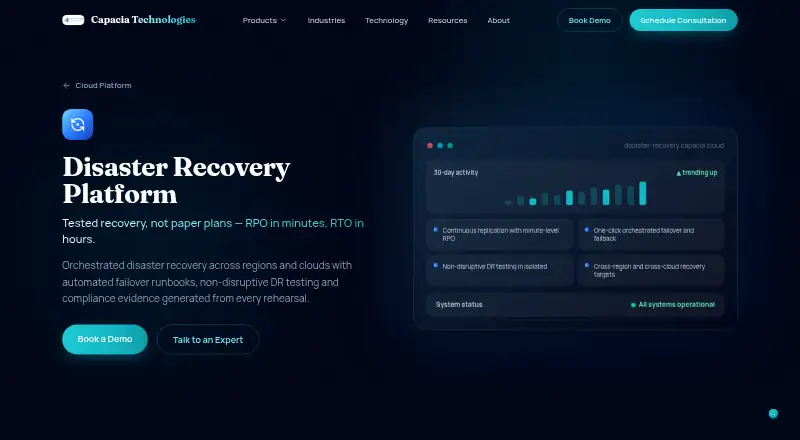
Capacia Disaster Recovery Platform coordinates disaster recovery across regions and clouds, with continuous replication and orchestrated failover and failback. Teams can use recovery runbooks and rehearse failover in isolated environments without disrupting live systems. Capacia describes recovery point objectives measured in minutes and recovery time objectives measured in hours. The platform provides recovery-time analytics, gap remediation and compliance evidence from each test. It can be deployed as managed SaaS in Capacia’s cloud, in a customer’s Azure, AWS or GCP tenancy, or on-premise. Integrations include REST and GraphQL APIs, webhooks, event streams and more than 200 prebuilt connectors. Its stated security controls include encryption, SSO with adaptive MFA, role-based access control and immutable audit trails. Capacia describes its controls as ISO 27001 aligned and SOC 2 ready, with GDPR- and HIPAA-eligible architectures and CIS Benchmarks. Pricing is subscription-based and scaled to usage tiers; a tailored quote is available on request. A typical rollout takes 4–12 weeks.
Who it suits
It suits organizations in finance, healthcare, manufacturing, retail, government and telecommunications that need coordinated recovery across regions or clouds. Its hybrid deployment options may fit teams choosing between managed cloud, their own cloud tenancy and on-premise environments.
What it does well
- Continuous replication and orchestrated failover and failback
- Non-disruptive testing in isolated environments
- Recovery analytics and compliance evidence from tests
- More than 200 prebuilt integration connectors
What to know first
- Pricing requires a tailored quote
- Typical rollout takes 4–12 weeks
Limits
The subscription is scaled to Cloud Platform usage tiers, and pricing is available by tailored quote. A typical rollout takes 4–12 weeks.
Plans
| Plan | Billed and limits | Price |
|---|---|---|
| Cloud Platform subscription | Usage tiers; volume, multi-product and multi-year discounts available | On request |
As capaciatechnologies.com lists them, read 7 Oct 2026. The maker's own page has the final word.
Getting started
- Visit Capacia's disaster recovery product page.
- Contact Capacia for a tailored subscription quote based on Cloud Platform usage tiers.
- Choose managed SaaS in Capacia's cloud, deployment in your Azure, AWS or GCP tenancy, or on-premise deployment.
- Plan a typical 4–12 week rollout covering discovery, configuration, data migration, validation and hypercare with Capacia's product team.
Overview
Capacia Disaster Recovery Platform is an enterprise service for coordinating recovery across regions and cloud providers. It suits organizations that need repeatable recovery exercises, cross-cloud targets and audit-ready evidence, especially in regulated sectors. The trade-off is a usage-scaled subscription and an implementation that requires deliberate planning rather than a quick self-service setup.
Key features
Continuous replication feeds one-click failover and failback orchestration, with targets spanning multiple regions and clouds. Capacia describes recovery point objectives in minutes and recovery time objectives in hours. That combination is appropriate for structured continuity plans, but it should not be read as a promise of instant restoration.
Recovery runbooks, test failover, protocol management and milestone tracking turn recovery procedures into repeatable workflows. Teams can run non-disruptive tests in isolated environments, avoiding production interruption during rehearsals. Recovery-time analytics expose gaps for remediation, and every test produces compliance evidence, which is particularly useful when auditors expect proof that plans were exercised rather than merely documented.
Integration is unusually broad for a recovery platform. REST and GraphQL APIs, webhooks and event streams support custom automation, while the Capacia Integration Hub supplies more than 200 prebuilt connectors. That breadth favors enterprises with existing orchestration and monitoring systems, although organizations seeking a narrow backup utility may have little use for all of these connection points.
The stated security baseline includes encryption in transit and at rest, SSO with adaptive MFA, granular role-based access control and immutable audit trails. Capacia describes controls aligned with ISO 27001 and ready for SOC 2, alongside GDPR- and HIPAA-eligible architectures and CIS Benchmarks. These claims make the platform a plausible fit for compliance-led programs, while procurement teams should still map the controls to their own obligations.
Pricing
Capacia sells a Cloud Platform subscription on usage tiers, with pricing supplied by quote. Volume, multi-product and multi-year discounts are available, so larger or longer commitments may change the effective rate. There is no published low-cost tier to trial the full service, and the subscription model means usage planning matters more than counting named seats.
The single stated plan includes the platform's recovery and testing capabilities, with a hybrid deployment model. It is best for organizations ready to size Cloud Platform consumption and negotiate an enterprise agreement. Smaller teams that only need occasional backups may find a quote-based, usage-scaled purchase harder to justify than a simpler product with a transparent free or entry plan.
Platforms
Capacia is offered through a web interface and API, and can run as managed SaaS in Capacia's cloud, in a customer's Azure, AWS or GCP tenancy, or on-premise. This hybrid choice is valuable for regulated environments and companies splitting workloads between clouds and data centers. It also creates more architecture and governance decisions than a single-hosted service.
A typical rollout takes 4–12 weeks and covers discovery, configuration, data migration, validation and hypercare. A Capacia product team leads the work with a named success manager, giving buyers an implementation path but requiring time from internal owners during the project.
Who it's for
Finance, healthcare, manufacturing, retail, government and telecommunications organizations are the clearest audience. Capacia is a strong match when recovery must cross cloud boundaries, exercises must avoid operational disruption, and compliance teams need evidence from each rehearsal. It is less suitable for a small business seeking a basic endpoint backup, a published monthly price or an immediate deployment.
Pros and cons
Pros
- Cross-region and cross-cloud orchestration: Failover and failback runbooks address complex estates instead of a single-site recovery plan.
- Safe, auditable rehearsals: Isolated testing, recovery analytics and evidence from every test support continuous improvement and compliance reviews.
- Flexible deployment: Managed SaaS, customer-cloud tenancy and on-premise options accommodate differing residency and control requirements.
- Extensive integration surface: APIs, event mechanisms and more than 200 connectors can connect recovery actions to existing systems.
Cons
- Quote-based cost: Usage-tier pricing makes budgeting and comparison difficult before a sales conversation.
- Enterprise rollout effort: The stated 4–12-week implementation is substantial for teams that need protection quickly.
- Recovery measured in hours: The stated objectives fit planned continuity, not workloads that require near-zero recovery time.
Alternatives
Veeam Recovery Orchestrator is worth choosing when a free demonstration or training license and self-hosted or Windows deployment are priorities.
Veeam Agent for Mac is the more focused option for macOS workstation backup, with a free edition limited to one backup job and no direct object-storage backup.
Veeam Kasten for Kubernetes fits Kubernetes teams that can start with a free five-node plan or evaluate up to 500 nodes for 60 days.
Datto Endpoint Backup for Windows is an alternative when consumption-based storage billing across Windows, macOS, Linux and web access is preferable.
Infrascale Backup and Disaster Recovery suits buyers seeking aggregated component subscriptions billed in 1 TB storage increments.
Acronis Cyber Disaster Recovery Cloud is the better comparison for broad device coverage and pay-as-you-go DR cloud storage and compute.
Disaster Recovery Linux Manager is the free, Linux-focused choice.
JetStream DR is an option when an on-demand monthly subscription and VM-level recovery SLAs match the operating model.
For a wider shortlist, see Disaster Recovery Software and Research Project Management Software.
Verdict
Choose Capacia Disaster Recovery Platform when your organization needs orchestrated cross-cloud recovery, isolated testing and evidence that stands up to compliance review, with deployment control extending to customer cloud or on-premise. Look elsewhere if transparent pricing, a free starting tier or a faster, lighter rollout matters more than that enterprise breadth.
Verdict
Capacia combines recovery orchestration, isolated testing and compliance evidence, with deployment choices spanning managed SaaS, customer cloud and on-premise. Buyers should account for quote-based pricing and a typical rollout measured in weeks.
Questions
How is Capacia Disaster Recovery Platform priced?
Pricing is subscription-based and scaled to Cloud Platform usage tiers. Capacia provides tailored quotes on request; volume, multi-product and multi-year discounts are available.
Where can it be deployed?
It is available as managed SaaS in Capacia’s cloud, in a customer’s Azure, AWS or GCP tenancy, or on-premise for regulated environments.
What recovery functions does it provide?
It supports continuous replication, orchestrated failover and failback, cross-region and cross-cloud recovery targets, and non-disruptive tests in isolated environments.
Which integrations are available?
The platform exposes entities through REST and GraphQL APIs, webhooks and event streams. Capacia’s Integration Hub provides more than 200 prebuilt connectors.
What security and compliance controls are described?
The stated baseline includes encryption in transit and at rest, SSO with adaptive MFA, granular role-based access control and immutable audit trails. Capacia describes its controls as ISO 27001 aligned and SOC 2 ready, with GDPR and HIPAA-eligible architectures and CIS Benchmarks.
How long does implementation take?
A typical rollout takes 4–12 weeks and includes discovery, configuration, data migration, validation and hypercare, led by a Capacia product team with a named success manager.
Facts from Capacia Disaster Recovery Platform's own pages
- Analytics
- The platform provides recovery-time analytics and gap remediation. · capaciatechnologies.com, 7 Oct 2026
- Availability
- Capacia advertises a 99.99% uptime SLA with follow-the-sun support available 24×7. · capaciatechnologies.com, 14 Oct 2026
- Business classification
- The legal profile assigns principal activity code 62, described as information and communication. · zaubacorp.com, 14 Oct 2026
- Capital contribution
- The LLP record lists a total contribution obligation of ₹100,000. · zaubacorp.com, 14 Oct 2026
- Company legal record
- ZaubaCorp identifies Capacia Technologies LLP as LLPIN ACA-0607 and says it was incorporated on 23 February 2023. · zaubacorp.com, 14 Oct 2026
- Company status
- The ZaubaCorp record marks the LLP as active and registered with ROC Hyderabad. · zaubacorp.com, 14 Oct 2026
- Compliance claims
- The product page lists ISO 27001 alignment, SOC 2 readiness, GDPR, HIPAA-eligible architectures and CIS Benchmarks. · capaciatechnologies.com, 14 Oct 2026
- Compliance evidence
- Each disaster-recovery test can generate automated compliance evidence. · capaciatechnologies.com, 14 Oct 2026
- Compliance frameworks
- Capacia describes its controls as ISO 27001 aligned and SOC 2 ready, with GDPR and HIPAA-eligible architectures and CIS Benchmarks. · capaciatechnologies.com, 7 Oct 2026
- Deployment
- It is available as managed SaaS in Capacia's cloud, in a customer's Azure, AWS or GCP tenancy, or on-premise for regulated environments. · capaciatechnologies.com, 7 Oct 2026
- Deployment models
- Deployment options are managed SaaS in Capacia’s cloud, a customer Azure/AWS/GCP tenancy, or on-premises. · capaciatechnologies.com, 14 Oct 2026
- Designated partners
- ZaubaCorp names Saikiran Satla and Thota Sandya Rani as designated partners. · zaubacorp.com, 14 Oct 2026
- Discovery workflow
- Automated discovery maps workloads, dependencies and compliance requirements before deployment. · capaciatechnologies.com, 14 Oct 2026
- Documentation
- Full documentation, API references and validation packages are available to customers and evaluators by request. · capaciatechnologies.com, 14 Oct 2026
- DR testing
- The platform supports non-disruptive tests inside isolated bubbles. · capaciatechnologies.com, 14 Oct 2026
- Event architecture
- The technology page describes Kafka-backed domain events connecting products in real time. · capaciatechnologies.com, 14 Oct 2026
- Failover
- One-click orchestrated failover and failback runbooks are listed as capabilities. · capaciatechnologies.com, 14 Oct 2026
- Filing history
- ZaubaCorp says the last available accounts and annual-return filing dates were 31 March 2023. · zaubacorp.com, 14 Oct 2026
- Headquarters
- Hyderabad, Telangana, India · capaciatechnologies.com, 28 Sept 2026
- Implementation and support
- A typical rollout takes 4–12 weeks and includes discovery, configuration, data migration, validation and hypercare, led by a Capacia product team with a named success manager. · capaciatechnologies.com, 7 Oct 2026
- Implementation time
- A typical rollout is estimated at four to twelve weeks, including discovery, configuration, migration, validation and hypercare. · capaciatechnologies.com, 14 Oct 2026
- Infrastructure landing zones
- Secure landing zones with identity, network and policy guardrails can be provisioned as code. · capaciatechnologies.com, 14 Oct 2026
- Integrations
- Capacia says its Integration Hub includes more than 200 prebuilt enterprise connectors. · capaciatechnologies.com, 14 Oct 2026
- Intended users
- The page lists finance, healthcare, manufacturing, retail, government and telecommunications among the industries served. · capaciatechnologies.com, 7 Oct 2026
Where Capacia Disaster Recovery Platform stands on Freedom251
- Disaster Recovery Software#12 of 25