Freedom251 › Property Tax Software
CAMAai
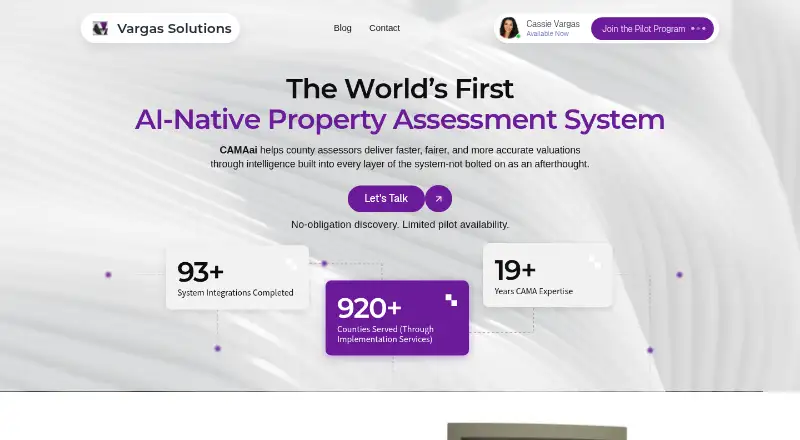
What CAMAai is
CAMAai is an AI-assisted property assessment system for county and local assessor offices. It supports ownership changes, supplemental rolls, and appeals, and can extract deed data and suggest valuations for assessor review. Valuation explanations can show comparable selections, contributing characteristics, confidence indicators, and rationale. Aerial imagery and GIS data help flag properties for review and prepare prioritized field worklists with mobile tools. Other features include constituent and staff AI chat, year-over-year value insights, anomaly tagging, and generated reports and analysis. Its configurable rules engine is described as adapting workflows to jurisdiction-specific statutes, with examples for California, Florida, Colorado, and Maryland. The maker says assessors retain final decision authority, while AI provides evidence to inform decisions. It describes phased rollout and parallel operation with existing systems, without a forced cutover. Pricing is on request. A limited pilot program offers early access and dedicated implementation support, with pricing described as a fraction of standard licensing costs.
Who it suits
It is designed for county and local assessor offices, assessment and appraisal teams, and GIS and data management teams. The pilot is aimed at counties modernizing workflows and seeking to reduce manual review and compliance risk.
What it does well
- Supports ownership changes, supplemental rolls, and appeals.
- Valuation explanations include rationale and confidence indicators.
- GIS and aerial imagery help prioritize field review.
- Phased rollout allows parallel operation with existing systems.
- Assessors retain final decision authority.
What to know first
- Pricing is available on request.
- Pilot availability is limited to some counties.
- Product-data handling details require contacting the maker.
Limits
The pilot is available to a limited number of counties, and its pricing is described as a fraction of standard licensing costs without a stated amount. The pilot targets workflow modernization and may not suit offices seeking only cosmetic upgrades.
Plans
| Plan | Billed and limits | Price |
|---|---|---|
| Pilot program | Limited county availability · early access · dedicated implementation support · pricing described as a fraction of standard licensing costs | On request |
As camaai.com lists them, read 7 Oct 2026. The maker's own page has the final word.
Getting started
- Visit the CAMAai website.
- Ask the maker about pricing and product questions.
- Ask about the limited county pilot and early access.
- Discuss dedicated implementation support and a phased rollout.
CAMAai is an AI-native property assessment system for county and local assessor offices. It is best suited to assessment teams prepared to change substantive workflows, especially where staff need to prioritize property review. Its clearest advantage is decision support that leaves authority with assessors; custom pricing and limited pilot availability make it a considered rather than immediate choice.
Overview
CAMAai brings ownership changes, supplemental rolls, appeals, valuation, deed processing, field review, and compliance workflows into a system for public-sector assessment work. Suggested valuations come with comparable selections, contributing characteristics, confidence indicators, and rationale, giving assessors evidence to weigh rather than an automated final answer. That balance suits offices seeking analytical support while retaining human control.
Its configurable rules engine is intended to adapt workflows to jurisdiction-specific statutes, with examples spanning California, Florida, Colorado, and Maryland. IAAO compliance monitoring and automated compliance workflows further focus the product on consistency and oversight. Those functions are relevant to offices managing local requirements, but a county should confirm how the rules fit its own processes before committing.
Key features
Assessment and AI workflows
Smart Deed Handling uses AI to extract and import critical deed data, while constituent and staff AI chat, year-over-year value insights, anomaly tagging, and generated reports and analysis extend assistance across office work. In practice, these tools can help staff surface patterns and move information through assessment tasks; they do not remove the need for assessor review. The product also supports parcel data import, assessment tools, and jurisdiction tracking.
Field review and deployment
AI change detection uses aerial imagery and GIS data to flag properties for review, then gives field assessors prioritized worklists and mobile tools. This is a practical fit for teams that want field attention directed toward potential changes rather than treating every parcel alike. CAMAai describes parallel operation with existing systems and a phased rollout without a forced cutover, which can make transition more manageable for offices that cannot switch all at once.
The maker says collaborative learning shares model improvements across jurisdictions without transferring raw county data. That is a stated privacy approach, not a complete account of product-data handling: the website privacy policy covers the website and directs assessment-data questions to the company. Counties should raise those questions as part of evaluating the product.
Pricing
CAMAai is paid software with custom pricing. Its Pilot program has limited county availability and offers early access, dedicated implementation support, and input into product development at a fraction of standard licensing costs. The pilot is aimed at counties modernizing workflows and seeking to reduce manual review and compliance risk; it may be a poor fit for an office seeking only a cosmetic upgrade. Standard licensing costs and pilot terms beyond that description are not provided.
Platforms
CAMAai supports Android, iOS, and web. Its web-based, mobile-first design aligns with a mix of office and field work, including mobile tools for field assessors.
Who it's for
The intended users are county and local assessor offices, assessment and appraisal teams, and GIS and data management teams. It is most compelling for offices looking to modernize review and compliance workflows, use aerial imagery and GIS data to direct field work, and retain assessor control over valuation decisions. Teams content with existing manual processes or seeking only a cosmetic interface change have less reason to take on a broader transition.
Pros and cons
- Pros: Explained valuation suggestions give assessors comparable selections, contributing characteristics, confidence indicators, and rationale to consider.
- Pros: Imagery- and GIS-based change detection can prioritize field review, with mobile tools supporting assessors working outside the office.
- Pros: Parallel operation and phased rollout avoid a forced cutover, while the rules engine is designed for jurisdiction-specific statutes.
- Cons: Custom pricing makes budget comparison difficult before a conversation with the maker.
- Cons: Pilot access is limited to a number of counties, so it is not an assured route for every interested office.
- Cons: The website privacy policy does not explain handling of assessment data; counties need to ask the maker directly.
Alternatives
Browse Property Tax Software for a broader set of options. ATS Assessor Treasurer Software is the alternative to consider when open-source software and a free plan matter most; its page describes customization, deployment, training, and consultation as available services. Springbrook Property Tax Management covers residential, commercial, agricultural, and personal property taxes from assessment through billing and collection, making it relevant to offices seeking that broader tax-management scope.
Vision CAMA is another paid web and Windows option for offices comparing CAMA systems. Catalis Assessment E-file is a paid web option to consider when assessment e-filing is the focus. CSC Corptax is enterprise corporate tax software, a different fit from a county assessment platform. DEVNET Edge offers an all-inclusive suite spanning CAMA, assessment administration, billing and collection, permitting and zoning, and records management, for offices seeking that wider scope. Ingenuity CAMA is another paid web-based CAMA option. itamlink offers Professional and Enterprise plans for readers comparing paid alternatives.
Verdict
CAMAai is worth considering for county and local assessor offices ready to modernize how they analyze, prioritize, and review property assessments. Its strongest reason to choose it is the combination of explained AI suggestions, field-review prioritization, and assessor decision authority, supported by phased transition. Look elsewhere if a county needs published pricing, broad assured pilot access, or a clearly described account of how assessment data is handled before evaluation.
Verdict
CAMAai combines assessment workflows, AI-assisted analysis, and field review tools while leaving final decisions with assessors. Pricing is on request, and the described pilot has limited county availability.
Questions
What does CAMAai cost?
Pricing is on request. The limited county pilot is described as costing a fraction of standard licensing costs.
Which platforms does CAMAai support?
The listed platforms are Android, iOS, and web.
Who makes CAMAai?
Vargas Solutions, LLC operates the CAMAai website.
Can CAMAai work alongside an existing assessment system?
The maker describes parallel operation with existing systems and a phased rollout without a forced cutover.
Who makes the final assessment decisions?
Assessors retain final decision authority; the AI provides evidence to support their decisions.
Facts from CAMAai's own pages
- AI features
- Features include constituent AI chat, deed data extraction, year-over-year value comparisons, anomaly tagging, and AI-generated reports and analysis. · camaai.com, 7 Oct 2026
- AI tools
- Listed features include constituent and staff AI chat, year-over-year value insights, anomaly detection and tagging, and generative reports and analysis. · camaai.com, 7 Oct 2026
- Assessment rules
- A configurable rules engine is described as adapting to jurisdiction-specific statutes, with examples for California, Florida, Colorado, and Maryland. · camaai.com, 7 Oct 2026
- Assessment workflow
- The platform supports workflows such as ownership changes, supplemental rolls, and appeals. · camaai.com, 7 Oct 2026
- Audience
- The site identifies county and local assessor offices, assessment and appraisal teams, and GIS and data management teams as intended users. · camaai.com, 7 Oct 2026
- Compliance
- The product describes IAAO compliance monitoring and automated compliance workflows as part of its assessment features. · camaai.com, 7 Oct 2026
- Deed processing
- Smart Deed Handling extracts and imports critical deed data with AI assistance. · camaai.com, 7 Oct 2026
- Deployment
- CAMAai is described as web-based and mobile-first, with parallel operation, phased rollout, and no forced cutover. · camaai.com, 7 Oct 2026
- Field data
- AI change detection uses aerial imagery and GIS data to flag properties for review and provide field assessors with prioritized worklists and mobile tools. · camaai.com, 7 Oct 2026
- Founded
- 2014 · camaai.com, 28 Sept 2026
- Headquarters
- Jacksonville, Florida, United States · camaai.com, 28 Sept 2026
- Human oversight
- The site says assessors make final decisions and AI provides evidence; it presents CAMAai as support for staff rather than a replacement. · camaai.com, 7 Oct 2026
- Human review
- The maker says assessors retain final decision authority and AI provides evidence for their decisions. · camaai.com, 7 Oct 2026
- Integration details
- The site refers to system integrations and using aerial imagery and GIS data, but does not name specific third-party integration partners. · camaai.com, 7 Oct 2026
- Intended users
- The product is designed for county and local assessor offices, assessment and appraisal teams, and GIS and data management teams. · camaai.com, 7 Oct 2026
- Jurisdiction rules
- Its configurable rules engine is described as adapting workflows to jurisdiction-specific statutes, with example capabilities for California, Florida, Colorado, and Maryland. · camaai.com, 7 Oct 2026
- Maker
- The site identifies Vargas Solutions, LLC as the operator of the CAMAai website and lists Napa, California as its location. · camaai.com, 7 Oct 2026
- Pilot
- The maker is selecting a limited number of county pilot partners, offering early access, dedicated implementation support, and input into product development at a fraction of standard licensing costs. · camaai.com, 7 Oct 2026
- Pilot fit
- The pilot targets counties modernizing workflows and seeking to reduce manual review and compliance risk; the maker says it may not suit offices seeking only cosmetic upgrades. · camaai.com, 7 Oct 2026
- Privacy approach
- The maker says collaborative learning shares model improvements across jurisdictions without transferring raw county data. · camaai.com, 7 Oct 2026
- Product
- CAMAai is an AI-native property assessment system for county assessors. · camaai.com, 7 Oct 2026
- Product security details
- The site privacy policy applies to the website and directs readers to contact the maker for information about how CAMAai handles property assessment data. · camaai.com, 7 Oct 2026
- Support
- The site invites visitors to ask questions and describes dedicated implementation support for pilot partners. · camaai.com, 7 Oct 2026
- Transition
- The maker describes parallel operation with existing systems, phased rollout, and no forced cutover. · camaai.com, 7 Oct 2026
Where CAMAai stands on Freedom251
- Property Tax Software#2 of 18