
CallFire API
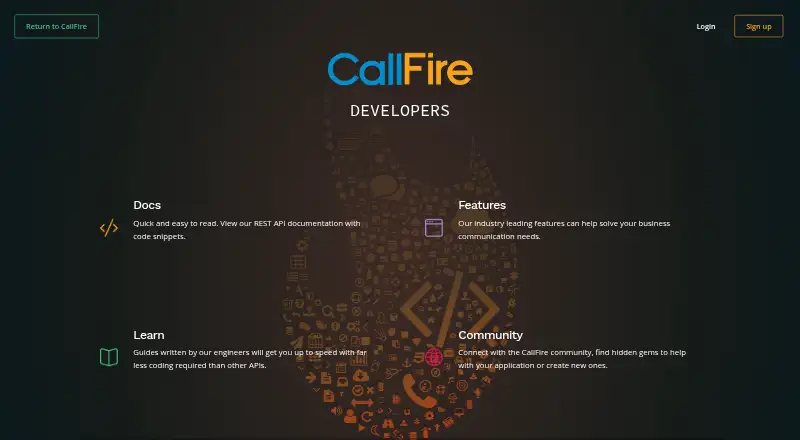
What CallFire API is
CallFire API v2 is a REST interface for connecting applications to CallFire telephony services. It works with HTTP clients and returns JSON, supporting individual and broadcast text and voice messaging. Developers can use webhooks for events such as campaign activity and incoming texts, along with features for campaign management, scheduling, call recording and real-time reporting. The documentation covers contacts, number and keyword ordering, a sound library, short codes, and action states and results. SDKs are listed for Java, .NET, JavaScript, Python and PHP; the JavaScript, Python and PHP SDKs are marked beta. Access requires separately generated API credentials for HTTP Basic Authentication, not standard CallFire UI credentials. CallFire says API communications use HTTPS with TLS and webhook calls use SSL certificates. It lists Do Not Call list management, 24/7 support and advertises 99.95% uptime. Pricing options include Pay as you go at no cost, Lite at $99 a month, Startup at $199 a month, Grow at $299 a month and Pro at $599 a month. Calls and texts stop when an account's allowance reaches zero; extra credits cost 6¢ each. Plans include calls to the US and Canada, while international text messages are not currently supported.
Who it suits
CallFire API suits developers connecting a CRM, mobile app or website backend to telephony services for calls, texts and campaign events. It is relevant to teams that can use API-specific credentials and whose messaging needs fit the stated geographic limits.
What it does well
- Supports individual and broadcast voice and text messaging
- Webhooks cover campaign events and incoming texts
- SDKs listed for five languages
- 24/7 support is listed
- Call recording and real-time reporting are listed
What to know first
- No free plan is listed
- Calls and texts stop when allowance reaches zero
- International text messages are not supported
- Three listed SDKs are marked beta
Limits
Pay as you go has no monthly fee and includes optional monthly rentals, with phone numbers at $10.00 and keywords at $25. Calls and texts stop when the account allowance is depleted; additional credits can be purchased at 6¢ per credit. Plans include calls to the US and Canada, and international text messages are not currently supported.
Plans
| Plan | Billed and limits | Price |
|---|---|---|
| Pay as you go | no monthly fee · Optional monthly rentals · $10.00 phone numbers · $25 keywords | Free |
| Startup | $199/month · 5500 minutes/texts · Optional monthly rentals · $2.25 phone numbers · $15 keywords | $199 a month |
| Grow | $299/month · 10000 minutes/texts · Optional monthly rentals · $2.00 phone numbers · $13 keywords | $299 a month |
| Pro | $599/month · 20000 minutes/texts · Optional monthly rentals · $1.75 phone numbers · $10 keywords | $599 a month |
| Lite | $99/month · 2500 minutes/texts · Optional monthly rentals · $2.50 phone numbers · $20 keywords | $99 a month |
As developers.callfire.com lists them, read 8 Oct 2026. The maker's own page has the final word.
Getting started
- Open the CallFire developer site at https://developers.callfire.com/.
- Choose an SDK listed for Java, .NET, JavaScript, Python, or PHP, or use another HTTP client.
- Generate API credentials separately from your standard CallFire UI credentials.
- Select a plan, such as Pay as you go at no cost or a paid monthly plan.
- Connect your CRM, mobile app, or backend website architecture to the API.
Overview
CallFire API is a REST interface for adding text, voice and campaign workflows to software that uses CallFire telephony. It best suits teams connecting an existing CRM, mobile app or website backend. Its broad messaging and calling tools are useful, but monthly allowances and North American coverage will determine whether it fits.
Key features
API v2 accepts requests from any HTTP client and returns JSON, so developers can work with their existing stack. CallFire also lists SDKs for Java, .NET, JavaScript, Python and PHP; the JavaScript, Python and PHP SDKs are beta, a consideration for teams building production integrations around them.
The API supports individual text and voice messages as well as text and voice broadcasts. Campaign management, scheduling controls, free call recording and real-time reporting support more involved communication programs. Contacts, number and keyword ordering, short codes, a sound library, and action states and results add tools for managing delivery and campaign outcomes. Webhooks report events such as campaign activity and incoming texts, allowing connected software to react to activity.
API v2 uses HTTP Basic Authentication with separately generated API credentials; standard CallFire UI credentials do not grant API access. CallFire says endpoint communications use HTTPS with TLS and webhook calls use SSL certificates. It also describes compliance solutions, including Do Not Call list management. Its API features include 24/7 support through the support page, and CallFire advertises 99.95% uptime and messaging from one contact up to one million.
Pricing
Pay as you go costs nothing, with no monthly fee. It includes optional monthly rentals, with phone numbers at $10.00 and keywords at $25. This is the lowest-commitment way to start, but the account still runs on an allowance: calls and texts stop when it reaches zero, and extra credits cost 6¢ per credit.
Lite is $99 a month and includes 2,500 minutes/texts, optional monthly rentals, $2.50 phone numbers and $20 keywords. Startup is $199 a month for 5,500 minutes/texts, with $2.25 phone numbers and $15 keywords. These plans suit teams that need a defined monthly allowance and regular number or keyword rentals, with Startup providing more usage at a higher monthly price.
Grow is $299 a month and includes 10,000 minutes/texts, optional monthly rentals, $2.00 phone numbers and $13 keywords. Pro is $599 a month for 20,000 minutes/texts, optional monthly rentals, $1.75 phone numbers and $10 keywords. The larger plans offer progressively more usage and lower number and keyword charges, making them the relevant tiers for higher-volume programs; users should match the allowance to expected traffic because service stops at zero unless credits are added.
Plans include calls to the US and Canada, while international text messages are not currently supported. That makes CallFire a poor fit for campaigns that depend on international texting. Pricing starts at 1 /mo; inbound and outbound calling, phone number support and call recording are supported.
Platforms
CallFire API is available on api. Its HTTP client compatibility and SDK options provide ways to integrate it with CRM platforms, mobile apps and website backends.
Who it's for
CallFire API is a strong fit for developers building text and voice communications into an existing product, especially when they need broadcasts, campaign controls, event notifications and call recording together. Teams should be comfortable generating separate API credentials and should check that the applicable usage allowance and US-and-Canada call coverage match their needs.
Pros and cons
- Pros: One API covers individual and broadcast messaging across both text and voice, plus campaign management, scheduling and real-time reporting.
- Pros: Webhooks can notify applications about campaign events and incoming texts, while multiple SDKs and support for any HTTP client leave integration options open.
- Pros: Free call recording and Do Not Call list management address useful operational needs within communications workflows.
- Cons: Calls and texts stop when the account allowance is depleted; continued use requires purchasing credits at 6¢ per credit.
- Cons: International text messages are unsupported, limiting its fit for globally distributed texting.
- Cons: JavaScript, Python and PHP SDKs are beta, and API access requires credentials generated separately from standard UI login details.
Alternatives
For a broader directory of voice-focused tools, browse Voice Broadcasting Software.
Choose CallHub if a free plan and free trial are priorities; it supports Android, iOS, macOS, web and Windows as well as API access. Text-Em-All (formerly Call-Em-All) is another option for those who want a free starting tier, including 25 credits for testing voice broadcasts and test texting to their own number; mass texting requires an upgrade.
Newfies-Dialer may suit teams seeking a self-hosted option, with API and web access and paid port plans that specify agent, tenant and daily call and SMS allowances. Consider TexTalk Voice Notification, Vasudev Voice Broadcasting, BBOX Voice Messaging, IVR Lab Automated Voice Broadcasting or Voice Broadcasting Platform when comparing other paid voice broadcasting options.
Verdict
Choose CallFire API if you need to embed text and voice messaging, broadcasts and campaign event notifications into an existing application, and your expected usage fits its allowances. Its integrated capabilities and flexible HTTP access are compelling for North American communications workflows. Look elsewhere if international texting is essential or if beta SDKs and allowance-based service interruption are unacceptable.
Verdict
CallFire API combines messaging, calling and event notifications with multiple SDK options and documented authentication requirements. Check allowance limits and destination coverage against your intended use before choosing a plan.
Questions
What does CallFire API cost?
Pricing is listed from $1/mo. The Pay as you go plan is free with no monthly fee; monthly plans include Lite at $99 a month, Startup at $199 a month, Grow at $299 a month, and Pro at $599 a month.
Is there a free plan?
There is no free plan. Pay as you go is listed as free and is billed with no monthly fee.
Which platforms and SDKs are supported?
The platform is listed as API. The developer site lists Java, .NET, JavaScript, Python, and PHP SDKs; JavaScript, Python, and PHP are marked beta.
Can I use my regular CallFire login credentials for the API?
No. API v2 uses HTTP Basic Authentication with separately generated API credentials; standard CallFire UI credentials do not work as API credentials.
Can it send international text messages?
CallFire says its plans include calls to the US and Canada. It does not currently support international text messages.
Who makes CallFire API, and where is it based?
CallFire is headquartered in Los Angeles, California, United States.
Facts from CallFire API's own pages
- API type
- CallFire API v2 is a REST API that works with any HTTP client and returns JSON responses. · developers.callfire.com, 8 Oct 2026
- Authentication
- API v2 uses HTTP Basic Authentication with separately generated API credentials; standard CallFire UI credentials do not work as API credentials. · developers.callfire.com, 8 Oct 2026
- Compliance
- CallFire describes its developer software as including compliance solutions and lists Do Not Call list management among its features. · developers.callfire.com, 8 Oct 2026
- Geographic limits
- The pricing page says plans include calls to the US and Canada and that CallFire does not currently support international text messages. · callfire.com, 8 Oct 2026
- Headquarters
- Los Angeles, California, United States · developers.callfire.com, 28 Sept 2026
- Integrations
- The API can be used to integrate existing CRM platforms, mobile apps, or backend website architecture with CallFire telephony solutions. · callfire.com, 8 Oct 2026
- Messaging and calling
- The API supports individual text and voice messaging as well as text and voice broadcast messaging. · developers.callfire.com, 8 Oct 2026
- Other capabilities
- The developer documentation includes contacts, number and keyword ordering, sound library, short codes, and action states and results. · developers.callfire.com, 8 Oct 2026
- Pricing allowance
- CallFire says calls and texts stop when an account's allowance reaches zero, and additional credits can be purchased at 6¢ per credit. · callfire.com, 8 Oct 2026
- Scale and uptime
- The API features page advertises 99.95% uptime and messaging from one contact up to one million. · developers.callfire.com, 8 Oct 2026
- SDKs
- The developer site lists Java, .NET, JavaScript (beta), Python (beta), and PHP (beta) SDKs for API v2. · developers.callfire.com, 8 Oct 2026
- Security
- CallFire says communications between its endpoints and customer applications use HTTPS with TLS, and webhook calls use SSL certificates. · developers.callfire.com, 8 Oct 2026
- Service features
- CallFire lists campaign management, scheduling controls, free call recording, real-time reporting, and webhooks among its API features. · developers.callfire.com, 8 Oct 2026
- Support
- The API features page says support is available 24/7 through its support page. · developers.callfire.com, 8 Oct 2026
- Webhooks
- The API supports webhooks for event notifications, including campaign events and incoming texts. · developers.callfire.com, 8 Oct 2026
Where CallFire API stands on Freedom251
- Voice APIs#20 of 52
- Voice Broadcasting Software#18 of 26