Freedom251 › Third-Party Logistics Software
byrd WMS
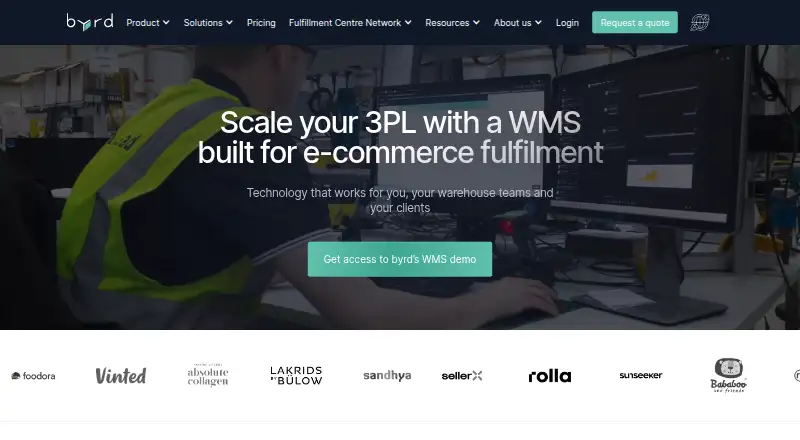
What byrd WMS is
byrd WMS is warehouse management software for third-party logistics providers (3PLs) handling e-commerce fulfilment for multiple clients. It supports inventory control and fulfilment workflows, with rules configurable by client, order, SKU, destination, carrier, packaging need, and service level. This lets an operation apply different fulfilment logic across the businesses it serves while keeping client data, inventory, workflows, and service levels separate.
The system covers B2C and B2B fulfilment, as well as omnichannel requirements in the same setup. Merchants can use a branded self-service portal to view inventory, orders, shipments, returns, and fulfilment performance. Integrations connect the WMS with shop systems, marketplaces, ERP systems, and carriers; named options include Shopify, Amazon, PlentyONE, Xentral, and SAP. Developers can use the API documentation to create products and shipments, check stock and shipment status, and list returns.
byrd says it hosts data in the EU using AWS, encrypts data in transit with TLS and at rest using native AWS features, and uses role-based permissions and multi-factor authentication. The product was founded in 2016 and is headquartered in Vienna and Berlin. It is available on web and through an API. Pricing is bespoke and scales with platform access and order volume; demo access is offered.
Who it suits
byrd WMS suits 3PLs that fulfil e-commerce orders for multiple brands and want to scale under their own brand and commercial model. It is relevant to operators that need client-specific workflows, separated operations, B2C and B2B support, and a merchant-facing portal.
What it does well
- Separates client data, inventory, workflows, and service levels.
- Configurable fulfilment logic covers clients, SKUs, destinations, and packaging.
- Supports B2C, B2B, and omnichannel fulfilment.
- Branded portal shows merchants orders, inventory, returns, and performance.
- Named integrations include Shopify, Amazon, PlentyONE, Xentral, and SAP.
What to know first
- Paid service with bespoke pricing available on request.
- Pricing scales with platform access and order volume.
- Access is listed for web and API.
Limits
The WMS has bespoke pricing based on platform access and order volume; no numeric price is provided.
Plans
| Plan | Billed and limits | Price |
|---|---|---|
| byrd WMS | Scalable pricing based on platform access and order volume · bespoke pricing | On request |
As getbyrd.com lists them, read 8 Oct 2026. The maker's own page has the final word.
Getting started
- Visit the byrd WMS website.
- Request demo access.
- Contact byrd at [email protected] for customer service.
- Request bespoke pricing based on platform access and order volume.
- Use the web platform or API documentation for developer access.
byrd WMS is warehouse management software built for third-party logistics providers running fulfilment for multiple e-commerce brands. It is strongest when one operation needs separate client environments, configurable rules, and a merchant-facing portal across B2C, B2B, and omnichannel work. Organisations that need a defined public price or a lightweight single-client warehouse system should look elsewhere.
Overview
Founded in 2016, byrd operates from Vienna and Berlin. Its WMS is designed for 3PLs scaling under their own brand and retaining their own client relationships and commercial model. Inventory control and fulfilment workflows are core capabilities, while integrations connect shop systems, marketplaces, ERP platforms, and carriers.
The central proposition is multi-client control without blending operations. Brands, inventories, workflows, and service levels can be managed in one system while client data remains separated. That is a meaningful fit for a 3PL onboarding several merchants; it is less compelling for a company that only needs basic stock and dispatch functions for its own store.
Key features
Configurable fulfilment logic
Rules can be set by client, order, SKU, destination, carrier, packaging requirement, and service level. This granularity lets a 3PL apply different operating models without forcing every merchant through the same process. It also implies more setup and governance than a fixed workflow tool, so teams should be prepared to maintain those rules as clients and carrier requirements change.
Multi-channel and client operations
B2C and B2B fulfilment, plus more complex omnichannel requirements, are supported in one setup. A branded self-service portal gives merchants visibility into inventory, orders, shipments, returns, and fulfilment performance. That portal can reduce routine status requests and reinforce the 3PL's own brand, although the value is greatest when clients actively use self-service reporting.
Integrations and API
Named connections include Shopify, Amazon, PlentyONE, Xentral, and SAP, alongside links to other shop systems, marketplaces, ERP systems, and carriers. Developers can use the documented API to create products and shipments, check stock and shipment status, and list returns. This makes byrd a better candidate for connected commerce stacks than for isolated warehouse operations, but implementation work remains part of any integration-heavy rollout.
Security and access
byrd says data is hosted in the EU on AWS, with TLS for data in transit and native AWS features for data at rest. Role-specific IAM permissions, role-based access control, and multi-factor authentication are intended to protect customer data. These controls suit 3PLs handling information for multiple merchants, though buyers should confirm their required compliance and contractual terms during a demo.
Pricing
byrd WMS
Custom pricing is based on platform access and order volume. No numeric subscription price is published, so the product is aimed at 3PLs comfortable requesting a quote and discussing their operating scale. Ask byrd for demo access and a proposal tailored to the number of users or platform access required and expected order volume; the absence of a public figure makes direct cost comparison harder.
The scalable model can suit a growing fulfilment provider whose volumes and client mix change, but it gives smaller operators no self-serve way to test cost against a fixed budget. There is no lower-priced public tier to trade away portal, multi-client, or omnichannel capabilities.
Platforms
byrd WMS is offered through web access and an API. That combination supports browser-based operational work and programmatic connections for products, shipments, stock, statuses, and returns. No mobile or desktop-native platform is specified.
Who it's for
Choose it for a 3PL managing several brands, inventories, service levels, and fulfilment channels from one operation. It is particularly suitable when each merchant needs separated data, branded self-service visibility, and rules that vary by order, SKU, destination, carrier, packaging, or service level. It is less suitable for a single-brand warehouse seeking a simple, transparent subscription or for buyers that require a published price before engaging sales.
Pros and cons
Pros
- Strong multi-client separation: brands, inventories, workflows, and service levels stay distinct within one WMS.
- Detailed rule configuration: fulfilment logic can reflect commercial and operational differences between clients and orders.
- Broad fulfilment scope: B2C, B2B, and omnichannel processes are covered together.
- Merchant portal: clients can self-serve on inventory, orders, shipments, returns, and performance.
- Integration depth: named Shopify, Amazon, PlentyONE, Xentral, and SAP connections plus an API support connected stacks.
Cons
- No public price: buyers must request a quote based on platform access and order volume.
- Operational complexity: highly configurable rules require ongoing administration rather than a one-size-fits-all setup.
- Web and API only: organisations expecting native mobile or desktop applications may need another option.
Alternatives
Browse Third-Party Logistics Software for a wider shortlist.
- Tremo is the better starting point for a freemium option: its Free plan covers 100 completed pick lists per month, then charges €0.26 per additional pick list.
- Camelot 3PLink BMS is a paid web and Windows alternative when those platforms fit your operation.
- EasyEcom 3PL suits teams comparing defined capacity tiers, including a Starter plan with up to three users, about 100,000 SKUs, one warehouse, and unlimited e-commerce channels and marketplaces.
- Infoplus 3PL WMS is another paid Android, iOS, API, and web option with monthly billing tied to product tier and add-ons.
- WMS123 is worth considering when a quote based on operation, capabilities, and integrations is acceptable.
- Binsy offers paid custom subscriptions quoted in rupees or dirhams according to warehouse count and monthly order volume, with client-level segregation and portals.
- Da Vinci WMS is a paid API and web product sold by custom quote.
- Infios WMS for 3PLs is a paid alternative available as self-hosted and web software.
Verdict
byrd WMS is a strong match for 3PLs that need configurable, separated operations for multiple merchants and want B2C, B2B, omnichannel, integrations, and a branded client portal in one system. Its main reason to look elsewhere is commercial uncertainty: pricing is bespoke and requires a sales conversation, while the product's flexibility brings administrative complexity. Request a demo and quote if those multi-client controls are central to your fulfilment model.
Verdict
Choose byrd WMS if you are a 3PL managing fulfilment for several brands and need configurable workflows with separated client operations. Its merchant portal and B2C, B2B, and omnichannel coverage add to that fit. Ask byrd for a demo and a quote based on your platform access and order volume.
Questions
How much does byrd WMS cost?
Pricing is available on request and scales based on platform access and order volume.
Is byrd WMS free?
It is a paid product. The WMS page offers demo access.
What platforms does it support?
The listed platforms are web and API.
Which integrations are named?
Named integrations include Shopify, Amazon, PlentyONE, Xentral, and SAP. The WMS also connects with shop systems, marketplaces, ERP systems, and carriers.
Who makes byrd WMS?
byrd WMS is byrd's warehouse management software. byrd was founded in 2016 and is headquartered in Vienna, Austria, and Berlin, Germany.
Facts from byrd WMS's own pages
- Access controls
- byrd describes role-specific IAM permissions, role-based access control, and multi-factor authentication as measures for protecting customer data. · getbyrd.com, 8 Oct 2026
- API
- byrd provides API documentation for developers to create products and shipments, check stock and shipment status, and list returns. · developers.getbyrd.com, 8 Oct 2026
- Availability and pricing
- The WMS page offers demo access and describes pricing as scalable based on platform access and order volume; it does not show a numeric WMS price. · getbyrd.com, 8 Oct 2026
- B2C, B2B, omnichannel
- The WMS supports B2C and B2B fulfilment and more complex omnichannel requirements in one setup. · getbyrd.com, 8 Oct 2026
- Client portal
- Merchants can use a branded self-service portal to view inventory, orders, shipments, returns, and fulfilment performance. · getbyrd.com, 8 Oct 2026
- Configurable workflows
- Fulfilment logic can be configured by client, order, SKU, destination, carrier, packaging requirement, and service level. · getbyrd.com, 8 Oct 2026
- Founded
- 2016 · getbyrd.com, 28 Sept 2026
- Headquarters
- Vienna, Austria; Berlin, Germany · getbyrd.com, 28 Sept 2026
- Integrations
- The WMS connects with shop systems, marketplaces, ERP systems, and carriers; named integrations include Shopify, Amazon, PlentyONE, Xentral, and SAP. · getbyrd.com, 8 Oct 2026
- Intended users
- The product is for 3PLs that want to scale under their own brand while keeping their own clients and commercial model. · getbyrd.com, 8 Oct 2026
- Multi-client operations
- The system manages multiple brands, inventories, workflows, and service levels while keeping client data and operations separated. · getbyrd.com, 8 Oct 2026
- Purpose
- byrd WMS is warehouse management software for 3PLs running multi-client e-commerce fulfilment. · getbyrd.com, 8 Oct 2026
- Security
- byrd says it hosts data in the EU using AWS and encrypts data in transit with TLS and data at rest with native AWS features. · getbyrd.com, 8 Oct 2026
- Support
- The WMS page offers demo access, and byrd lists [email protected] as its customer service contact. · getbyrd.com, 8 Oct 2026
Where byrd WMS stands on Freedom251
- Third-Party Logistics Software#12 of 29