Freedom251 › Third-Party Logistics Software
Binsy
What Binsy is
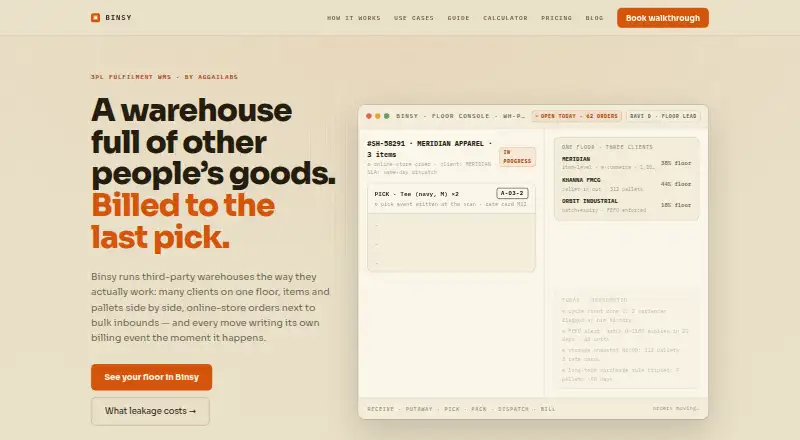
Binsy is a web-based warehouse management system for third-party warehouses that store and fulfil goods for client brands. It supports multiple clients in one facility, with separate inventory, rate cards, and rules. Receiving, storage snapshots, picking, packing, and value-added services can create billable events against a client’s rate card as work happens. Its workflow covers receiving, bin putaway, wave picking, scan-verified packing, dispatch, and invoice review. Binsy handles item-level fulfilment and pallet-level bulk storage, including batch and expiry details where needed. Orders can be grouped into waves with sequenced pick paths, and packs can be checked by scan before sealing. Shopify orders flow into picking, packing, and dispatch, with fulfilment status returned to the store. Each client can view its own stock and orders through a portal. Rolling counts can be run by bin, zone, or client, alongside full stock takes; variances are flagged with bin history. Pricing is quoted based on warehouse count and monthly order volume, with exact numbers requiring a written quote. The product is made by AggAiLabs Software Solutions Private Limited, headquartered in Pune, India.
Who it suits
Binsy is aimed at third-party warehousing and fulfilment companies serving client brands. Its multi-client inventory, rate-card billing, and client portals suit operators managing several businesses in one facility.
What it does well
- Separates inventory, rate cards, and rules by client.
- Records billable events as warehouse work happens.
- Supports item-level and pallet-level inventory workflows.
- Shopify orders flow into fulfilment and status returns to stores.
- Provides client-specific stock and order portals.
What to know first
- Exact subscription pricing requires a written quote.
- Pricing depends on warehouse count and monthly order volume.
- Privacy policy is a placeholder pending a final version.
Limits
The custom subscription is banded by warehouse count and monthly order volume. The described pilot runs for 14 days, with configuration on days 1–3, parallel running on days 4–10, and live operation on days 11–14.
Plans
| Plan | Billed and limits | Price |
|---|---|---|
| Custom subscription | Quoted in rupees or dirhams; based on warehouse count and monthly order volume · Client-level segregation, billing-event capture, client portals and Shopify fulfilment included in every band | On request |
As 3pl-ai.com lists them, read 8 Oct 2026. The maker's own page has the final word.
Getting started
- Visit the Binsy website.
- Request a written quote based on warehouse count and monthly order volume.
- Configure the system for one warehouse using actual client rate cards.
- Run the configured system in parallel during days 4–10 of the described pilot.
- Move to live operation during days 11–14 of the described pilot.
- Connect Shopify orders to picking, packing, and dispatch if applicable.
Binsy is a web-based warehouse management system built for third-party logistics operators handling several client brands in one facility. It suits 3PLs that need client-specific stock, service rules and billing tied to daily warehouse work. The best reason to consider it is the way operational events feed rate-card charges; custom, volume-based pricing and an unfinished privacy policy are important reasons to qualify it carefully.
Overview
Binsy is designed for warehouses that store and fulfil goods on behalf of other companies, not for a brand managing only its own inventory. Its model keeps client records distinct while allowing shared warehouse operations, making it relevant to operators whose customers require separate controls and visibility.
The system runs in a browser and comes from AggAiLabs Software Solutions Private Limited, headquartered in Pune, India. A described pilot uses one warehouse and real client rate cards: configuration occupies days 1–3, parallel operation days 4–10, and live running days 11–14. That staged approach is useful for validating workflows before a wider rollout.
Key features
Multi-client control and billing
Client-level inventory segregation, separate rules and individual rate cards let one warehouse serve multiple brands without collapsing their stock or charging models together. Receiving, storage snapshots, picks, packs and value-added services can create billable events against the appropriate rate card as work occurs. For a 3PL, that can make invoice review more closely reflect the work actually performed.
Each customer gets a portal for its own stock and orders. This gives clients direct visibility without exposing other customers’ records, a practical distinction in shared facilities.
Warehouse execution
The workflow covers receiving, bin putaway, wave-based picking, packing, dispatch and billing. Waves can use sequenced pick paths, while scan verification before sealing adds a control against packing errors. Shopify orders move into picking, packing and dispatch, with fulfilment status sent back to the store.
Inventory accuracy
Binsy handles item-level fulfilment and pallet-level bulk storage in the same operation, including batch and expiry information when required. Rolling cycle counts can target a bin, zone or client, and full stock takes are also supported. Variances are flagged with bin history attached, giving supervisors a trail for investigating discrepancies.
Pricing
Custom subscription: custom pricing, billed in quoted rupees or dirhams. The subscription is banded by warehouse count and monthly order volume, and exact figures require a written quote. Every band includes client-level segregation, billing-event capture, client portals and Shopify fulfilment.
This structure is aimed at established 3PL operations whose costs depend on facilities and throughput rather than a simple per-user plan. It gives no public entry price or stated free allowance, so smaller operators and teams comparing budgets must obtain a quote before assessing fit. Ask how renewal, volume bands and additional warehouses affect the commercial terms.
Platforms
Binsy runs on the web, making it suitable for browser-based access across warehouse and client teams. Shopify connectivity is part of the fulfilment workflow.
Who it's for
Choose Binsy if you operate third-party warehouses for multiple brands and need their stock, service rules and charges separated inside one facility. It is particularly relevant when receiving, storage, fulfilment and value-added work must translate into client billing, or when customers need their own order and inventory portal.
It is a weaker match for a single brand managing only its own stock, or for a buyer that needs transparent self-serve pricing before engaging a vendor. The privacy policy is currently marked as a placeholder to be finalised before public launch, so organisations with strict governance requirements should resolve that issue during evaluation.
Pros and cons
Pros
- Client separation: inventory, rules, rate cards and portals are designed for multi-brand warehouse operations.
- Billing tied to work: receiving, storage, picking, packing and value-added events can feed client charges as they happen.
- Broad warehouse flow: receiving through dispatch, wave picking, scan-verified packing and invoice review are covered.
- Flexible stock models: item and pallet handling, batch and expiry data, and targeted cycle counts support varied operations.
- Shopify handoff: orders and fulfilment status move between Shopify and warehouse execution.
Cons
- Quote-only cost: warehouse and order-volume bands provide no public price for quick comparison.
- Governance uncertainty: the privacy policy is still a placeholder pending finalisation.
- 3PL focus: its multi-client design is unnecessary overhead for brands running only their own inventory.
Alternatives
Browse the Third-Party Logistics Software directory for more options.
- Tremo is the better starting point for a freemium option: its free tier covers up to 100 pick lists per month, then charges €0.26 per additional pick list.
- Camelot 3PLink BMS is a paid web and Windows alternative with pricing available on request.
- EasyEcom 3PL suits teams comparing defined capacity tiers, including a Starter plan with up to three users, about 100,000 SKUs and one warehouse.
- Infoplus 3PL WMS is a paid Android, iOS, API and web option with monthly billing based on product tier and add-ons.
- WMS123 uses operation-, capability- and integration-dependent quote pricing.
- byrd WMS offers bespoke pricing based on platform access and order volume.
- Da Vinci WMS is another paid API and web system sold by custom quote.
- Infios WMS for 3PLs is a paid option available for self-hosted and web deployments.
Verdict
Binsy is a strong candidate for a multi-client 3PL that wants warehouse execution and rate-card billing in one workflow, with client portals and Shopify fulfilment included. Choose it when segregated operations and accurate service charging matter more than a published price. Look elsewhere if you need transparent subscription costs, a free tier, or a finalised privacy policy before procurement.
Verdict
Binsy focuses on multi-client warehouse operations, with workflows connecting inventory, fulfilment, and billing. Ask for a quote and review the privacy-policy status before deciding.
Questions
What does Binsy cost?
Binsy uses a paid custom subscription quoted in rupees or dirhams. The quote is based on warehouse count and monthly order volume.
What is included in every subscription band?
Every band includes client-level segregation, billing-event capture, client portals, and Shopify fulfilment.
What platform does Binsy support?
The listed platform is web.
Does Binsy integrate with Shopify?
Shopify orders flow into picking, packing, and dispatch, and fulfilment status flows back to the store.
Who makes Binsy?
Binsy is made by AggAiLabs Software Solutions Private Limited, whose listed headquarters are in Pune, India.
Who is Binsy designed for?
It is aimed at third-party warehousing and fulfilment companies operating for client brands, rather than brands managing only their own inventory.
Facts from Binsy's own pages
- Billing
- Receiving, storage, picking, packing and value-added services create billable events against client rate cards as work happens. · 3pl-ai.com, 8 Oct 2026
- Billing capture
- Receiving, storage snapshots, picks, packs and value-added services can write billable events against a client’s rate card as the work happens. · 3pl-ai.com, 8 Oct 2026
- Client inventory
- It supports client-level inventory segregation, separate rate cards and different client rules within the same facility. · 3pl-ai.com, 8 Oct 2026
- Client portals
- Each client can view its own stock and orders through its own portal. · 3pl-ai.com, 8 Oct 2026
- Company
- Binsy is made by AggAiLabs Software Solutions Private Limited, whose listed headquarters are in Pune, India. · freigh.ai, 8 Oct 2026
- Cycle counts
- Binsy supports rolling cycle counts by bin, zone or client, as well as full stock takes; it flags variances with bin history attached. · 3pl-ai.com, 8 Oct 2026
- Headquarters
- Pune, India · 3pl-ai.com, 28 Sept 2026
- Integration
- Shopify orders flow into picking, packing and dispatch, and fulfilment status flows back to the store. · 3pl-ai.com, 8 Oct 2026
- Inventory models
- It handles item-level fulfilment and pallet-level bulk storage in the same facility, including batch and expiry tracking where needed. · 3pl-ai.com, 8 Oct 2026
- Inventory workflows
- The product supports both item-level tracking and pallet-level operations, including batch and expiry details where needed. · 3pl-ai.com, 8 Oct 2026
- Multi-client operations
- It supports client-level inventory segregation and separate rate cards and rules for multiple clients on one warehouse floor. · 3pl-ai.com, 8 Oct 2026
- Picking and packing
- Orders can be built into waves with sequenced pick paths, and packs can be scan-verified before sealing. · 3pl-ai.com, 8 Oct 2026
- Pilot
- The described pilot runs in one warehouse on actual client rate cards, with configuration on days 1–3, parallel running on days 4–10, and live operation on days 11–14. · 3pl-ai.com, 8 Oct 2026
- Pricing limits
- The subscription is banded by warehouse count and monthly order volume, and the page says exact numbers require a written quote. · 3pl-ai.com, 8 Oct 2026
- Product
- Binsy is a warehouse management system for third-party warehouses that store and fulfil other companies’ goods. · 3pl-ai.com, 8 Oct 2026
- Purpose
- Binsy is a warehouse management system for third-party warehouses that store and fulfil other companies’ goods. · 3pl-ai.com, 8 Oct 2026
- Security and privacy
- The linked privacy policy is marked as a placeholder whose final version will be drafted before public launch. · freigh.ai, 8 Oct 2026
- Shopify integration
- Shopify orders flow into pick, pack and dispatch, and fulfilment status flows back to the store. · 3pl-ai.com, 8 Oct 2026
- Support
- The walkthrough page says the team reads submissions and replies within 24 hours. · 3pl-ai.com, 8 Oct 2026
- Target customers
- Binsy is aimed at third-party warehousing and fulfilment companies operating on behalf of client brands, rather than brands managing only their own inventory. · 3pl-ai.com, 8 Oct 2026
- Warehouse operations
- Its workflow covers receiving, bin putaway, wave picking, scan-verified packing, dispatch and invoice review. · 3pl-ai.com, 8 Oct 2026
- Warehouse workflow
- The described workflow covers receiving, putaway, pick and pack, dispatch, and billing, with bin locations and client segregation. · 3pl-ai.com, 8 Oct 2026
- Who it serves
- Binsy is for third-party warehousing and fulfilment companies operating for client brands, rather than brands managing only their own stock. · 3pl-ai.com, 8 Oct 2026
Where Binsy stands on Freedom251
- Third-Party Logistics Software#18 of 29