Freedom251 › Ransomware Protection Software
BullWall Ransomware Containment
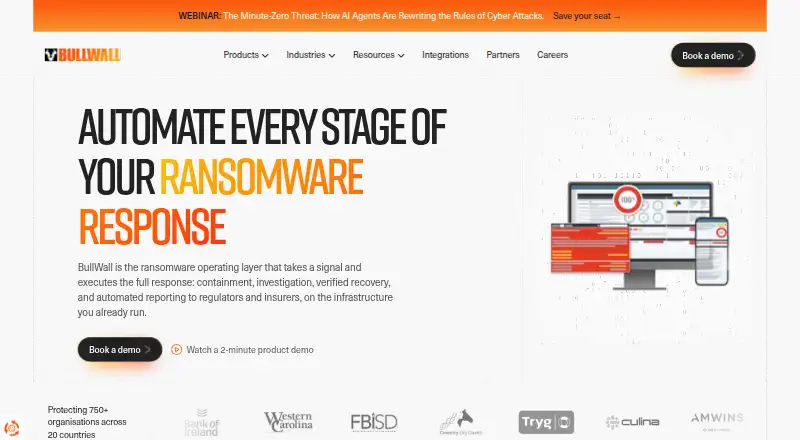
What BullWall Ransomware Containment is
BullWall Ransomware Containment detects ransomware activity at the data layer and automates containment and recovery verification. It monitors file systems, servers, SAN/NAS storage, Active Directory, SharePoint Online, and OneDrive. BullWall says 28 sensors and machine learning help distinguish normal activity from ransomware behavior, with detection and containment across file systems, identity, and endpoints in under a second.
When it responds, the system can isolate a compromised user, revoke sessions and access permissions, disable the account, and stop lateral movement. Before recovery is cleared, it checks backup integrity, sweeps the network for indicators of compromise, checks endpoint health, and confirms connectivity. Each containment event creates a forensic timeline and structured SOC alerts, with evidence mapped to GDPR, NIS2, DORA, and cyber insurance requirements. BullWall says deployment is agentless on one virtual machine and most organizations are operational within days. RESTful APIs connect it to SIEM, EDR, NAC, and SOC platforms, with CrowdStrike, SentinelOne, and Microsoft Sentinel among the examples. The company serves financial services, manufacturing, pharma, and public sector organizations, including those with legacy or unmanaged infrastructure. The product is paid and prospective customers can contact BullWall or book a demo for pricing.
Who it suits
BullWall suits organizations in financial services, manufacturing, pharma, and the public sector that need ransomware detection and automated containment. Its stated support for legacy or unmanaged infrastructure may also suit organizations managing those environments.
What it does well
- Monitors storage, servers, identity services, and cloud services.
- Can isolate users and revoke access automatically.
- Checks backup integrity and endpoint health before recovery clearance.
- Creates forensic timelines and structured SOC alerts.
- Connects to SIEM, EDR, NAC, and SOC platforms through RESTful APIs.
- Agentless deployment uses a single virtual machine.
What to know first
- Pricing is available through contact or a demo request.
- Deployment is described as agentless on a virtual machine.
- An advisory identifies detection limitations in four named versions.
Limits
BullWall's advisory says versions 4.6.0.0, 4.6.0.6, 4.6.0.7, and 4.6.1.4 may not detect certain encrypted files when the first four bytes are preserved. The advisory says other integrity-based detection mechanisms remain available.
Plans
| Plan | Billed and limits | Price |
|---|---|---|
| Ransomware Containment | Pricing not listed; contact BullWall or book a demo | On request |
As bullwall.com lists them, read 9 Oct 2026. The maker's own page has the final word.
Getting started
- Visit the BullWall website.
- Contact BullWall or book a demo to discuss the product and pricing.
- Deploy agentlessly on a virtual machine.
- Connect it to SIEM, EDR, NAC, or SOC platforms through RESTful APIs.
Verdict
Choose BullWall if your organization needs automated ransomware containment, recovery checks, and incident records across its data and identity environment. It is aimed at organizational security teams and offers integrations through RESTful APIs. Buyers should review the advisory concerning versions 4.6.0.0, 4.6.0.6, 4.6.0.7, and 4.6.1.4, which may miss certain encrypted files when their first four bytes are preserved.
Questions
How much does BullWall Ransomware Containment cost?
The product pages direct prospective customers to contact BullWall or book a demo for pricing.
What does BullWall monitor?
It monitors file systems, servers, SAN/NAS storage, Active Directory, SharePoint Online, and OneDrive.
How does containment work?
It can isolate a compromised user, revoke sessions and access permissions, disable the account, and cut off lateral movement.
Which integrations does BullWall support?
RESTful APIs connect it to SIEM, EDR, NAC, and SOC platforms. Named examples include CrowdStrike, SentinelOne, and Microsoft Sentinel.
How is BullWall deployed?
BullWall describes agentless deployment on a single virtual machine and says most organizations are operational within days.
Are there any version-specific detection caveats?
An advisory says versions 4.6.0.0, 4.6.0.6, 4.6.0.7, and 4.6.1.4 may not detect certain encrypted files when the first four bytes are preserved. It says other integrity-based detection mechanisms remain available.
Facts from BullWall Ransomware Containment's own pages
- Automated containment
- Its response can isolate a compromised user, revoke sessions and permissions, disable the account, and cut off lateral movement. · bullwall.com, 9 Oct 2026
- Company
- BullWall says it was founded in Denmark in 2016 and works from offices in Denmark, the United Kingdom, and the United States. · bullwall.com, 9 Oct 2026
- Compliance reporting
- The product generates incident evidence mapped to GDPR, NIS2, DORA, and cyber insurance requirements. · bullwall.com, 9 Oct 2026
- Containment
- Its automated response can isolate a compromised user, revoke sessions and access permissions, disable the account, and cut off lateral movement. · bullwall.com, 9 Oct 2026
- Deployment
- BullWall says it deploys agentlessly on a single virtual machine and most organizations are operational within days. · bullwall.com, 9 Oct 2026
- Detection
- The product page says BullWall uses 28 sensors and machine learning to distinguish legitimate activity from ransomware behavior. · bullwall.com, 9 Oct 2026
- Detection and response
- BullWall says it detects encryption behavior and contains threats across file systems, identity, and endpoints in under a second. · bullwall.com, 9 Oct 2026
- Founded
- 2016 · bullwall.com, 28 Sept 2026
- Headquarters
- Copenhagen, Denmark · bullwall.com, 28 Sept 2026
- Incident records
- BullWall says each containment event is logged with a forensic timeline and structured alerts for the SOC. · bullwall.com, 9 Oct 2026
- Integrations
- BullWall connects to SIEM, EDR, NAC, and SOC platforms through RESTful APIs and names CrowdStrike, SentinelOne, and Microsoft Sentinel as examples. · bullwall.com, 9 Oct 2026
- Intended customers
- BullWall describes serving financial services, manufacturing, pharma, and public sector organizations, including those with legacy or unmanaged infrastructure. · bullwall.com, 9 Oct 2026
- Monitoring
- It monitors file systems, servers, SAN/NAS storage, Active Directory, SharePoint Online, and OneDrive using 28 sensors and machine learning. · bullwall.com, 9 Oct 2026
- Monitoring scope
- The product page says it monitors file systems, servers, SAN/NAS storage, Active Directory, SharePoint Online, and OneDrive. · bullwall.com, 9 Oct 2026
- Pricing
- The product pages direct prospective customers to contact BullWall or book a demo and do not state a product price. · bullwall.com, 9 Oct 2026
- Purpose
- BullWall detects ransomware activity at the data layer and automates containment and recovery verification. · bullwall.com, 9 Oct 2026
- Recovery checks
- Before recovery clearance, BullWall says it verifies backup integrity, runs a network-wide IOC sweep, checks endpoint health, and confirms network connectivity. · bullwall.com, 9 Oct 2026
- Reporting
- BullWall says each incident generates a forensic evidence trail mapped to GDPR, NIS2, DORA, and cyber insurance requirements. · bullwall.com, 9 Oct 2026
- Security advisory
- BullWall's advisory says versions 4.6.0.0, 4.6.0.6, 4.6.0.7, and 4.6.1.4 may not detect certain encrypted files when the first four bytes are preserved; it notes other integrity-based detection mechanisms remain available. · bullwall.com, 9 Oct 2026
- Support
- BullWall provides a contact support page for support requests. · bullwall.com, 9 Oct 2026
- Target customers
- BullWall identifies financial services, manufacturing, pharma, and public sector organizations among the industries it serves. · bullwall.com, 9 Oct 2026
Where BullWall Ransomware Containment stands on Freedom251
- Ransomware Protection Software#8 of 22