Freedom251 › Crypto Payment Processors

BTCPay Server
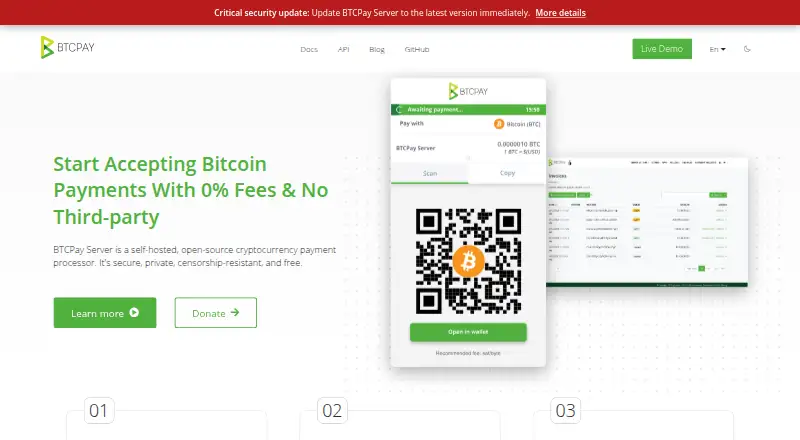
What BTCPay Server is
BTCPay Server is free, open-source cryptocurrency payment processing software that merchants host themselves. It has no subscriptions or transaction fees, and payments go directly to wallets controlled by the merchant rather than being held by BTCPay as an intermediary. Users can create and manage invoices, receive payment notifications, and export invoices for bookkeeping. Built-in apps include point of sale, tipping buttons, payment links, and crowdfunding campaigns. Wallet management includes hardware wallet support. Integrations include WooCommerce, Shopify, Drupal, Magento, and PrestaShop, among other supported platforms. The Greenfield REST API can connect commerce applications, automate instances, and support client libraries. Available checkout methods include hosted invoice checkout, payment requests, HTML payment buttons, e-commerce plugins, point of sale, and API or custom integration. For on-chain transactions using an existing wallet, BTCPay requires public wallet information rather than the master private key. Third-party hosted accounts may lack Lightning by default, wallet rescanning, and access to server settings. The project points users to its documentation, GitHub, and community channels for help.
Who it suits
BTCPay Server may suit merchants, freelancers, charities, content creators, and privacy-minded individuals who want to process cryptocurrency payments through a self-hosted system. Its plugins, API, and built-in payment tools offer several ways to connect a checkout.
What it does well
- No subscriptions or transaction fees.
- Payments go directly to merchant-controlled wallets.
- Includes invoices, notifications, and bookkeeping exports.
- Supports hardware wallet management.
- Offers multiple checkout methods and integrations.
What to know first
- Merchants host the software themselves.
- Third-party hosted accounts may lack Lightning by default.
- Third-party hosting may lack wallet rescanning.
- Third-party hosting may restrict server-setting access.
Plans
| Plan | Billed and limits | Price |
|---|---|---|
| BTCPay Server | No subscriptions · No transaction fees | Free |
| Free | 100% free and open-source · hosting costs paid by operator | Free |
As btcpayserver.org lists them, read 30 Sept 2026. The maker's own page has the final word.
Getting started
- Visit the BTCPay Server website.
- Choose a self-hosted, Linux, or web setup.
- Connect a wallet using the public wallet information needed for on-chain transactions.
- Select a checkout route such as hosted invoices, payment requests, e-commerce plugins, or the API.
- Use the documentation, GitHub, or community channels for help.
BTCPay Server is a self-hosted, open-source system for accepting cryptocurrency payments across online, in-person, and custom commerce flows. It is best suited to merchants, freelancers, charities, creators, and privacy-focused operators prepared to manage their own payment infrastructure. Its strongest case is direct wallet settlement with no subscription or transaction charge; readers wanting a managed service should weigh the operational trade-offs first.
Overview
BTCPay Server runs on infrastructure controlled by the merchant rather than acting as a payment intermediary. Customer payments move directly to wallets the merchant controls, and the project does not hold those funds. That structure gives operators custody and privacy, but it also makes hosting and administration part of the buying decision.
The software combines checkout, invoicing, wallet tools, and commerce integrations. It is published as an open-source project rather than a company, with documentation, GitHub, and community channels as its support routes. It belongs in our Crypto Payment Processors selection for readers comparing ways to take digital-currency payments.
Key features
- Flexible collection methods: Hosted invoice checkout, payment requests, HTML payment buttons, point of sale, e-commerce plugins, and API or custom integrations cover storefronts, counter sales, donations, and bespoke applications.
- Built-in apps: Point of Sale, tipping buttons, payment links, and crowdfunding campaigns let smaller operations launch focused payment experiences without restricting BTCPay to a standard cart.
- Invoices and records: Users can create and manage invoices, receive payment notifications, and export invoices for bookkeeping. This is useful when payment reconciliation matters as much as the checkout itself.
- Wallet control: Wallet management and hardware-wallet support are included. For on-chain use of an existing wallet, BTCPay requires public wallet information instead of the master private key, reducing the need to expose the key to the payment system.
- Commerce integrations: Listed connections include WooCommerce, Shopify, Drupal, Magento, PrestaShop, OpenCart, Odoo, Wix, BigCommerce, Invoice Ninja, Ghost, ECWID, WHMCS, Joomla VirtueMart, NopCommerce, GrandNode, SmartStore, and Pretix. The breadth favors merchants who already use one of these platforms.
- Developer API: The Greenfield REST API can connect commerce applications, automate BTCPay instances, and work with client libraries, making it a practical route for custom payment workflows.
Pricing
BTCPay Server costs free under its single “BTCPay Server” plan. The plan has no subscriptions and no transaction fees, uses crypto settlement, and includes hosted checkout, crypto invoices, and a payment API. There is no free trial because the product is already offered as a free plan.
That price is compelling for merchants who can operate the software themselves and want payment proceeds sent straight to their wallets. It does not turn hosting, maintenance, or operational responsibility into a managed service. Third-party hosting can simplify deployment, but hosted accounts may lack Lightning by default, wallet rescanning, or access to server settings. Those limitations matter to operators who need broader wallet administration or specific server controls.
Platforms
BTCPay Server supports API, Linux, self-hosted, and web use. Linux and self-hosted deployment fit teams comfortable running infrastructure, while the web interface and API support day-to-day payment administration and integrations. The platform list is a strength for technical operators, not a substitute for managed hosting.
Who it's for
Merchants can use the hosted checkout, plugins, point of sale, and invoice tools for online or physical sales. Freelancers and content creators can use payment links, tipping, and invoices; charities can use donations and crowdfunding campaigns. Privacy-minded individuals benefit from direct wallet settlement and the absence of an intermediary holding funds.
BTCPay is a poorer fit for organizations that want a conventional payment provider to handle infrastructure, wallet operations, and server configuration. A third-party host may remove some setup work, but its missing Lightning, rescanning, or server-setting capabilities can constrain advanced requirements.
Pros and cons
Pros
- No subscription or transaction fees: The free plan avoids recurring software charges and per-payment deductions.
- Merchant-controlled settlement: Funds go directly to wallets controlled by the merchant instead of being held by a payment intermediary.
- Broad payment toolkit: Invoices, notifications, bookkeeping exports, point of sale, tipping, payment links, and crowdfunding cover varied use cases.
- Strong integration path: Major commerce plugins and the Greenfield REST API support both ready-made stores and custom applications.
- Hardware-wallet support: Existing on-chain wallets can be connected with public wallet information rather than a master private key.
Cons
- Self-hosting responsibility: The model suits technically capable operators better than businesses seeking a fully managed processor.
- Third-party hosting constraints: Hosted accounts may omit Lightning by default, wallet rescanning, and server-setting access.
- Crypto-only settlement: The plan is built around cryptocurrency payments, so it does not serve businesses seeking a conventional card-processing stack.
- Community-led support: Help is directed through documentation, GitHub, and community channels rather than a conventional company support organization.
Alternatives
Choose BitPay instead if you want a paid processor available across Android, iOS, Linux, macOS, web, and Windows, with pricing bands tied to monthly transaction volume.
KuCoin Pay is the alternative for consumer payments with a 0.00 USD free plan and no KuCoin Pay fee, while merchant pricing is volume-based and handling fees may be added.
Consider NOWPayments for a standard processing service with a 0.00 USD plan; blockchain network fees remain payable and enterprise pricing is available on request.
Plisio suits readers wanting a freemium wallet and gateway API, including a 0.50 USD one-time Gateway API plan.
Apirone is an API and web alternative using fixed service fees that vary by cryptocurrency and transfer type, in addition to network fees.
CoinPayments offers several processing modes, including 3% fees in its ASAP and balance-payment options.
CoinRemitter is a freemium API and web service whose free plan charges 0.23% per transaction and limits usage to 100 API requests per minute and 500 addresses per wallet.
Blockonomics is another API and web option, with its merchant plan charging 1% after the first 10 payments.
Verdict
BTCPay Server is the right choice for merchants and organizations that want open-source, self-hosted cryptocurrency payments, direct wallet control, and no subscription or transaction fees. Choose it when you can own the infrastructure and value flexible integrations, invoices, and wallet tooling. Look elsewhere when you need a managed processor, conventional payment methods, or guaranteed access to advanced server and Lightning capabilities from a hosted account.
Verdict
BTCPay Server gives merchants a self-hosted way to accept cryptocurrency payments without subscriptions or transaction fees. Check third-party hosting capabilities if you need Lightning, wallet rescanning, or server-setting access.
Questions
How much does BTCPay Server cost?
The listed plan is free. The project describes BTCPay as having no subscriptions or transaction fees.
Is BTCPay Server open source?
Yes. BTCPay Server describes itself as an open-source project rather than a company.
Where do payments go?
Payments go directly to wallets controlled by the merchant. BTCPay does not hold funds as a payment intermediary.
Which platforms and commerce integrations are supported?
It supports web, Linux, self-hosted, and API use. Listed platforms include WooCommerce, Shopify, Drupal, Magento, PrestaShop, OpenCart, Odoo, Wix, BigCommerce, Invoice Ninja, Ghost, ECWID, WHMCS, Joomla VirtueMart, NopCommerce, GrandNode, SmartStore, and Pretix.
What payment tools are included?
Built-in apps include point of sale, tipping buttons, payment links, and crowdfunding campaigns. Users can also create and manage invoices, receive payment notifications, and export invoices.
What are the limits of third-party hosting?
Third-party hosted accounts may lack Lightning by default, wallet rescanning, and access to server settings.
Facts from BTCPay Server's own pages
- API
- The Greenfield API is a versioned REST API for stores, invoices, users, automation, and client-library development. · docs.btcpayserver.org, 15 Oct 2026
- API documentation depth
- Each instance exposes an interactive /docs reference and an OpenAPI document at /swagger/v1/swagger.json. · docs.btcpayserver.org, 15 Oct 2026
- Architecture requirements
- A typical deployment uses Nginx, BTCPay Server, NBXplorer, Bitcoin Core, and PostgreSQL. · publications.jrc.ec.europa.eu, 15 Oct 2026
- Built-in apps
- Built-in apps include Point of Sale, tipping buttons, payment links, and crowdfunding campaigns. · btcpayserver.org, 30 Sept 2026
- Built-in wallet
- Every instance includes wallet management with hardware-wallet support. · btcpayserver.org, 15 Oct 2026
- Company leadership
- Crunchbase lists Souhil Benkorichi as founder and CEO. · crunchbase.com, 15 Oct 2026
- Company status
- Crunchbase classifies BTCPay Server as an active New York-based non-profit with 1–10 employees. · crunchbase.com, 15 Oct 2026
- Crowdfunding
- The crowdfunding app lets operators run self-hosted campaigns with funds sent directly to the campaign owner’s wallet. · docs.btcpayserver.org, 15 Oct 2026
- Demo uptime caveat
- The project’s public mainnet demo is intended for testing and explicitly carries no uptime guarantee. · docs.btcpayserver.org, 15 Oct 2026
- Documentation
- The documentation is organized into user, operator, and developer tracks covering deployment, wallets, Lightning, POS, APIs, plugins, and troubleshooting. · docs.btcpayserver.org, 15 Oct 2026
- E-commerce integrations
- Official integration documentation covers WooCommerce, Drupal, Magento, PrestaShop, Shopify, and custom integrations, among others. · docs.btcpayserver.org, 15 Oct 2026
- Fees
- The project describes BTCPay as free, with no subscriptions or transaction fees. · docs.btcpayserver.org, 30 Sept 2026
- Funding
- Crunchbase records three grant funding rounds and lists Kraken among the investors, while amounts are obscured on the public page. · crunchbase.com, 15 Oct 2026
- Google Play listing
- The third-party BITCOIN POS Android app integrates with BTCPay Server, generates invoices, receives payment notifications, prints receipts, and supports Android phones and Bluetooth printers. · play.google.com, 15 Oct 2026
- Google Play traction
- The BITCOIN POS listing shows 1K+ downloads and was updated in July 2026; the opened page does not display a star rating or rating count. · play.google.com, 15 Oct 2026
- Independent architecture finding
- The same study says BTCPay is accessed by APIs and has free open-source plugins for major content-management and e-commerce systems. · publications.jrc.ec.europa.eu, 15 Oct 2026
- Independent technical description
- A European Commission Joint Research Centre study describes BTCPay as a free MIT-licensed self-hosted Bitcoin gateway with no intermediary fee. · publications.jrc.ec.europa.eu, 15 Oct 2026
- Install method
- The recommended production installation is a dedicated Linux VPS using the official Docker deployment. · docs.btcpayserver.org, 15 Oct 2026
- Integrations
- The project lists integrations including WooCommerce, Shopify, Drupal, Magento, and PrestaShop. · btcpayserver.org, 30 Sept 2026
- Invoices
- BTCPay creates invoices, tracks payment status, sends payment notifications, and exports invoice data for bookkeeping. · btcpayserver.org, 15 Oct 2026
- License
- The main BTCPay Server repository is released under the MIT License. · github.com, 15 Oct 2026
- Limit: payment dispute
- One Trustpilot reviewer alleged that an underpayment was not completed and that support did not respond. · trustpilot.com, 15 Oct 2026
- Maker structure
- The project’s foundation describes itself as a non-profit funded entirely by donations and says it does not commercialize products. · foundation.btcpayserver.org, 15 Oct 2026
- No platform fees
- The project states that it charges 0% fees; users still pay blockchain network fees and hosting costs. · btcpayserver.org, 15 Oct 2026
Where BTCPay Server stands on Freedom251
- Crypto Payment Processors#2 of 20