Freedom251 › Brand Management Software
Brand Context Protocol
What Brand Context Protocol is
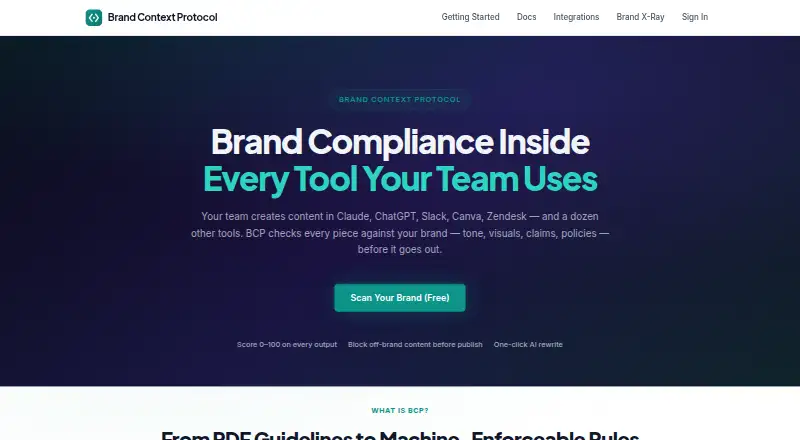
Brand Context Protocol (BCP) turns brand guidelines into structured JSON that tools, AI agents, and platforms can read and enforce. It checks content for tone, visuals, claims, and policies before publication. Brand X-Ray reviews a website and public social signals, then reports coherence across visual, verbal, and presence dimensions; running a scan requires no signup. Published changes have version histories and changelogs, with an option to restore an earlier version. API keys can be limited by permissions and brand sections, monitored for usage, and revoked. Through MCP clients, BCP provides tools for retrieving brand context, evaluating and rewriting text, reviewing designs, analyzing images, and evaluating documents. Its Global Policy Library covers more than 38 marketing tactics and 15 claim types, with options to allow, warn, escalate, or block. Listed connections include Claude Desktop, ChatGPT, Slack, Zendesk, and Canva; Canva is in review, with early access offered meanwhile. BCP is a free open standard available through web and API. Its privacy policy says account details, submitted scan URLs, public site or social data, and standard server logs are collected. Scraped website text is sent to OpenAI for brand analysis, and scan results are retained indefinitely; account holders may request deletion by email.
Who it suits
BCP suits teams that want machine-readable brand guidance, content checks, version control, or policy enforcement. Brand X-Ray may also suit anyone who wants to scan a website and public social signals without signing up.
What it does well
- Free open standard
- Brand X-Ray scans without signup
- Published changes include changelogs and rollback
- API keys can be scoped and revoked
- Policy library supports allow, warn, escalate, or block
What to know first
- Canva app is still in review
- Scan results are retained indefinitely
- Scraped website text is sent to OpenAI for analysis
Limits
BCP is free to use. The Canva app is still in review, with early access available in the meantime.
Plans
| Plan | Billed and limits | Price |
|---|---|---|
| Brand Context Protocol | Open standard · Free to use | Free |
As brandcontextprotocol.com lists them, read 9 Oct 2026. The maker's own page has the final word.
Getting started
- Open the Brand Context Protocol website.
- Run a Brand X-Ray scan without signing up, or use the listed integrations.
- Connect through a described integration such as Claude Desktop, ChatGPT, Slack, or Zendesk.
- Use an MCP client for brand-context retrieval and content evaluation tools.
- Consider Canva early access while its app is in review.
Brand Context Protocol (BCP) is a free, open standard that turns brand guidance into rules software and AI systems can apply. It fits teams that need repeatable checks across content and connected tools, especially where policy enforcement matters. The main attraction is broad evaluation and governance without a subscription; data retention and the still-in-review Canva integration merit caution.
Overview
BCP represents brand guidelines as structured JSON that tools, AI agents, and platforms can read and enforce. Before publication, it can check tone, visual treatment, claims, and policy compliance. That makes it more operational than a static brand manual, provided your workflow can use its API, web interface, or MCP clients.
Brand X-Ray scans a website and public social signals, then reports coherence across visual, verbal, and presence dimensions. No signup is required for a scan, so it is a practical first audit. The service is built by Aryabhatta Labs, a small product studio focused on AI tools.
Key features
Evaluation and policy governance
BCP exposes brand-context retrieval, text evaluation and rewriting, design evaluation, image analysis, and document evaluation through MCP clients. This range suits teams that want review actions inside AI-assisted workflows rather than in a separate checklist. Its Global Policy Library covers more than 38 marketing tactics and 15 claim types, with each rule able to allow, warn, escalate, or block. That gives compliance owners meaningful control, although the value depends on defining and maintaining appropriate policies.
Versioning and access
Published changes receive versions and changelogs, and teams can roll back to an earlier release. API keys can be limited by permission and brand section, usage is tracked per key, and keys can be revoked. These controls are useful when several applications or agents consume the same brand standard and administrators need an audit trail.
Connections and data handling
BCP describes integrations for Claude Desktop, ChatGPT, Slack, Zendesk, and Canva. The Canva app remains in review, with early access offered meanwhile, so Canva-dependent teams should treat that connection as provisional. Google sign-in account data, submitted scan URLs, public site or social data, and standard server logs are collected. Scraped website text is sent to OpenAI for brand analysis, and BCP says it does not sell data to third parties. Brand X-Ray results are retained indefinitely, though account holders may request deletion by email. Essential login cookies are used without advertising or tracking cookies.
Pricing
| Plan | Price | What it includes |
|---|---|---|
| Brand Context Protocol | free | Open standard; free to use |
The single free plan removes a budget barrier for experimentation, internal standards, and small teams. There are no paid tiers, seat allowances, storage quotas, or trial terms published for this entry, so organizations needing commercial-plan commitments or defined capacity should confirm suitability before rollout.
Platforms
BCP is offered through an API and web interface. MCP-client tools extend evaluation to compatible assistants and applications.
Who it's for
Choose BCP if your team wants one machine-readable standard for brand guidance, content review, and policy decisions across AI and software workflows. It is particularly relevant to teams managing multiple keys, versions, or connected services. It is less suitable when you require a mature, confirmed Canva integration, finite scan-retention controls, or conventional paid-plan support commitments.
Pros and cons
- Pro: A free, open JSON standard can be adopted without a subscription purchase.
- Pro: Tone, visual, claim, policy, design, image, and document checks cover more than a basic style guide.
- Pro: Version history, rollback, scoped keys, usage tracking, and revocation support controlled team deployments.
- Pro: Brand X-Ray offers a no-signup coherence scan across websites and public social signals.
- Con: Brand X-Ray results are retained indefinitely unless an account holder requests deletion by email.
- Con: Website text is processed by OpenAI, which may disqualify sensitive brands or regulated workflows.
- Con: Canva access is early access while the app is under review.
Alternatives
For a broader directory of tools, see Brand Management Software.
- BrandHalo is a freemium API and web option with a free brand profile and paid Essentials plan.
- BrandKity offers freemium API and web plans, including storage and analytics limits on its free tier.
- BrandPatrol is a freemium web service centered on Brand Twin snapshots and checker quotas.
- Brandy provides freemium API and web plans with asset storage and brand-space limits.
- Brink is a freemium web alternative with workspace and brand-focused free plans.
- Guidelines is a freemium web tool for public guides, editors, pages, and asset storage.
- Lingo is a paid API product with a 30-day free try and a Starter plan billed annually.
- Marq is a freemium web platform with free user, storage, and project caps.
Verdict
BCP is a strong choice for teams that want a free, machine-readable brand standard with serious evaluation, policy controls, and versioned governance. Look elsewhere if indefinite scan retention, OpenAI processing, or Canva’s unconfirmed integration conflicts with your privacy, compliance, or workflow requirements.
Verdict
BCP combines structured brand guidelines with content evaluation, policy controls, and versioned updates. Consider its stated data handling and the Canva integration’s review status before adopting it.
Questions
Is Brand Context Protocol free?
Yes. The listed plan is free, and BCP describes the standard as free to use.
Can I run a scan without an account?
Yes. Brand X-Ray scans can be run without signup.
Which integrations are described?
Connections are described for Claude Desktop, ChatGPT, Slack, Zendesk, and Canva. The Canva app is in review, with early access offered meanwhile.
Who makes BCP?
It is built by Aryabhatta Labs, described as a small product studio building AI tools.
How does BCP handle data from scans?
Its privacy policy says scraped website text is sent to OpenAI for brand analysis and scan results are retained indefinitely. Account holders may request deletion by email.
Does BCP have brand monitoring and analytics?
Yes. The listed features include brand monitoring and brand analytics.
Facts from Brand Context Protocol's own pages
- Access controls
- API keys can be scoped by permissions and brand sections, usage is tracked per key, and keys can be revoked. · brandcontextprotocol.com, 9 Oct 2026
- Brand X-Ray
- Brand X-Ray audits a website and public social signals, then reports brand coherence across visual, verbal, and presence dimensions; no signup is required to run a scan. · brandcontextprotocol.com, 9 Oct 2026
- Content checks
- It checks content for tone, visuals, claims, and policies before publication. · brandcontextprotocol.com, 9 Oct 2026
- Cookies
- The privacy policy says the service uses essential login cookies and does not use advertising or tracking cookies. · brandcontextprotocol.com, 9 Oct 2026
- Data retention
- Brand X-Ray scan results are retained indefinitely, and account holders may request deletion by email. · brandcontextprotocol.com, 9 Oct 2026
- Evaluation features
- BCP exposes tools for brand-context retrieval, text evaluation and rewriting, design evaluation, image analysis, and document evaluation through MCP clients. · brandcontextprotocol.com, 9 Oct 2026
- Integrations
- The integrations page describes connections for Claude Desktop, ChatGPT, Slack, Zendesk, and Canva; the Canva app is in review and offers early access in the meantime. · brandcontextprotocol.com, 9 Oct 2026
- Maker
- BCP is built by Aryabhatta Labs, described as a small product studio building AI tools. · brandcontextprotocol.com, 9 Oct 2026
- Policy governance
- Its Global Policy Library includes more than 38 marketing tactics and 15 claim types, with enforcement options including allow, warn, escalate, or block. · brandcontextprotocol.com, 9 Oct 2026
- Privacy data collection
- The privacy policy says BCP collects account details from Google sign-in, submitted scan URLs and public site or social data, and standard server logs. · brandcontextprotocol.com, 9 Oct 2026
- Purpose
- BCP turns brand guidelines into a structured JSON standard that tools, AI agents, and platforms can read and enforce. · brandcontextprotocol.com, 9 Oct 2026
- Support
- The maker invites questions, feedback, and pilot inquiries at [email protected]. · brandcontextprotocol.com, 9 Oct 2026
- Third-party processing
- The privacy policy says scraped website text is sent to OpenAI for brand analysis and that BCP does not sell data to third parties. · brandcontextprotocol.com, 9 Oct 2026
- Version control
- Published BCP changes are versioned with changelogs, and teams can roll back to an earlier version. · brandcontextprotocol.com, 9 Oct 2026
Where Brand Context Protocol stands on Freedom251
- Brand Management Software#1 of 48