Freedom251 › Synthetic Data Generation Software

BlueGen.ai
What BlueGen.ai is
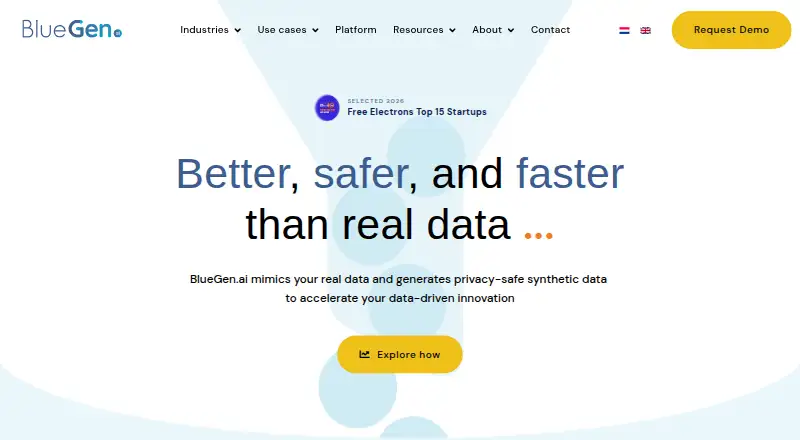
BlueGen.ai generates synthetic data from real data for sharing, software testing, and machine learning. Its AI learns from tabular data to create synthetic records that follow the source's statistical distribution, business rules, and referential integrity. Differential privacy can be applied during generation to provide a mathematical privacy guarantee, with a tradeoff between resemblance to the original data and utility. The platform can add training examples, produce edge cases for software tests, or create a smaller substitute dataset. Its federated learning framework supports generation across multiple sources without exposing the real data. BlueGen connects to CSV files and databases including MS SQL Server, Oracle, PostgreSQL, MySQL, SQLite, SAP HANA, Snowflake, and AWS Redshift. Its command-line interface can integrate with data engineering and CI/CD pipelines; APIs are available as an add-on. Deployment can run on-premise in a data center or private cloud, with a browser agent used alongside the cloud platform while data remains on-premise. After training, it creates a shareable PDF report with resemblance, utility, privacy, and performance measures. BlueGen is a spin-off of Technical University Delft and highlights energy, healthcare, statistics offices, and universities among its customers.
Who it suits
BlueGen.ai suits data teams that need synthetic datasets for research, data sharing, software testing, or machine learning. Its deployment options and federated generation are relevant to organizations that want to work across data sources while keeping real data on-premise or unexposed.
What it does well
- Preserves statistical distribution, business rules, and referential integrity.
- Applies differential privacy during data generation.
- Supports on-premise and private cloud deployment.
- Connects to CSV and a range of database systems.
- Produces a PDF report with resemblance, utility, privacy, and performance measures.
- CLI can integrate with data engineering and CI/CD pipelines.
What to know first
- Pricing is available on request.
- The maker says at least 1,000 rows are needed for training.
- API access is available as an add-on.
Getting started
- Visit the BlueGen.ai website.
- Contact the team by email, phone, or form to discuss pricing.
- Prepare a dataset with at least 1,000 rows for training.
- Connect data using CSV or a supported database.
- Choose an on-premise data center or private cloud deployment approach.
- Use the command-line interface to connect with data engineering or CI/CD pipelines, or ask about the API add-on.
Verdict
Consider BlueGen.ai if you need synthetic tabular data for testing, sharing, or model training and want privacy techniques plus on-premise or private cloud deployment. Ask the team for pricing and API add-on details; datasets need at least 1,000 rows to train properly, and larger or more complex data takes longer to process.
Questions
How much does BlueGen.ai cost?
Pricing is on request. The team invites prospective customers to contact them by email, phone, or form.
What data sources does it support?
It supports CSV and connections to MS SQL Server, Oracle, PostgreSQL, MySQL, SQLite, SAP HANA, Snowflake, and AWS Redshift.
Does BlueGen.ai provide API access?
Yes. APIs are available as an add-on for integration with a customer's IT environment.
Where can BlueGen.ai run?
It can run on-premise in a data center or private cloud. The maker also describes using a browser agent with its cloud platform while data stays on-premise.
How much data is needed to train it?
The FAQ says at least 1,000 rows are needed for proper training. Datasets with more columns require more rows.
What does the evaluation report contain?
It is a shareable PDF covering resemblance, utility, and privacy scores, along with measures such as distributions, percentiles, distances, correlations, precision, and recall.
Facts from BlueGen.ai's own pages
- API
- The FAQ says APIs are available as an add-on for integration with a customer's IT environment. · bluegen.ai, 8 Oct 2026
- Audience
- The maker highlights energy, healthcare, national statistics offices and universities among the industries it serves. · bluegen.ai, 8 Oct 2026
- Augmentation
- The platform can generate additional data points for ML training, create software-testing edge cases, or produce a smaller subset of real data. · bluegen.ai, 7 Oct 2026
- Company
- BlueGen says it is a spin-off of Delft University of Technology. · bluegen.ai, 8 Oct 2026
- Data connectors
- The platform supports CSV and direct connections to MS SQL Server, Oracle, PostgreSQL, MySQL, SQLite, SAP HANA, Snowflake, and AWS Redshift. · bluegen.ai, 7 Oct 2026
- Data limits
- The maker says it has not encountered a maximum amount of real data it can process, while noting that larger and more complex datasets increase training time. · bluegen.ai, 8 Oct 2026
- Data synthesis
- Its AI learns from real tabular data to create synthetic data with the same statistical distribution, business rules and referential integrity. · bluegen.ai, 8 Oct 2026
- Deployment
- The software can run in a customer's own cloud or on-premise environment, and its federated framework can keep data on-premise while sending only data structure and characteristics to the cloud platform. · bluegen.ai, 8 Oct 2026
- Differential privacy
- BlueGen applies differential privacy during data generation to provide a mathematical privacy guarantee. · bluegen.ai, 7 Oct 2026
- Evaluation
- BlueGen says it automatically creates a PDF evaluation report with measures such as distributions, percentiles, distances, correlations, precision, and recall. · bluegen.ai, 7 Oct 2026
- Evaluation report
- After training, the software creates a shareable PDF report with resemblance, utility and privacy scores and performance indicators such as distributions, percentiles, distances, correlation, precision and recall. · bluegen.ai, 8 Oct 2026
- Federated generation
- Its federated learning framework lets multiple users generate synthetic data without exposing their real data to one another. · bluegen.ai, 8 Oct 2026
- Headquarters
- The Hague, Netherlands · bluegen.ai, 28 Sept 2026
- Integrations
- The platform supports CSV and database connections including MS SQL Server, Oracle, PostgreSQL, MySQL, SQLite, SAP HANA, Snowflake and AWS Redshift; its CLI can connect to data engineering and CI/CD pipelines. · bluegen.ai, 8 Oct 2026
- Minimum data
- The FAQ says BlueGen needs at least 1,000 rows to train properly, and datasets with more columns require more rows. · bluegen.ai, 8 Oct 2026
- Pipeline integration
- BlueGen's command-line interface can integrate with data engineering and CI/CD pipelines. · bluegen.ai, 7 Oct 2026
- Privacy
- BlueGen evaluates privacy leakage risks for singling out, linkability and inference, and offers differential privacy during training for a mathematically proven privacy guarantee, with some resemblance and utility tradeoff. · bluegen.ai, 8 Oct 2026
- Product
- BlueGen.ai generates privacy-safe synthetic data that mimics real data to support data-driven innovation. · bluegen.ai, 8 Oct 2026
- Robustness
- The platform is built to handle missing values, complex data distributions, and high-dimensional categorical columns. · bluegen.ai, 7 Oct 2026
- Support
- The contact page invites users to reach the company by email, phone or form and says it will get back to them shortly. · bluegen.ai, 8 Oct 2026
- Use cases
- The maker lists machine learning training, exploratory analysis, collaborative research, software development and testing as uses for synthetic data. · bluegen.ai, 8 Oct 2026
Where BlueGen.ai stands on Freedom251
- Synthetic Data Generation Software#26 of 29