Freedom251 › Internet Filtering Software
Blocky
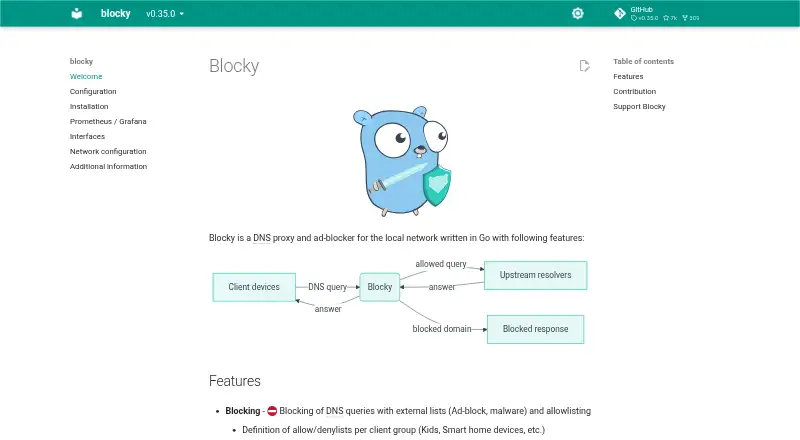
What Blocky is
Blocky is a free, open-source DNS proxy and ad blocker for local networks, written in Go. It filters DNS queries with external allowlists and denylists, and supports rules for different client groups, regular expressions, CNAME and IP checks, and periodic list updates. DNS settings include custom resolution, conditional forwarding, and upstream resolvers configured by client group. It supports DNS over UDP, TCP, HTTPS, TLS, QUIC, and HTTPS/3, along with configurable caching, prefetching, and multiple external resolvers. The project describes Blocky as having a low memory footprint and says it collects no user data, telemetry, or statistics; it also supports DNSSEC validation of upstream resolvers.
For monitoring, Blocky exports metrics to Prometheus, with Grafana dashboards documented by the project. DNS query logs can be saved in CSV, MySQL, MariaDB, PostgreSQL, or Timescale formats. Its REST API has endpoints for blocking controls, refreshing lists, DNS queries, cache flushing, and statistics. Installation options include a standalone binary and Docker, with Homebrew documented for macOS. The project describes support for x86-64, ARM, and MIPS. Blocky costs nothing plan.
Who it suits
Blocky suits people who want to manage DNS filtering for a local network and configure rules by client group. It may also suit administrators who want DNS metrics, query logs, and API controls alongside filtering.
What it does well
- Free and open source, with no telemetry or data collection.
- Per-client group rules include upstream resolver settings.
- Supports DNS over UDP, TCP, HTTPS, TLS, QUIC, and HTTPS/3.
- Exports metrics to Prometheus and provides Grafana dashboards.
- Query logs can be stored in several database formats.
- Offers standalone binary and Docker installation options.
What to know first
- Activity reports are listed as advanced.
- There is no free trial; the plan is free.
Limits
Activity reports are listed as advanced.
Plans
| Plan | Billed and limits | Price |
|---|---|---|
| Free | Free and open source; no telemetry or data collection | Free |
As 0xerr0r.github.io lists them, read 11 Oct 2026. The maker's own page has the final word.
Getting started
- Visit the Blocky project website.
- Choose a standalone binary or Docker installation; macOS installation through Homebrew is also documented.
- Install on a supported platform, including Linux, Windows, macOS, Docker, OpenWrt, or Kubernetes.
- Configure allowlists or denylists and, if needed, per-client group rules and DNS settings.
Verdict
Choose Blocky if you want a free DNS proxy for local-network ad blocking with client-group rules and configurable DNS settings. Its metrics, logs, and REST API may suit administrators who also need monitoring and controls. Look elsewhere if advanced activity reports are central to your requirements.
Questions
How much does Blocky cost?
Its Free plan costs nothing.
Is there a free plan or trial?
Yes. Blocky has a free plan, and there is no free trial.
Which platforms does it support?
Listed platform support includes Linux, Windows, macOS, Docker, OpenWrt, and Kubernetes. The project also describes support for x86-64, ARM, and MIPS.
Is Blocky open source?
Yes. Blocky is free and open source.
What DNS protocols does Blocky support?
It supports DNS over UDP, TCP, HTTPS, TLS, QUIC, and HTTPS/3.
Who makes Blocky?
Blocky is written in Go, and its project welcomes issues, feature suggestions, and pull requests on GitHub.
Facts from Blocky's own pages
- API
- Its REST API includes endpoints for blocking controls, list refresh, DNS queries, cache flushing, and statistics. · 0xerr0r.github.io, 11 Oct 2026
- Blocking
- It blocks DNS queries using external allowlists and denylists, with per client group rules, periodic list reloads, regex support, and CNAME and IP checks. · 0xerr0r.github.io, 11 Oct 2026
- DNS configuration
- It supports custom DNS resolution, conditional forwarding, and upstream resolvers configured per client group. · 0xerr0r.github.io, 11 Oct 2026
- Installation
- Official installation options include a standalone binary and a Docker container; the project also describes a multi-architecture Docker image and support for x86-64, ARM, and MIPS. · 0xerr0r.github.io, 11 Oct 2026
- Logging
- DNS query logs can be stored in CSV, MySQL, MariaDB, PostgreSQL, or Timescale database formats. · 0xerr0r.github.io, 11 Oct 2026
- macOS
- The installation documentation lists macOS installation through Homebrew. · 0xerr0r.github.io, 11 Oct 2026
- Monitoring
- Blocky can export metrics to Prometheus, and its documentation provides Grafana dashboards. · 0xerr0r.github.io, 11 Oct 2026
- Performance
- It supports configurable DNS caching, prefetching, and multiple external resolvers, and the documentation describes it as having a low memory footprint. · 0xerr0r.github.io, 11 Oct 2026
- Privacy and security
- The project says Blocky collects no user data, telemetry, or statistics and supports DNSSEC validation of upstream resolvers. · 0xerr0r.github.io, 11 Oct 2026
- Protocols
- It supports DNS over UDP, TCP, HTTPS, TLS, QUIC, and HTTPS/3. · 0xerr0r.github.io, 11 Oct 2026
- Purpose
- Blocky is a DNS proxy and ad blocker for local networks, written in Go. · 0xerr0r.github.io, 11 Oct 2026
- Support
- The project welcomes issues, feature suggestions, and pull requests on GitHub, and asks users who find Blocky useful to consider contributing. · 0xerr0r.github.io, 11 Oct 2026
Where Blocky stands on Freedom251
- Internet Filtering Software#5 of 65