Freedom251 › DNS Filtering Services
Blocky
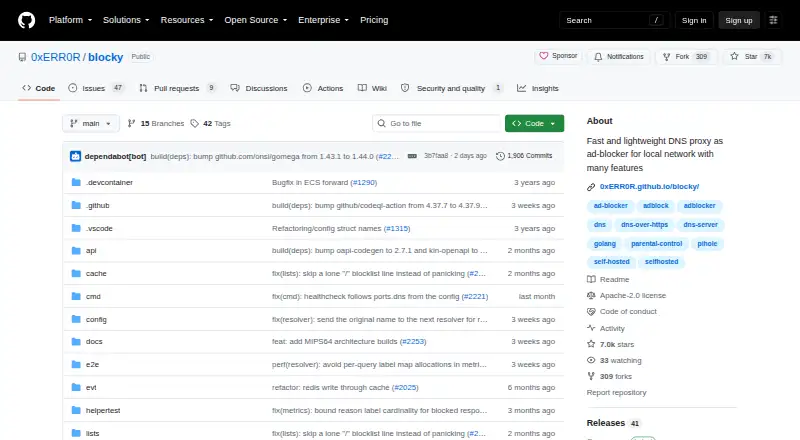
What Blocky is
Blocky is a free, open-source DNS proxy and ad blocker for local networks, written in Go. It filters DNS queries using external ad-blocking and malware lists, with allowlisting and the option to apply policies by client group. Administrators can configure custom DNS resolution, conditional forwarding, and upstream resolvers for different groups. It supports DNS over UDP and TCP, HTTPS, TLS, QUIC, and HTTPS/3, as well as DNSSEC validation. Configurable caching and prefetching handle frequently used queries. For monitoring and integration, Blocky provides Prometheus metrics, Grafana dashboards, REST API endpoints, and a command-line tool. Query logs can be stored in CSV or MySQL, MariaDB, PostgreSQL, or Timescale databases. It is available as a standalone binary or Docker container, with multi-architecture images and a community-supported Helm chart. Configuration uses YAML files; the project describes Blocky as stateless, requiring no database or temporary files. Listed architectures include x86-64, ARM, and MIPS, including Raspberry Pi and OpenWrt routers. The project describes use in home networks, homelabs, and businesses, and welcomes issues, suggestions, and contributions.
Who it suits
Blocky suits people managing home networks, homelabs, or business networks who want DNS filtering and client-group policies. Its listed hardware support includes Raspberry Pi and OpenWrt routers.
What it does well
- Free and open source
- Applies filtering lists by client group
- Supports DNSSEC and multiple encrypted DNS protocols
- Provides Prometheus metrics, Grafana dashboards, and a REST API
- Runs on x86-64, ARM, and MIPS
What to know first
- Requires self-hosted deployment
- Configuration uses YAML files
Plans
| Plan | Billed and limits | Price |
|---|---|---|
| Blocky | Free and open source · self-hosted DNS proxy | Free |
As github.com lists them, read 4 Oct 2026. The maker's own page has the final word.
Getting started
- Choose a deployment route: standalone binary or Docker container; a community-supported Helm chart is also available.
- Use a supported x86-64, ARM, or MIPS system.
- Create one or more YAML configuration files.
- Configure DNS filtering, client groups, and resolvers as needed.
- Optionally connect monitoring, logging, or API tools.
Verdict
Blocky offers network-level DNS filtering with configurable policies, logging, and monitoring integrations. It is a fit for administrators comfortable managing a self-hosted tool through YAML configuration.
Questions
How much does Blocky cost?
The Blocky plan costs nothing. It is described as free and open source, and self-hosted.
Which platforms and architectures does it support?
It is listed for API, Linux, macOS, and self-hosted use. Supported architectures include x86-64, ARM, and MIPS, including Raspberry Pi and OpenWrt routers.
What DNS protocols does Blocky support?
It supports DNS over UDP and TCP, HTTPS, TLS, QUIC, and HTTPS/3. DNSSEC validation is also supported.
What deployment options are available?
The project offers a standalone binary and Docker container, with multi-architecture images. A community-supported Helm chart is also available.
Does Blocky collect user data or telemetry?
The project says Blocky collects no user data, telemetry, or statistics.
Can I save DNS query logs?
Yes. Logs can be stored in CSV or in MySQL, MariaDB, PostgreSQL, or Timescale databases.
Facts from Blocky's own pages
- Audience
- The project describes use across home networks, homelabs, and businesses, and its feature list includes client groups such as kids and smart home devices. · github.com, 4 Oct 2026
- Blocking
- It blocks DNS queries using external ad-blocking and malware lists, supports allowlisting, and can apply lists by client group. · github.com, 4 Oct 2026
- Caching
- It offers configurable DNS answer caching and prefetching for frequently used queries. · github.com, 4 Oct 2026
- Configuration
- Blocky uses one or more YAML configuration files and is described as stateless, with no database or temporary files required. · github.com, 4 Oct 2026
- Deployment
- The project offers a standalone binary and Docker container, with multi-architecture images and a community-supported Helm chart. · 0xerr0r.github.io, 4 Oct 2026
- DNS configuration
- It supports custom DNS resolution, conditional forwarding, and upstream resolvers assigned by client group. · github.com, 4 Oct 2026
- DNS protocols
- It supports DNS over UDP and TCP, HTTPS, TLS, QUIC, and HTTPS/3. · github.com, 4 Oct 2026
- Integrations
- It provides Prometheus metrics, Grafana dashboards, REST API endpoints, and a CLI tool. · github.com, 4 Oct 2026
- Query logging
- DNS query logs can be stored in CSV or MySQL, MariaDB, PostgreSQL, or Timescale databases. · github.com, 4 Oct 2026
- Security
- It supports DNSSEC validation and says it collects no user data, telemetry, or statistics. · github.com, 4 Oct 2026
- Support
- The maintainer welcomes issues, feature suggestions, and pull requests, and invites users to contribute financially to ongoing development. · github.com, 4 Oct 2026
- Supported hardware
- The project lists support for x86-64, ARM, and MIPS architectures, including Raspberry Pi and OpenWrt routers. · github.com, 4 Oct 2026
- What it does
- Blocky is a DNS proxy and ad blocker for local networks, written in Go. · github.com, 4 Oct 2026
Where Blocky stands on Freedom251
- DNS Filtering Services#5 of 60
- DNS Server Software#2 of 23
- DNS Filtering Software#5 of 28