Freedom251 › Reverse Engineering Tools
Binwalk
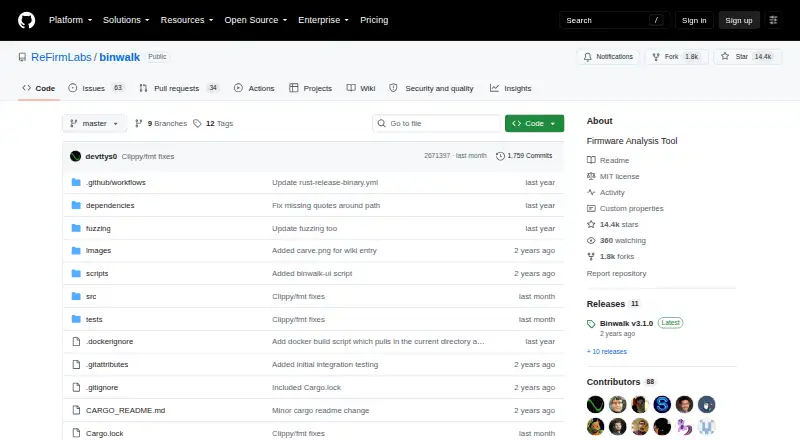
What Binwalk is
Binwalk is a free firmware analysis tool that identifies and can extract files or data embedded inside other files. Its scanner looks for known signatures; the project documents 111 supported signatures, 72 of which are extractable, so results depend on patterns it recognizes. Binwalk can generate entropy graphs to help identify sections that may be compressed or encrypted. The quick start guide demonstrates extraction with the `-e` option and recursive scanning with `-M`. Version 3 is rewritten in Rust, and the project includes a library for integration into other Rust projects. Listed installation methods are Docker, the Rust package manager and compiling from source. The project officially supports 64-bit Linux, preferably Ubuntu or an Ubuntu-based system; Windows and macOS are largely untested. Analysis requires at least as much free memory as the files being examined. Binwalk is distributed under the MIT License, which permits use, modification and distribution subject to its terms. The license provides the software as-is and disclaims warranties.
Who it suits
It suits people analyzing firmware who need to locate or extract embedded data and can work with officially supported 64-bit Linux systems.
What it does well
- Free under the MIT License.
- Documents 111 supported signatures, including 72 extractable.
- Can generate entropy graphs.
- Offers a Rust library for integration into other projects.
- Installation options include Docker and compiling from source.
What to know first
- Official support is for 64-bit Linux.
- Windows and macOS are largely untested.
- Results depend on recognized signatures.
- Analysis needs free memory at least equal to file size.
Limits
Binwalk’s free analysis depends on known signatures and requires at least as much free memory as the analyzed files’ size. Official support is for 64-bit Linux; Windows and macOS are largely untested.
Plans
| Plan | Billed and limits | Price |
|---|---|---|
| Binwalk | MIT licensed · official support for 64-bit Linux | Free |
As github.com lists them, read 4 Oct 2026. The maker's own page has the final word.
Getting started
- Open https://github.com/ReFirmLabs/binwalk.
- Install using Docker, Rust’s package manager, or compile from source.
- Run it on 64-bit Linux; Ubuntu or an Ubuntu-based system is preferred.
- Use `-e` for extraction or `-M` for recursive scanning.
Verdict
Binwalk provides signature scanning, extraction and entropy analysis for firmware work at no cost. Its official support is focused on 64-bit Linux, and findings depend on known signatures.
Questions
Is Binwalk free?
Yes. The project is distributed under the MIT License.
Which platforms are officially supported?
Official support is for 64-bit Linux, preferably Ubuntu or an Ubuntu-based system. Windows and macOS are largely untested.
What can Binwalk analyze?
It identifies and can extract files and data embedded inside other files, with a primary focus on firmware analysis.
Can Binwalk extract files and scan recursively?
Yes. The quick start guide shows extraction with `-e` and recursive scanning with `-M`.
What are Binwalk’s analysis limits?
Results depend on the signatures it recognizes, and it requires at least as much free memory as the analyzed files’ size.
What license does Binwalk use?
It uses the MIT License, which permits use, copying, modification, and distribution subject to its terms. The license disclaims warranties.
Facts from Binwalk's own pages
- Entropy analysis
- Binwalk can generate entropy graphs to help identify sections that may be compressed or encrypted. · github.com, 4 Oct 2026
- Extraction
- The quick start guide shows file extraction with the -e option and recursive scanning with -M. · github.com, 4 Oct 2026
- Implementation
- Binwalk v3 is rewritten in Rust for speed and accuracy. · github.com, 4 Oct 2026
- Installation
- The README lists Docker, the Rust package manager, and compiling from source as installation methods. · github.com, 4 Oct 2026
- Intended use
- The repository describes Binwalk as a firmware analysis tool. · github.com, 4 Oct 2026
- Known limits
- Results depend on known signatures, and Binwalk requires at least as much free memory as the analyzed files’ size. · github.com, 4 Oct 2026
- License
- The repository is distributed under the MIT License, which grants permission to use, copy, modify, merge, publish, distribute, sublicense, and sell copies subject to its terms. · github.com, 4 Oct 2026
- Purpose
- Binwalk identifies and can extract files and data embedded inside other files, with a primary focus on firmware analysis. · github.com, 4 Oct 2026
- Rust integration
- Binwalk includes a library that can be integrated into other Rust projects. · github.com, 4 Oct 2026
- Security and warranty
- The MIT license provides the software “AS IS” and disclaims warranties, including merchantability, fitness for a particular purpose, and noninfringement. · github.com, 4 Oct 2026
- Signature scanning
- The project’s signature list documents 111 supported signatures, 72 of which are extractable. · github.com, 4 Oct 2026
- Supported platforms
- The project says it officially supports 64-bit Linux, preferably Ubuntu or Ubuntu-based systems; Windows and OSX are largely untested. · github.com, 4 Oct 2026
Where Binwalk stands on Freedom251
- Reverse Engineering Tools#7 of 73